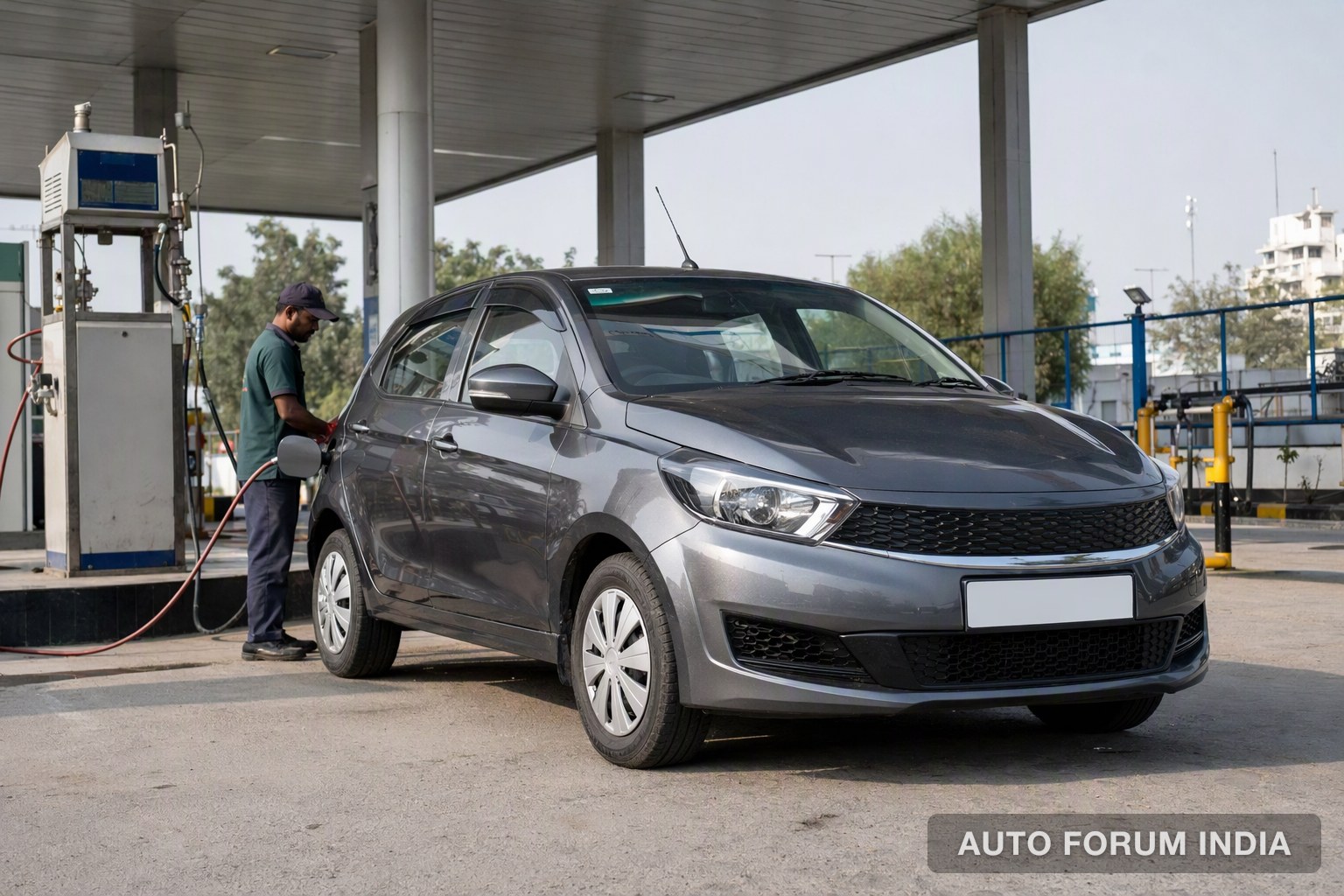
Best CNG Hatchbacks Under Rs 20 Lakh in India (2026)
Three of these six offer CNG with an automatic: the Maruti Baleno uses Maruti's AGS, and the Tata Tiago and Altroz use an AMT. The Baleno is the most efficient at 34.47 km/kg on the AGS, where the automatic is the more efficient of its two gearboxes. The Tata Altroz is the only car here whose 5-star Bharat NCAP rating the manufacturer has confirmed covers the CNG powertrain rather than just the petrol car.
Six CNG hatchbacks are on sale in India under ₹20 lakh, and in practice the whole segment sits under ₹11 lakh. Five carry factory-fitted systems and one, the Renault Kwid, is a dealer-fitted retrofit. Three of the six offer CNG with an automatic gearbox, which is the single biggest change in this segment in recent years.
Running a hatchback on petrol through a daily city commute adds up fast, and it is why buyers in this segment now cross-shop CNG before picking a colour. The catch used to be that CNG meant giving something up: no automatic, a smaller boot, or a bare trim with none of the equipment the petrol car had.
That has changed more than most buyers realise. Automatic gearboxes, factory systems with full manufacturer warranties, and dual-cylinder tank layouts designed to protect boot space are all on sale now, alongside the older retrofit route. This compares six CNG hatchbacks on price, mileage, transmission and safety, so it is clear what each approach costs and what it gives back.
Key takeaways
- Three of these six offer a CNG automatic. The Maruti Baleno uses Maruti's AGS, and the Tata Tiago and Altroz use an AMT. The Glanza, Grand i10 Nios and Kwid are manual-only.
- Maruti Baleno is the most efficient here at 34.47 km/kg on the AGS, and the automatic is the more efficient of its two gearboxes.
- Tata Altroz has the strongest safety credentials, with a 5-star Bharat NCAP rating Tata has confirmed covers the CNG powertrain.
- Renault Kwid is the cheapest way in, but it is a retrofit with no published CNG-mode output or certified mileage.
- Hyundai Grand i10 Nios offers the most deliberate boot-space engineering, with a dual-cylinder Hy-CNG Duo layout.
- The ₹20 lakh ceiling is not a real constraint. The most expensive car here is about ₹10.90 lakh.
The six compared
| Model | Fitting | Price | Mileage on CNG | Gearbox |
|---|---|---|---|---|
| Renault Kwid | Retrofit, dealer-fitted | about ₹5.23 lakh | Not published | 5-speed MT |
| Tata Tiago | Factory | about ₹5.87 lakh | 26.49 km/kg MT, 28.06 AMT | 5-speed MT or AMT |
| Tata Altroz | Factory | about ₹7.30 lakh | 26.2 km/kg | 5-speed MT or AMT |
| Hyundai Grand i10 Nios | Factory | about ₹7.68 lakh | 27 km/kg | 5-speed MT |
| Maruti Baleno | Factory | ₹7.92 lakh | 33.61 km/kg MT, 34.47 AGS | 5-speed MT or AGS |
| Toyota Glanza | Factory | about ₹9.53 lakh | 30.61 km/kg | 5-speed MT |
| Where these numbers come from. The Baleno figures are read off Maruti's own current brochure, which prints both CNG mileage numbers and the CNG-mode output directly, and the Baleno prices off the NEXA price page. Toyota, Tata, Hyundai and Renault do not publish equivalent brochure specification tables for their CNG variants, so those figures are the best available published numbers. Prices are ex-showroom Delhi and move frequently. |
Factory-fitted or retrofit: the distinction that matters most
This is the first thing to settle, because it changes what every other number on the page means.
A factory-fitted system is engineered into the car on the assembly line, with the tank, plumbing and engine calibration designed together and the CNG components covered by the manufacturer's own warranty. It also carries a certified mileage figure, because the car is homologated as a CNG vehicle.
A retrofit is a kit added after the car is built, usually by the dealer. It can be perfectly legal and government-approved, as the Kwid's is, but the manufacturer has not homologated the CNG configuration, so there is no certified mileage, no published CNG-mode power figure, and the kit carries its own warranty from the installer rather than the carmaker's.
That is why the Kwid has blanks in this table where other cars have numbers. It is not an oversight, it is the nature of the purchase.
1. Maruti Baleno
Price: ₹7,92,400 for the Delta CNG, ₹8,32,400 for the Delta CNG with AGS, ₹8,92,400 for the Zeta CNG manual and ₹9,32,400 for the Zeta CNG with AGS, all ex-showroom.
Fitting: factory-fitted S-CNG.
The Baleno pairs CNG with an automatic across two of its four CNG trims, and it is comfortably the most efficient car here. The facelift moved it to Maruti's Z-Series engine, which is where the mileage advantage comes from.
Features: 17.78 cm touchscreen with wireless Android Auto and Apple CarPlay, 6 airbags standard, stability programme with brake assist, rear AC vents, steering-mounted audio controls. The Delta CNG has reverse parking sensors without a camera, and manual air conditioning rather than automatic climate control.
Engine on CNG: 1.2-litre three-cylinder Z12E, 51.3 kW or 69.75 PS at 5,700 rpm and 101.8 Nm at 2,900 rpm. On petrol the same car makes 82.93 PS and 112.4 Nm.
Mileage: 34.47 km/kg on the AGS and 33.61 km/kg on the manual, both from Maruti's brochure. On petrol, 23.80 km/l manual and 24.77 km/l AMT.
Gearbox: 5-speed manual or 5-speed AGS, both with CNG.
Safety: there is no current-generation crash-test rating for the Baleno CNG. Bharat NCAP tested a pre-facelift, two-airbag Baleno in April 2024 and awarded it 4 stars, which does not reflect the six-airbag car sold now.
Warranty: 3 years or 100,000 km, extendable to 6 years or 160,000 km.
2. Toyota Glanza
Price: about ₹9.53 lakh ex-showroom for the CNG trim.
Fitting: factory-fitted CNG.
The Glanza is Toyota's only hatchback in India and shares its platform with the Baleno, though the two no longer share an engine. That is the whole story of its position here: it returns 30.61 km/kg against the Baleno's 33.61 on the manual, a gap that comes down to the newer Z-Series unit the Toyota has not received.
Features: 17.78 cm touchscreen with Apple CarPlay and Android Auto on the G trim, which is the CNG entry point, steering-mounted audio controls, automatic climate control, keyless entry.
Engine on CNG: 1.2-litre four-cylinder. Toyota does not publish a separate CNG-mode output figure for the Glanza.
Mileage: 30.61 km/kg.
Gearbox: 5-speed manual only.
Warranty: 3 years or 100,000 km, extendable to 5 years or 220,000 km.
3. Tata Tiago
Price: about ₹5.87 lakh for the Smart CNG to about ₹8.62 lakh for the Creative Plus CNG, ex-showroom.
Fitting: factory-fitted twin-cylinder CNG.
The Tiago was refreshed in May 2026 with a stronger safety package including a reinforced roll cage, and it offers the widest CNG trim spread here, six variants from base to range-topping. It is also the cheapest factory system on this list.
Features: 6 airbags and ABS with EBD standard even on the base Smart CNG, reinforced roll cage from the 2026 refresh, LED tail lamps, and direct CNG-mode starting without needing to start on petrol first.
Engine on CNG: 1.2-litre three-cylinder, 75.5 PS at 6,000 rpm and 96.5 Nm at 3,500 rpm.
Mileage: 26.49 km/kg on the manual and 28.06 km/kg on the AMT. These are the prior-generation figures, since Tata has not published updated numbers for the 2026 refresh.
Gearbox: 5-speed manual or AMT, both with CNG.
Safety: Global NCAP awarded the Tiago, tested alongside its Tigor sibling, 4 stars for adult and 3 stars for child occupant protection.
4. Tata Altroz
Price: about ₹7.30 lakh for the Smart CNG to about ₹10.90 lakh for the Accomplished S AMT CNG, ex-showroom.
Fitting: factory-fitted dual-cylinder CNG, mounted beneath the boot floor.
The Altroz was the first premium hatchback in India to pair CNG with an automatic, and it is the only car here whose 5-star Bharat NCAP rating has been confirmed by the manufacturer as covering the CNG powertrain specifically rather than just the petrol car.
Features: sunroof on select higher CNG trims, which is uncommon on a factory CNG hatchback, 10.25-inch touchscreen and a 360-degree camera on higher trims, dual-cylinder tank beneath the boot floor.
Engine on CNG: 1.2-litre three-cylinder, 73.5 PS and 103 Nm.
Mileage: 26.2 km/kg.
Gearbox: 5-speed manual or AMT.
Safety: 5-star Bharat NCAP, which Tata has stated covers petrol, diesel and CNG powertrains alike.
5. Hyundai Grand i10 Nios
Price: about ₹7.68 lakh ex-showroom for the Magna CNG with the single-cylinder tank. The Hy-CNG Duo dual-cylinder variants are priced roughly ₹7,000 above their single-cylinder equivalents.
Fitting: factory-fitted, available with either a single-cylinder tank or the newer dual-cylinder Hy-CNG Duo layout.
The Nios recently added the Duo option alongside its existing single-cylinder trims, a layout built specifically to give back some of the boot space a CNG tank normally takes.
Features: 8-inch touchscreen with wireless Android Auto and Apple CarPlay, rear AC vents and a rear parking camera on Sportz and above, 6 airbags with stability control and hill-start assist across the CNG range, two cylinders totalling 60 litres on the Duo variants.
Engine on CNG: 68.9 PS and 95.2 Nm.
Mileage: 27 km/kg.
Gearbox: 5-speed manual only.
Safety: the India-spec car scored 2 stars for both adult and child occupant protection in a 2020 Global NCAP test of a base two-airbag variant. A separate zero-star result exists for an Africa-spec export version, which is a different build and should not be read as the India-spec rating.
6. Renault Kwid
Price: about ₹5.23 lakh for the Evolution to about ₹5.85 lakh for the Climber, including the dealer-fitted kit at about ₹70,449 over the petrol price.
Fitting: retrofit, dealer-fitted rather than factory-built.
The Kwid is the cheapest way into a CNG hatchback here by a clear margin, and the only retrofit. The kit is government-approved and available on the Evolution and Climber trims of the facelifted car, but Renault does not engineer or warranty it as part of the vehicle.
Features: 8-inch touchscreen with Bluetooth and USB, digital instrument cluster, 184 mm ground clearance, dual airbags with ABS and EBD.
Engine: 1.0-litre petrol rated at 69 PS and 92.5 Nm. Renault does not publish CNG-mode output.
Mileage: not published for the CNG variant.
Gearbox: 5-speed manual only, not offered on AMT variants.
Safety: no confirmed India-spec Bharat NCAP or Global NCAP rating. A South Africa-built export version scored 2 stars and a Latin America-spec version 3 stars in separate Global NCAP tests, neither of which reflects the India-spec car.
Warranty: Renault's vehicle warranty applies to the car, with the CNG kit carrying a separate 3-year or 100,000 km warranty from the installer.
Conclusion
CNG hatchbacks now span a much wider range than a basic kit bolted onto a budget car. The cheapest entry here is still a retrofit with unpublished figures, but the factory systems bring automatic gearboxes, six-airbag safety as standard, and tank layouts engineered to protect cargo space.
Three questions separate these six in practice. If efficiency decides it, the Baleno leads by nearly 4 km/kg over the next factory car. If a confirmed crash-test rating covering the CNG variant itself matters most, only the Altroz can claim one. And if outright price decides it, the retrofit route remains cheapest, provided the buyer is comfortable with a system that is not part of the manufacturer's own build and carries no certified mileage.
Worth noting that the ₹20 lakh figure in the question is generous to the point of irrelevance for this segment. Every CNG hatchback on sale in India today costs under ₹11 lakh.
FAQs
Which CNG hatchbacks offer an automatic gearbox?
Three of these six. The Maruti Baleno offers Maruti's AGS on two of its four CNG trims, and the Tata Tiago and Tata Altroz both offer an AMT. The Glanza, Grand i10 Nios and Kwid are manual-only on CNG.
What is the difference between factory-fitted and retrofit CNG?
A factory system is engineered into the car and warrantied by the manufacturer, and it carries a certified mileage figure because the car is homologated as a CNG vehicle. A retrofit is added after the car is built, carries the installer's warranty rather than the carmaker's, and has no certified mileage or published CNG-mode output.
Which CNG hatchback is most efficient?
The Maruti Baleno, at 34.47 km/kg with the AGS automatic and 33.61 km/kg with the manual.
Which has the best safety rating?
The Tata Altroz is the only one here with a 5-star Bharat NCAP rating that the manufacturer has confirmed covers the CNG powertrain, not just the petrol car.
Is CNG worth it in a hatchback?
If daily running is high, the lower per-kilometre cost usually repays the price premium. The trade-offs are reduced boot space on most of these cars and, on half of them, no automatic option.
Last verified: 2026-09-25