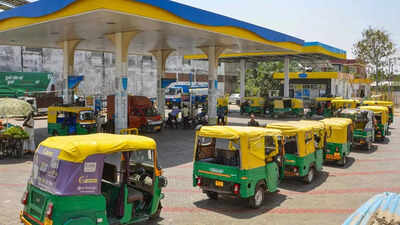

CNG prices in UP range from ₹93/kg to ₹108/kg across cities as of October 2026, squeezing the running-cost edge of popular S-CNG cars like the Maruti Swift, Dzire, and Baleno.
CNG prices in Uttar Pradesh as of October 2026 range from ₹93.00 per kg in cities like Mirzapur and Chandauli to as high as ₹107.98 per kg in Bahraich, Balrampur, Lakhimpur, and Maharajganj — a spread of nearly ₹15/kg within a single state. This wide variation, driven by differences in city gas distribution (CGD) licensees, pipeline distances, and local taxes, has a direct and measurable impact on the running economics of the CNG cars that dominate UP's roads.
The rate environment in UP has been turbulent in 2026. A national CNG hike of ₹2/kg was announced in May 2026 following a ₹3/litre petrol and diesel revision, both triggered by the West Asia conflict disrupting global energy supplies and pushing Brent crude past $104/barrel. Lucknow, the state capital and the most active CNG car market in UP, saw its price peak before settling at ₹95.75/kg in September 2026 after a ₹3.75 reduction — the largest single-month swing in the past year.
For buyers evaluating a CNG car purchase in UP right now, the city-level price is not an abstract number. It feeds directly into the cost-per-km calculation that makes CNG attractive in the first place.
City-by-City CNG Rates in UP and Cost-Per-Km Impact on Popular S-CNG Cars
The table below shows current CNG prices across key UP cities alongside the running cost per km for the Maruti Swift S-CNG (ARAI claim: 32.85 km/kg, factory-fitted) — the single best-selling CNG hatchback in the state — and a petrol equivalent at current Lucknow petrol prices (₹97.77/litre, ARAI claim ~22 km/l for Swift petrol).
| City | CNG Price (₹/kg) | Swift S-CNG cost/km (₹) | Swift Petrol cost/km (₹) | Saving vs Petrol |
|---|---|---|---|---|
| Mirzapur | ₹93.00 | ₹2.83 | ₹4.44 | ~36% |
| Chandauli | ₹93.00 | ₹2.83 | ₹4.44 | ~36% |
| Meerut | ₹93.50 | ₹2.85 | ₹4.44 | ~36% |
| Lucknow | ₹95.75 | ₹2.91 | ₹4.44 | ~34% |
| Ghaziabad / Gautam Budh Nagar | ₹95.59 | ₹2.91 | ₹4.44 | ~34% |
| Kanpur Urban | ₹98.31 | ₹2.99 | ₹4.44 | ~33% |
| Aligarh | ₹100.50 | ₹3.06 | ₹4.44 | ~31% |
| Gorakhpur | ₹102.00 | ₹3.10 | ₹4.44 | ~30% |
| Bahraich / Lakhimpur | ₹107.98 | ₹3.29 | ₹4.44 | ~26% |
Swift S-CNG ARAI claim: 32.85 km/kg (factory-fitted, manufacturer claim). Petrol cost/km based on ₹97.77/litre (Delhi rate post-May 2026 hike) and 22 km/l ARAI claim. Real-world mileage is typically 10–15% lower on both fuels. Sources: Goodreturns UP CNG tracker, Times of India.
Even at ₹107.98/kg in Bahraich, CNG still saves around 26% versus petrol. The margin has narrowed considerably from the 40%+ savings that buyers in these cities enjoyed before the 2026 hike cycle began.
Which UP Cities Saw the Biggest Rate Increases in 2026?
The national CNG hike of ₹2/kg in May 2026 was the most significant single revision, but it was not uniform across UP. Cities served by different CGD operators — Indraprastha Gas Limited (IGL) in the NCR belt, Adani Gas in Lucknow and Agra, and smaller operators in eastern and Bundelkhand UP — applied the hike at different timings and magnitudes.
The Goodreturns UP CNG price tracker shows that the most significant price increase in the past 12 months was ₹3.75/kg in June 2026, while the most significant decrease was also ₹3.75/kg in September 2026 — suggesting a volatile correction cycle rather than a smooth upward trend. Lucknow's price went from ₹99.50/kg last month to ₹95.75/kg currently, a rare downward revision that provided temporary relief to daily commuters.
Cities in eastern UP — Bahraich (₹107.98), Balrampur (₹107.98), Maharajganj (₹107.98), and Lakhimpur (₹107.98) — remain the most expensive CNG markets in the state. These are also areas with the thinnest CNG station networks, meaning buyers face both higher per-kg costs and longer detours to refuel. Amethi/CSM Nagar at ₹106.41/kg and Deoria at ₹103.41/kg are similarly placed.
The western UP and NCR-adjacent belt — Meerut (₹93.50), Baghpat (₹93.50), Ghaziabad (₹95.59), Gautam Budh Nagar (₹95.59) — benefits from IGL's more competitive pricing and denser station infrastructure, making it the most CNG-friendly zone in the state for car buyers.
Why Are CNG Prices Different Across UP Cities?
CNG pricing in India follows a two-part structure: the cost of natural gas at the city gate (set by the government's APM allocation and market-linked pricing for the remaining volume) plus the city gas distribution company's margin, compression cost, and local levies. This is why two cities in the same state can differ by ₹15/kg.
UP has multiple CGD licensees operating across its 75 districts. IGL covers Ghaziabad and Gautam Budh Nagar (Noida), which is why those cities price closer to Delhi's ₹79.09/kg than to Lucknow's ₹95.75/kg. Adani Total Gas and GAIL Gas cover Lucknow, Agra, Kanpur, and several other cities. Smaller operators serve the eastern and Bundelkhand regions, where pipeline infrastructure is newer and per-unit costs are higher.
The West Asia conflict disrupted the Strait of Hormuz and pushed Brent crude above $104/barrel by May 2026, forcing a revision in the domestic gas price allocation. The government's response — a ₹2/kg CNG hike alongside a ₹3/litre petrol and diesel revision — was described by PTI sources as "only a fraction of the hike required to fully offset the sharp rise in global energy prices." Further revisions remain possible if crude stays elevated.
How Does the UP CNG Price Hike Affect Maruti S-CNG Buyers Specifically?
Maruti Suzuki's S-CNG lineup features factory-fitted CNG systems integrated at the manufacturing stage, with no dealer-fitted aftermarket kit involved. This matters for warranty: unlike dealer-fitted CNG conversions (which can void the original manufacturer warranty on affected components), Maruti's S-CNG cars carry a standard manufacturer warranty covering the CNG system. All three models most popular in UP — the Swift, Dzire, and Baleno — carry factory-fitted S-CNG systems.
The Swift S-CNG (ARAI claim: 32.85 km/kg) is the volume leader. At Lucknow's current ₹95.75/kg, the running cost works out to approximately ₹2.91/km on CNG. The Dzire S-CNG (ARAI claim: 33.73 km/kg) is marginally more efficient, bringing the cost to around ₹2.84/km at the same price. The Baleno S-CNG (ARAI claim: 30.61 km/kg) is the least efficient of the three on paper, costing approximately ₹3.13/km at Lucknow rates.
The Tata Tiago iCNG (ARAI claim: 35.60 km/kg, factory-fitted twin-cylinder kit) achieves ₹2.69/km at ₹95.75/kg — the best running cost among mainstream CNG hatchbacks in UP. The Hyundai Grand i10 Nios CNG (ARAI claim: 31.59 km/kg, factory-fitted) comes in at ₹3.03/km at Lucknow rates.
ARAI claims are manufacturer-stated figures tested under controlled conditions. Real-world CNG mileage in UP's stop-start urban traffic — particularly in Lucknow, Kanpur, and Varanasi — typically runs 10–15% lower. Buyers should budget for approximately ₹3.20–₹3.40/km in actual city use for the Swift S-CNG, and ₹2.95–₹3.10/km for the Tiago iCNG.
A notable weakness of Maruti's S-CNG models is boot space. The Swift S-CNG carries its CNG cylinder in the boot, reducing usable luggage space to approximately 141 litres from the petrol variant's 268 litres — a loss of over 120 litres. The Dzire S-CNG similarly sacrifices a significant portion of its 378-litre boot. The Tata Tiago iCNG addresses this with a twin-cylinder setup that splits the tank between two smaller cylinders under the boot floor, preserving more usable cargo space — though the total CNG capacity is comparable. For UP buyers who regularly carry luggage for inter-city travel (Lucknow–Varanasi, Kanpur–Allahabad), this is a practical consideration, not just a spec-sheet footnote.
CNG also delivers lower power output than petrol in all these cars. The Swift S-CNG produces approximately 77 PS on CNG versus 90 PS on petrol. The engine starts on petrol and switches to CNG automatically, but performance on CNG is noticeably softer, particularly on UP's expressways (Agra-Lucknow, Purvanchal) where higher speeds are common.
What Do the New Rates Mean for Buyers Considering a CNG Car Purchase in UP?
The fundamental case for CNG in UP remains intact, but it is thinner than it was 18 months ago. For a typical UP buyer doing 1,500 km per month in Lucknow:
On CNG (Swift S-CNG, ARAI 32.85 km/kg, real-world ~28 km/kg at ₹95.75/kg):
- Fuel needed: ~53.6 kg/month
- Monthly fuel cost: ~₹5,130
On petrol (Swift petrol, ARAI 22 km/l, real-world ~18 km/l at ₹97.77/litre):
- Fuel needed: ~83.3 litres/month
- Monthly fuel cost: ~₹8,145
Monthly saving on CNG: approximately ₹3,015. Annual saving: approximately ₹36,180.
The CNG variant of the Swift carries a premium of approximately ₹90,000–₹1,00,000 over the equivalent petrol variant. At current Lucknow CNG prices, the break-even point is roughly 2.5 years of 1,500 km/month driving — reasonable for a car kept 5–7 years, but longer than the sub-2-year break-even that buyers enjoyed when CNG was under ₹80/kg.
In Bahraich at ₹107.98/kg, the same calculation yields a monthly CNG fuel cost of approximately ₹5,785 (real-world 28 km/kg), a monthly saving of ₹2,360 versus petrol, and a break-even of over 3.5 years. For buyers in high-price eastern UP cities, the CNG premium recovery timeline has stretched significantly.
If CNG prices rise further — which PTI sources suggest is possible given that the May 2026 hike was described as partial — the break-even could stretch to 4+ years in the most expensive UP cities, at which point the financial case weakens considerably.
Should You Buy a CNG Car in UP Right Now, or Wait?
The answer depends on two variables: how long you plan to keep the car, and which city you live in.
Buyers in western UP and the NCR belt (Ghaziabad, Noida, Meerut, Baghpat) where CNG is under ₹96/kg and station density is high should find the case for a factory-fitted CNG car remains strong. The infrastructure is there, the prices are relatively competitive, and the break-even is under three years at typical usage.
For buyers in eastern UP — Bahraich, Lakhimpur, Maharajganj, Balrampur — the calculation is harder. CNG at ₹107–₹108/kg narrows the savings window, and the station network in these districts is sparse enough that range anxiety is a real operational concern. A buyer who drives 80 km between CNG stations on a regular basis is not getting the full benefit of CNG economics.
The Maruti Swift S-CNG and Dzire S-CNG remain the most practical choices for UP buyers because of Maruti's service network density across the state — critical in smaller cities where Tata or Hyundai service centres may be fewer. The Tata Tiago iCNG's twin-cylinder advantage and higher ARAI efficiency (35.60 km/kg) make it worth considering in cities where boot space matters and the Tata service network is accessible.
Waiting makes sense in one scenario: if global crude prices moderate following any resolution of the West Asia conflict, domestic CNG prices could see further corrections similar to the September 2026 ₹3.75/kg reduction in Lucknow. Buying after a price correction locks in better break-even economics.
How Does UP Compare to Other States on CNG Pricing?
UP's CNG price range (₹93–₹108/kg) sits above Delhi (₹79.09/kg post-May 2026 hike) but below Pune, where MNGL raised CNG to ₹94.75/kg in May 2026 — and that was before subsequent revisions. MNGL noted that even at ₹94.75/kg, CNG offered savings of approximately 48% versus petrol in Pune.
Delhi's lower CNG price reflects IGL's scale, the city's mature CNG infrastructure, and the government's historically subsidised APM gas allocation to the capital. UP cities served by IGL (Ghaziabad, Noida) benefit from proximity to this pricing structure. The rest of UP pays more because its CGD operators have smaller scale and higher per-unit infrastructure costs.
For UP buyers, the practical implication is that a car bought and used in Ghaziabad is a materially different CNG proposition than the same car used in Bahraich. The vehicle is identical; the economics are not.
What About CNG Station Availability in UP?
CNG station density is defined as the number of operational dispensing points per 100 km of road network. UP has made significant progress in expanding its CGD network under the government's CGD bidding rounds, but coverage remains uneven. The NCR belt, Lucknow, Kanpur, Agra, Varanasi, and Prayagraj have reasonably dense networks. Districts in eastern UP — Balrampur, Bahraich, Maharajganj, Shravasti — have limited stations, often just one or two per district.
This matters for CNG car buyers in two ways. First, the effective range between fill-ups is constrained not by the tank capacity but by station location. Second, peak-hour queues at the few available stations can add 20–40 minutes to a refuelling stop, eroding the convenience advantage of CNG over petrol.
The Swift S-CNG carries approximately 60 litres of CNG (water capacity), giving a real-world range of roughly 300–350 km on a full tank at UP highway speeds. In districts with one CNG station, this is workable but requires planning. The Dzire S-CNG's slightly larger tank offers marginally more range.
Maruti's S-CNG cars are also designed to switch smoothly to petrol when CNG runs low, which is a practical safety net in low-density CNG areas. The petrol tank is retained at full capacity, so a buyer in Bahraich who runs out of CNG 40 km from the nearest station is not stranded — they simply pay petrol prices for that leg.
For more on how CNG cars stack up across India's best options, see our guide to the 5 Best CNG Cars in India (2026) and the Best CNG Hatchbacks Under 25 Lakh in India.
Key Takeaways for UP CNG Car Buyers in October 2026
The October 2026 CNG price space in UP rewards buyers who do their city-specific homework. A buyer in Meerut at ₹93.50/kg is in a different position from a buyer in Bahraich at ₹107.98/kg — same car, same ARAI rating, but a gap of nearly ₹1/km in running cost and a very different break-even timeline.
The Maruti Swift S-CNG and Dzire S-CNG remain the dominant choices in UP for good reasons: factory-fitted systems with full warranty coverage, Maruti's unmatched service network across UP's 75 districts, and competitive ARAI efficiency figures. Their weaknesses — reduced boot space, lower CNG power output, and a price premium over petrol variants — are real and should be weighed against the running cost savings at your specific city's CNG rate.
The Tata Tiago iCNG's twin-cylinder design and 35.60 km/kg ARAI claim make it the efficiency leader among mainstream CNG hatchbacks, and its preserved boot space is a genuine advantage for buyers who need cargo room. The Hyundai Grand i10 Nios CNG sits between the two on efficiency.
What none of these cars can protect you from is further CNG price hikes. The May 2026 national revision was explicitly described as partial, and global energy markets remain volatile. Buyers who are on the fence should run their own break-even calculation using their city's current CNG rate — not a national average — before signing the dotted line.
For SUV buyers in UP considering CNG options, our guide to Best SUVs With a CNG Option Under 30 Lakh in India (2026) covers the Fronx CNG, Grand Vitara CNG, and their rivals in detail.
Sources
- MSN: CNG Price Hike in Uttar Pradesh — Rates Increased in Several Cities
- Times of India: CNG prices hiked by Rs 2/kg after petrol, diesel revision; check rates in your city
- Times of India: MNGL hikes CNG price by Rs 2.50 in Pune; 1kg to now go up to Rs 94.75
- Goodreturns: CNG Price in Uttar Pradesh Today
- Maruti Suzuki S-CNG Official Page