
TERI's 2025–26 research shows CNG has a lower lifecycle carbon burden than EVs under India's current coal-heavy grid, but that advantage shrinks rapidly as renewables grow — and Bio-CNG can go net-negative.
Does CNG Beat EVs on Environmental Impact in India 2026? TERI Study Reveals Lifecycle Carbon Advantage
Under India's current electricity mix — where coal still dominates generation — a TERI study published in 2025–26 finds that compressed natural gas (CNG) vehicles carry a lower lifecycle environmental burden than battery electric vehicles (BEVs) charged from the national grid. That finding is real, but it comes with a time stamp: the same body of research, including ICCT's lifecycle assessment data, shows BEVs are already 19–34% cleaner than petrol cars on a full lifecycle basis, and that advantage is projected to grow to 30–56% by 2030 as India's renewable energy share rises. The CNG-vs-EV debate is not static—it is a race against India's own energy transition.
For a buyer in Delhi, Pune or Ahmedabad today, the practical question is: which car is actually greener right now, and which Maruti S-CNG model makes the most sense if you want to act on that conclusion without waiting for the grid to clean up?
Comparison: Lifecycle Carbon, Running Costs and Practicality — CNG vs EV vs Petrol (2026)
The table below compares key environmental and ownership metrics across powertrain types. Mileage figures are ARAI claims unless noted. CNG running cost is calculated at ₹90/kg (Delhi retail, mid-2026 estimate); petrol at ₹105/litre; electricity at ₹8/kWh (home charging).
| Model / Powertrain | Lifecycle CO₂ vs petrol baseline | ARAI efficiency | Fuel cost per km (approx.) | CNG kit type | Boot space trade-off |
|---|---|---|---|---|---|
| Maruti Baleno S-CNG (hatchback) | ~10–15% lower than petrol (CNG tailpipe + upstream; grid-dependent EV comparison favours CNG today) | 30.61 km/kg (CNG) | ~₹2.94/km | Factory-fitted S-CNG | ~148 L (reduced from 318 L petrol; single cylinder under boot floor) |
| Maruti Swift S-CNG (hatchback) | Similar to Baleno CNG | 32.85 km/kg (CNG) | ~₹2.74/km | Factory-fitted S-CNG | Reduced boot (single cylinder); no CNG in top AMT variant |
| Maruti Dzire S-CNG (sedan) | Similar to Baleno CNG | 33.73 km/kg (CNG) | ~₹2.67/km | Factory-fitted S-CNG | Reduced boot vs petrol Dzire; single cylinder |
| Tata Tiago iCNG (hatchback) | Similar CNG lifecycle profile | 26.49 km/kg (CNG) | ~₹3.40/km | Factory-fitted iCNG (twin-cylinder) | Better boot retention vs single-cylinder rivals; twin cylinders under rear seat |
| Hyundai Grand i10 Nios CNG (hatchback) | Similar CNG lifecycle profile | 31.59 km/kg (CNG) | ~₹2.85/km | Factory-fitted | Reduced boot; single cylinder |
| BEV (grid average, 2026) | 19–34% lower than petrol today; 30–56% lower by 2030 | ~6–7 km/kWh typical | ~₹1.14–1.33/km | N/A — no fuel cylinder | Full boot; no range anxiety on short trips but charging infra gaps persist |
| Bio-CNG vehicle | Net-negative: up to −1.141 kg CO₂eq/km (cattle-dung feedstock) | Same as CNG hardware | Similar to CNG | Factory or dealer CNG kit; fuel availability limited | Same as CNG |
Sources: ICCT LCA Fact Sheet (Sept 2021), TERI Multi-Fuel Mobility article (Oct 2025), manufacturer ARAI data. Running costs are illustrative; actual fuel prices vary by city and date.
What does "lifecycle environmental burden" actually mean?
Lifecycle environmental burden is the total greenhouse gas emissions generated across a vehicle's entire life — from raw material extraction and manufacturing, through fuel or electricity production and distribution, to tailpipe combustion and eventual disposal. It differs fundamentally from "tank-to-wheel" or tailpipe-only measurement.
This distinction matters enormously in India. A BEV has zero tailpipe emissions, but the electricity it consumes is generated partly from coal-fired power plants. A CNG car emits CO₂ at the tailpipe, but natural gas combustion produces roughly 25–30% less CO₂ per unit of energy than coal. The upstream extraction and distribution chain for CNG adds methane leakage — a potent greenhouse gas — to the ledger.
The TERI study referenced in MSN's coverage applies this full-chain lens and concludes that, under India's current power mix, CNG vehicles come out ahead of grid-charged BEVs. That is defensible for 2026 — but it is not a permanent verdict.
What does the ICCT's independent lifecycle data say?
The International Council on Clean Transportation's 2021 lifecycle assessment for India reaches a more detailed conclusion that buyers should read alongside the TERI headline.
The ICCT found that average new CNG cars in India exceed the lifecycle GHG emissions of average new petrol cars — particularly when methane leakage from natural gas extraction, processing and transport is counted using a 20-year global warming potential for methane. Methane is approximately 28 times more potent than CO₂ over a 100-year horizon, and considerably more potent over 20 years. That upstream leakage is the hidden cost of CNG that manufacturers and policy documents rarely foreground.
BEVs, by contrast, are already 19–34% lower in lifecycle GHG emissions than average new petrol cars in India today, depending on whether the electricity mix follows current policy trajectories or a Paris Agreement-compatible pathway. For BEVs registered in 2030, that benefit grows to 30–56%. Powered entirely by renewable energy, BEVs deliver 80% lower lifecycle emissions than petrol cars.
How do the TERI and ICCT findings coexist? The answer lies in methodology and scope. The TERI study appears to compare CNG against the current grid average for EVs in a specific set of Indian cities, while the ICCT study uses a broader national grid projection. Both are legitimate framings; neither is wrong. What they collectively tell a buyer is: CNG may have a marginal advantage over grid-charged EVs in coal-heavy regions today, but that window is closing as India adds solar and wind capacity at record pace.
Why does India's coal-heavy grid matter so much for EV emissions?
India's electricity grid is a mixed-source system in which coal-fired thermal plants still account for roughly 55–60% of generation as of 2026, even as solar and wind capacity additions accelerate. When an EV charges from this grid, a significant fraction of the electrons it stores originated from coal combustion — and coal is the dirtiest fossil fuel per unit of energy.
CNG, by contrast, burns at the point of use in the vehicle's engine. Natural gas combustion is cleaner than coal per unit of energy, and the distribution losses are different in character. This is why, in a coal-heavy grid scenario, the well-to-wheel math can tilt toward CNG.
However, NITI Aayog has consistently advocated a technology-neutral strategy for decarbonising Indian transport, precisely because the grid is not static. As India's renewable energy share grows — and the IEA's Global EV Outlook 2026 confirms India is among the world's fastest-growing EV markets with annual EV sales crossing 2.4 million units — the lifecycle advantage of EVs over CNG will compound year by year.
A 2026 buyer faces this reality: a CNG car will run for 8–12 years. Over that ownership period, the grid will get progressively cleaner, meaning an EV bought today will become greener each year while a CNG car's emissions profile remains roughly fixed (unless Bio-CNG becomes widely available at retail stations).
Are Maruti S-CNG cars genuinely environmentally sound choices?
For buyers genuinely motivated by environmental impact — not just running costs — Maruti's factory-fitted S-CNG lineup deserves an honest assessment rather than a marketing one.
The Maruti Baleno S-CNG, Swift S-CNG and Dzire S-CNG are all factory-fitted systems, which is a meaningful distinction. Factory-fitted is defined as a CNG system designed, tested and warranted by the original equipment manufacturer (OEM) as part of the vehicle's production process — as opposed to a dealer-fitted or aftermarket retrofit, which typically voids the manufacturer's powertrain warranty and may not meet the same safety or emissions standards.
Maruti's S-CNG systems retain the full Maruti warranty, are tuned to the engine's ECU from the factory, and include a dedicated CNG ECU and stainless-steel fuel lines. The Baleno S-CNG claims 30.61 km/kg (ARAI), the Swift S-CNG claims 32.85 km/kg, and the Dzire S-CNG claims 33.73 km/kg — all manufacturer ARAI figures. Real-world efficiency typically runs 15–20% lower depending on city traffic, AC use and driving style.
Running cost arithmetic (Delhi, mid-2026 estimate):
- CNG at ₹90/kg, Dzire S-CNG at 33.73 km/kg (ARAI) → ₹2.67/km (ARAI basis); real-world ~₹3.15–3.30/km
- Petrol at ₹105/litre, Dzire petrol at ~22 km/l (ARAI) → ₹4.77/km (ARAI basis)
- EV at ₹8/kWh, ~6 km/kWh → ₹1.33/km
On running costs, EVs win decisively. CNG wins over petrol by a wide margin. The environmental story is more layered, as discussed above.
The weaknesses buyers must know: All three Maruti S-CNG models use a single large cylinder mounted in the boot, which reduces usable luggage space significantly — the Baleno's boot drops from 318 litres to approximately 148 litres in CNG trim. The Swift and Dzire suffer comparable reductions. Power output on CNG is lower than on petrol (typically 8–10% less peak power), and the Swift S-CNG is not available with an AMT gearbox — manual only. CNG range per fill is also limited by tank capacity, and CNG station density outside major metros and highway corridors remains patchy, which is a real-world constraint the ARAI mileage figures do not capture.
How does Tata's twin-cylinder iCNG approach compare?
Tata Motors' iCNG system, used in the Tiago iCNG and Tigor iCNG, is a factory-fitted twin-cylinder CNG configuration where two smaller cylinders are mounted beneath the rear seat rather than in the boot. This preserves significantly more boot space than the single-cylinder layout used by Maruti, Hyundai and most other manufacturers.
The Tiago iCNG claims 26.49 km/kg (ARAI) — lower than the Maruti Swift S-CNG's 32.85 km/kg — but the boot-space retention is a genuine quality-of-life advantage for families. The lifecycle emissions profile of Tata's iCNG is broadly similar to Maruti's S-CNG on a per-km basis, since both burn the same fuel. The environmental differentiation between CNG models is marginal; the bigger differentiation remains CNG-versus-EV, not Maruti-versus-Tata.
What is Bio-CNG, and why does it change the environmental equation entirely?
Bio-CNG is compressed biomethane produced through the anaerobic digestion of organic waste — including cattle dung, crop residues and municipal solid waste — rather than extracted from fossil natural gas reserves. It is chemically similar to fossil CNG and can be used in any existing CNG vehicle without modification.
TERI's October 2025 analysis of India's multi-fuel mobility future makes a striking claim: Bio-CNG from cattle dung can achieve net-negative lifecycle emissions, avoiding up to 1.141 kg CO₂ equivalent per kilometre for a four-wheeler. This negative outcome occurs because the process captures methane that would otherwise escape from unmanaged dung heaps (methane is ~28 times more potent than CO₂ over 100 years), and the digestate byproduct replaces synthetic fertiliser, avoiding further emissions.
If Bio-CNG were widely available at retail CNG stations, a Maruti Dzire S-CNG or Baleno S-CNG running on it would be not merely lower-carbon than a grid-charged EV — it would be actively carbon-negative on a lifecycle basis. That is a more compelling environmental case than any current BEV can make.
The catch is availability. India's SATAT and GOBARDhan schemes have laid groundwork for Bio-CNG production, but uptake remains modest due to absent assured offtake, limited capital support and weak integration with broader sustainability goals. Many Bio-CNG plants run at 10–20% of capacity. A buyer cannot currently fill up on Bio-CNG at a standard CNG station — the fuel is blended into the grid in small quantities, not sold separately at the pump.
What does TERI's EV research say about the long-term picture?
It would be misleading to cite only the TERI finding that favours CNG without noting that TERI's own broader research strongly supports EV adoption. A separate TERI study published in April 2025 found that transitioning to EVs in 44 Indian cities with populations above 10 lakh could avoid 11.5 tonnes of PM2.5 emissions every day by 2035 and reduce greenhouse gas emissions by 61 million tonnes of CO₂ equivalent.
The same study noted that a mixed approach — replacing half the older vehicles with CNG and half with EVs — would result in 30% lower greenhouse gas reductions compared to a full EV switch. TERI's researchers are not anti-EV; they are pro-evidence. Their lifecycle finding about CNG's current advantage is a snapshot, not a recommendation to avoid EVs.
The study also quantified the infrastructure required: more than 45,000 public EV charging stations and 130 vehicle-scrapping facilities for a full EV transition in those 44 cities, versus approximately 2,655 new CNG stations for a partial CNG transition. CNG infrastructure is cheaper and faster to build — which is a legitimate policy argument for CNG as a bridging technology, not a permanent destination.
Is India's clean mobility future going to be EV-only?
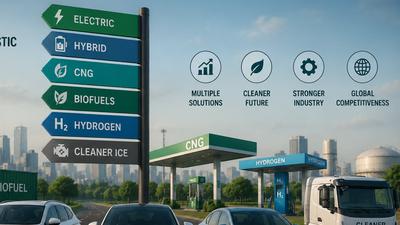
No — and that is now a mainstream policy position, not a fringe view. India's transition to cleaner mobility is expected to follow a technology-agnostic path, with EVs, hybrids, CNG, biofuels and hydrogen coexisting over the coming decade. The IEA's Global EV Outlook 2026 confirms India is among the world's fastest-growing EV markets — annual EV sales have crossed 2.4 million units, but EVs still account for a small share of the total vehicle fleet.
NITI Aayog's technology-neutral stance reflects a practical reality: India's diverse geography, varying income levels, different vehicle usage patterns and uneven charging infrastructure make a single-technology mandate impractical. A farmer in rural Rajasthan and a tech worker in Bengaluru have different refuelling realities. CNG networks, while not universal, are more evenly distributed across Tier-2 and Tier-3 cities than DC fast chargers.
For the automotive component industry, this multi-fuel future is an opportunity. The Automotive Component Manufacturers Association of India (ACMA) reports the sector has grown into a USD 75-billion industry contributing nearly 2.3% of GDP, and manufacturers are developing components simultaneously for advanced ICE engines, hybrid vehicles and electric drivetrains.
What should a buyer decide in 2026?
The environmental case for CNG versus EVs in India in 2026 is genuinely context-dependent, and any source that tells you the answer is simple is oversimplifying.
CNG makes environmental sense if: You live in a city with good CNG station coverage, you drive high annual kilometres (making the running-cost advantage significant), you are in a region where the grid is particularly coal-heavy, and you plan to keep the car for under 8 years (before the grid cleans up substantially). A factory-fitted Maruti S-CNG car — Baleno, Swift or Dzire — is the most warranty-safe and resale-friendly way to run CNG, though you will live with a smaller boot and manual-only gearbox options in some variants.
EVs make environmental sense if: You have home charging access, your city's grid has above-average renewable penetration (parts of Karnataka, Tamil Nadu, Gujarat), you drive moderate annual kilometres, and you are comfortable with the current charging infrastructure. The lifecycle advantage of EVs over CNG grows every year as India adds renewable capacity, so an EV bought in 2026 will be progressively greener through its ownership life in a way a CNG car will not.
Bio-CNG is the wildcard: If India's SATAT programme scales up and Bio-CNG becomes available at retail pumps within the next 3–5 years, the environmental case for CNG vehicles — including existing Maruti S-CNG cars — becomes dramatically stronger. A Dzire S-CNG running on cattle-dung Bio-CNG would be lifecycle carbon-negative. That is not science fiction; it is the TERI assessment. But it requires infrastructure investment that has not yet materialised at scale.
For buyers exploring their options across segments, our guides on the best CNG cars in India, best CNG hatchbacks under ₹25 lakh and best CNG compact SUVs under ₹20 lakh cover the full market with current pricing and mileage data.
The bottom line: CNG's lifecycle advantage over grid-charged EVs under India's current power mix is real but narrow and time-limited. Bio-CNG's potential is major but not yet retail-accessible. EVs are on a trajectory to become decisively cleaner within this decade. A buyer who chooses a factory-fitted CNG car today is making a defensible environmental choice — but should not assume that choice will look as good in 2030 as it does in 2026.
Sources
- TERI study finds CNG has lower lifecycle environmental burden than EVs under India's current power mix
- Life-cycle greenhouse gas emissions of combustion engine and electric passenger cars and two-wheelers in India — ICCT Fact Sheet
- EV switch in 44 cities can slash 61 million tonnes CO2: TERI — ETAuto
- India's clean mobility shift won't be EV-only; hybrids, CNG, hydrogen and biofuels to share the road — Times of India
- Charting India's Multi-Fuel Mobility Future — TERI
- Maruti Suzuki Baleno S-CNG — Official Specifications
- Maruti Suzuki Swift S-CNG — Official Page
- Maruti Suzuki Dzire S-CNG — Official Page