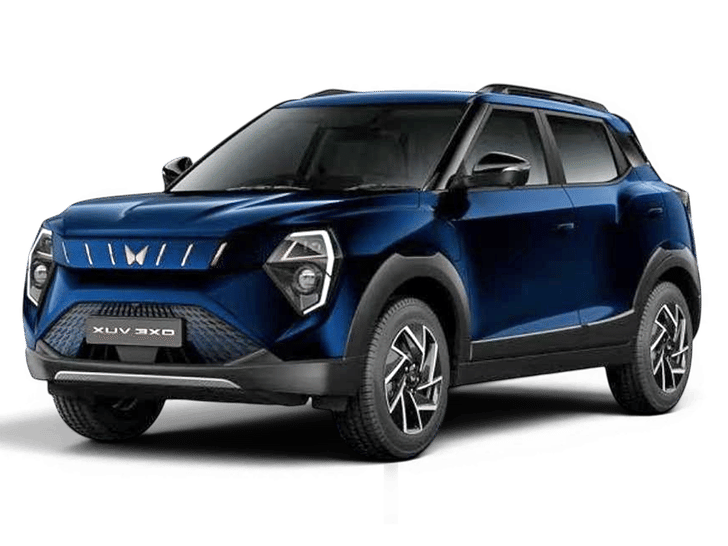

Mahindra XUV 3XO CNG launches October 15, 2026 with a twin-cylinder underfloor setup like the Nexon iCNG, preserving boot space over single-cylinder rivals like the Maruti Fronx CNG.
The Mahindra XUV 3XO CNG, confirmed for launch on October 15, 2026, uses a factory-fitted underfloor twin-cylinder CNG installation — a setup that directly mirrors the Tata Nexon iCNG's approach and sets it apart from the single-cylinder Maruti Suzuki Fronx S-CNG in the compact SUV segment.
Spy shots published on October 13, 2026 show both cylinders mounted side by side beneath the boot floor, secured with metal straps, with valves and connecting pipes visible. A dedicated CNG/PETROL selector button sits inside the cabin, positioned below the driver-side AC vent. The car retains its full exterior design — dual-tone alloy wheels, ORVMs with turn indicators, and the familiar DRL arrangement — with no visible external CNG-specific changes.
How do the compact SUV CNG rivals compare at a glance?
| Model | CNG Setup | CNG Kit Type | Claimed Mileage (km/kg) | Boot Space (CNG) | Starting CNG Price |
|---|---|---|---|---|---|
| Mahindra XUV 3XO CNG | Twin-cylinder, underfloor | Factory-fitted | TBA (ARAI pending) | TBA (petrol: 364 L) | ~₹10 lakh (expected) |
| Tata Nexon iCNG | Twin-cylinder, underfloor | Factory-fitted | ~24 km/kg (ARAI claim) | ~350 L (usable above cylinders) | ~₹10.0–11.5 lakh |
| Maruti Suzuki Fronx S-CNG | Single-cylinder, boot-mounted | Factory-fitted | 28.51 km/kg (ARAI claim) | Significantly reduced | ~₹9.0–10.5 lakh |
Prices are ex-showroom estimates. XUV 3XO CNG mileage and exact boot space are manufacturer-pending at time of writing. Nexon and Fronx figures are ARAI claims, not real-world verified.
The central trade-off in this segment is clear: twin-cylinder setups preserve boot usability but are mechanically more complex and typically cost more; single-cylinder setups are cheaper but eat into the luggage area. The XUV 3XO CNG's petrol boot of 364 litres is already the smallest in the compact SUV segment, which is precisely why Mahindra's choice of a twin-cylinder underfloor layout matters so much here.
What exactly is a twin-cylinder CNG setup, and why does it matter?
A twin-cylinder CNG setup arranges two smaller CNG tanks side by side — typically beneath the boot floor or under the vehicle — rather than a single large cylinder occupying the main luggage compartment. This contrasts with the conventional single-cylinder approach, where one large tank sits upright or flat inside the boot, directly consuming usable cargo space.
With a twin-cylinder underfloor layout, luggage can be placed above the cylinder compartment, restoring near-normal boot usability. Tata pioneered this in the compact SUV segment with the Nexon iCNG, and Mahindra's spy shots confirm the XUV 3XO CNG follows the same principle.
For the XUV 3XO specifically, this decision carries real weight. Autocar India's segment boot-space ranking already places the XUV 3XO's 364-litre petrol boot at the bottom of the compact SUV class. A conventional single-cylinder tank would have made the CNG variant nearly impractical for family use. Mahindra has not yet disclosed the exact CNG boot volume or cylinder capacity, so buyers will need to wait for official confirmation post-launch.
How does the Tata Nexon iCNG compare to the XUV 3XO CNG?
The Tata Nexon iCNG stands as the segment benchmark that the XUV 3XO CNG is directly targeting. Its twin-cylinder iCNG setup delivers an ARAI-claimed mileage of approximately 24 km/kg on CNG, and its 1.2-litre turbocharged petrol engine produces around 100 hp in CNG mode — a drop from the petrol figure, as is standard with bi-fuel CNG systems.
In CY2025, Nexon sold 2,00,559 units, more than double the XUV 3XO's 1,00,029 units. CNG availability is a significant factor in Nexon's dominance, particularly in high-CNG-penetration states like Uttar Pradesh, Gujarat, Delhi and Mumbai. By entering this space, Mahindra is directly targeting these markets.
The XUV 3XO CNG will use the 1.2-litre turbocharged MPFI petrol engine, which makes 110–111 hp and 200 Nm in petrol form. Mahindra chose the MPFI variant over the more powerful 131 hp direct-injection (GDI) version because MPFI engines are simpler and cheaper to adapt for CNG — fuel injection into the intake manifold is more compatible with bi-fuel systems than direct injection into the combustion chamber. CNG-mode output figures are awaited, but a drop of 10–15% from the petrol figure is typical for factory CNG systems.
One honest caveat: the XUV 3XO's 1.2-litre MPFI engine is the less powerful of the two petrol options available in the range. Buyers wanting the 131 hp GDI engine will not get a CNG option. The spy shots also show only a manual transmission variant, suggesting an automatic CNG option is unlikely at launch — a gap the Nexon iCNG similarly has.
Where does the Maruti Suzuki Fronx S-CNG fit in this segment?
The Maruti Suzuki Fronx S-CNG is the most direct price-point rival to the XUV 3XO CNG, and it embodies a different engineering philosophy. Maruti's S-CNG setup across its range — including the Fronx — uses a single-cylinder factory-fitted CNG tank. This is a factory-fitted kit, not a dealer-fitted aftermarket installation, which means it carries Maruti's full warranty and does not compromise the vehicle's insurance status.
The Fronx S-CNG's single-cylinder setup delivers an ARAI-claimed 28.51 km/kg — a higher efficiency figure than the Nexon iCNG's ~24 km/kg claim. However, this comes at a cost: the single tank occupies a meaningful portion of the Fronx's boot, reducing cargo practicality. The Fronx's petrol boot is already modest in this segment, and the CNG version compounds this.
On running costs, the arithmetic is instructive. At CNG prices of approximately ₹90/kg in Delhi (a representative CNG-heavy market), the Fronx S-CNG's 28.51 km/kg ARAI claim translates to a cost of roughly ₹3.16 per km on CNG. The Nexon iCNG at ~24 km/kg would cost approximately ₹3.75 per km. Real-world figures are typically 15–20% lower than ARAI claims for both models, so actual costs will be higher — but the relative efficiency advantage of the Fronx's single-cylinder setup is real. The XUV 3XO CNG's mileage figure is not yet available, so a direct running-cost comparison must wait for post-launch ARAI certification.
Where the Fronx S-CNG genuinely wins is on entry price — it undercuts the Nexon iCNG by a meaningful margin, and is likely to undercut the XUV 3XO CNG as well. Buyers in smaller cities with good CNG infrastructure and modest boot-space needs will find the Fronx S-CNG a rational choice. For families who need usable cargo space and want a feature-rich CNG compact SUV, the twin-cylinder approach of the XUV 3XO CNG and Nexon iCNG is more liveable day-to-day.
Maruti Suzuki has also developed an underbody CNG tank approach — already used on the larger Victoris — and the upcoming Brezza facelift is reported to adopt a similar underbody layout. If that arrives, the single-cylinder boot-space penalty for Maruti's compact SUV CNG offering may be resolved in a future update.
What variants and features will the XUV 3XO CNG offer?
Based on the spy shots and Mahindra's official teaser, the XUV 3XO CNG will be available in at least two trim levels. The teaser confirmed the availability of a panoramic sunroof, which Mahindra offers on the REVX Edge (O) variant in the petrol range. The spy shots show a single-pane sunroof, corresponding to the REVX M(O) variant.
This is significant: CNG buyers in India have historically been offered only base or mid-spec variants, with feature-rich trims reserved for petrol and diesel. Mahindra's decision to offer a panoramic sunroof on the CNG variant signals a deliberate push to attract buyers who want both fuel economy and premium features — a positioning move that could differentiate it from the Nexon iCNG and Fronx S-CNG, neither of which offers a panoramic sunroof on CNG trims.
The cabin retains the familiar light-coloured lower dashboard and gloss-black trim. The CNG/PETROL selector button is positioned below the driver-side AC vent, beside the headlamp levelling control — a clean, integrated placement rather than an afterthought.
What is the business case for Mahindra launching a CNG compact SUV now?
CNG is the second most popular fuel type in India's passenger vehicle market, with a 21.98% market share in FY2026 — second only to petrol. For Mahindra, which derives a major portion of its volumes from heavier diesel SUVs, adding CNG to the XUV 3XO serves two purposes simultaneously.
First, it directly targets the Nexon's stronghold in CNG-heavy markets. The Nexon's sales lead over the XUV 3XO — 2,00,559 units vs 1,00,029 units in CY2025 — is partly explained by CNG availability. Buyers in UP, Gujarat, Delhi and Mumbai who want a compact SUV and have access to CNG infrastructure have had limited options outside the Nexon and Fronx. The XUV 3XO CNG changes that calculus.
Second, stricter CAFE 3 (Corporate Average Fuel Economy) norms are approaching. CNG vehicles emit significantly less CO2 per km than equivalent petrol or diesel cars, which helps Mahindra offset the fleet-average emissions from its diesel-heavy lineup. This is not a niche play — it is a regulatory and commercial necessity.
The timing is also deliberate: XUV 3XO registered 8,302 units in August 2026, up 50.37% year-on-year, and the October 15 launch is squarely within the festive season buying window, when CNG-seeking buyers are most active.
Is the XUV 3XO CNG factory-fitted or dealer-fitted, and does that matter?
The XUV 3XO CNG is a factory-fitted CNG variant — confirmed by WionDrive's launch preview and consistent with Mahindra's engineering approach. This distinction matters significantly for buyers.
A factory-fitted CNG kit is integrated during manufacturing, calibrated with the engine management system, and covered under the manufacturer's standard warranty. A dealer-fitted or aftermarket CNG kit — even from reputable suppliers like Lovato or BRC — typically voids the manufacturer's powertrain warranty, may not be optimised for the specific engine's fuelling map, and can affect resale value.
All three CNG compact SUVs discussed here — the XUV 3XO CNG, Nexon iCNG, and Fronx S-CNG — are factory-fitted. This is the minimum buyers should expect in this segment. If you are considering a CNG kit retrofit on a non-CNG variant of any of these cars, be aware that the warranty implications are significant and the fuel-efficiency gains will be lower than the factory-tuned versions.
What are the real-world trade-offs a buyer should expect?
Boot space: Even with the twin-cylinder underfloor setup, some boot volume will be lost compared to the petrol XUV 3XO's 364 litres — which is already the smallest in the segment. Mahindra has not disclosed the CNG boot figure. Buyers should verify this at the dealership before committing.
Power on CNG: The 1.2-litre MPFI engine produces 110–111 hp on petrol. On CNG, expect a reduction of approximately 10–15 hp — bringing it to roughly 95–100 hp. This is a real-world driving difference, particularly on highway overtakes or hill climbs. The XUV 3XO's 200 Nm torque figure will also see a reduction in CNG mode.
CNG station availability: CNG infrastructure in India remains concentrated in specific corridors — primarily the NCR, Gujarat, Maharashtra, and parts of UP. Buyers in Tier-2 cities or states with limited CNG networks will find the petrol fallback essential but will not realise the full running-cost benefit of CNG ownership.
Transmission: The spy shots show a manual-only CNG variant. An automatic CNG option is not confirmed, which limits appeal for urban buyers who prefer automatics for stop-go traffic — precisely the conditions where CNG is most cost-effective.
Running costs (illustrative): At ₹90/kg CNG in Delhi and an assumed real-world mileage of 18–20 km/kg (pending ARAI certification), the XUV 3XO CNG would cost approximately ₹4.50–5.00 per km on CNG. Petrol at ₹95/litre and a real-world 12–13 km/l would cost approximately ₹7.30–7.90 per km. The CNG saving is meaningful over high annual mileages — but buyers driving under 15,000 km/year may find the payback period on the CNG premium longer than expected.
How does the XUV 3XO CNG's expected pricing stack up?
A starting price below ₹10 lakh is expected for the XUV 3XO CNG, per Rushlane's pre-launch analysis. The petrol XUV 3XO starts at approximately ₹7.79 lakh (ex-showroom), and CNG variants typically carry a premium of ₹1–1.5 lakh over equivalent petrol trims.
For context, the Nexon iCNG is priced from approximately ₹10–11.5 lakh, and the Fronx S-CNG from approximately ₹9–10.5 lakh. If Mahindra can hold the XUV 3XO CNG entry point below ₹10 lakh, it creates a genuine value — particularly given the twin-cylinder boot advantage over the Fronx S-CNG and the feature-rich variant availability.
Official pricing will be confirmed at the October 15 launch event. Buyers in CNG-heavy markets should also factor in state-level registration benefits for CNG vehicles, which vary by state but can reduce effective on-road costs by ₹20,000–50,000 in some regions.
For a broader view of the CNG compact SUV space, our guide to best CNG compact SUVs under ₹10 lakh covers the full segment, and our roundup of best SUVs with a CNG option under ₹30 lakh places the XUV 3XO CNG in the wider market context.
What should buyers watch for at the October 15 launch?
Four numbers will define whether the XUV 3XO CNG is a genuine Nexon iCNG challenger or a niche addition:
The ARAI-certified km/kg figure will determine running-cost competitiveness. Anything above 24 km/kg would match or beat the Nexon iCNG's claim; anything below would need to be offset by a price or feature advantage.
The CNG boot volume in litres will confirm whether the twin-cylinder underfloor setup genuinely preserves usable cargo space or merely reduces the penalty compared to a single-cylinder layout.
The variant lineup will reveal how many trims get CNG, and whether the panoramic sunroof variant is priced accessibly or positioned as a premium add-on.
The transmission options — if an automatic CNG variant is announced, it would be a segment first and a significant differentiator for urban buyers.
India Today's earlier coverage flagged the XUV 3XO CNG as targeting both the Nexon and the Brezza CNG, which means Mahindra is playing for volume across both the premium and value ends of the CNG compact SUV market. Whether the October 15 pricing confirms that ambition will be the real story of launch day.
Sources
- Mahindra XUV3XO CNG Spied With Twin Cylinder Setup Like Nexon – Rushlane
- Mahindra XUV 3XO CNG in the works – Autocar India
- Top five car launches this week including Mahindra XUV 3XO CNG – WionDrive
- Mahindra likely to introduce XUV 3XO CNG by late 2026 to rival Nexon and Brezza – India Today
- Mahindra XUV 3XO vs Skoda Kylaq vs Tata Nexon Comparison – Autocar India
- Mahindra XUV 3XO – Official Model Page
- Best CNG Compact SUVs Under ₹10 Lakh in India – AutoForumIndia
- Best SUVs With a CNG Option Under 30 Lakh in India (2026) – AutoForumIndia