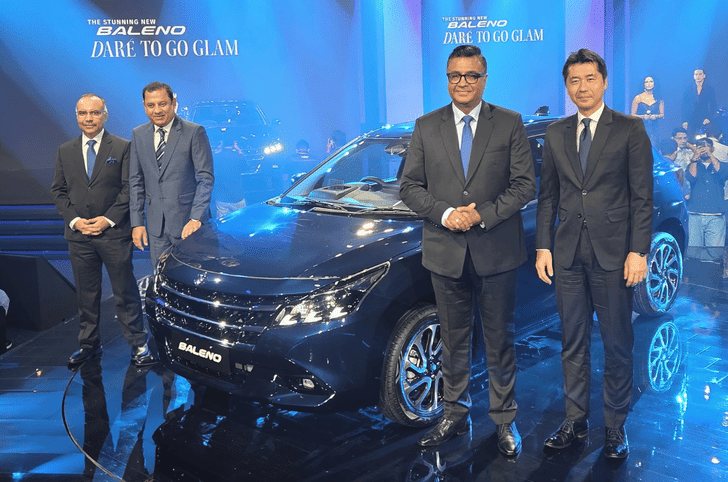

Maruti's new CNG-AMT trio — Dzire (36.47 km/kg), Swift (35.34 km/kg) and Baleno (34.47 km/kg) — launched September 2026, with the Baleno S-CNG AMT starting at Rs 8.32 lakh ex-showroom.
Maruti Suzuki's new automatic S-CNG variants of the Swift, Dzire and Baleno — launched on 19 September 2026 under the company's 'Auto Green Mission' — are the first factory-fitted CNG cars in India to pair a CNG powertrain with an automated manual transmission (AMT), eliminating the clutch pedal entirely from the CNG-car equation. The Dzire S-CNG AMT leads the trio with an ARAI-claimed 36.47 km/kg, the Swift S-CNG AMT returns 35.34 km/kg, and the Baleno S-CNG AMT delivers 34.47 km/kg.
The table below puts the three new models side by side against the manual CNG variants they sit above, so you can judge whether the AMT premium is worth it.
| Model | CNG Variant | Ex-Showroom Price | ARAI Mileage (CNG) | Transmission | Boot Space | CNG Kit |
|---|---|---|---|---|---|---|
| Maruti Dzire S-CNG AMT | ZXi CNG AMT (new) | ~Rs 9.41 lakh* | 36.47 km/kg | 5-speed AMT | Reduced (single cylinder under boot) | Factory-fitted |
| Maruti Dzire S-CNG MT | VXi CNG MT | Rs 8.10 lakh | 33.73 km/kg | 5-speed MT | Reduced (single cylinder under boot) | Factory-fitted |
| Maruti Swift S-CNG AMT | New AMT variant | ~Rs 8.99 lakh* | 35.34 km/kg | 5-speed AMT | Reduced (single cylinder under boot) | Factory-fitted |
| Maruti Baleno S-CNG AMT | New AMT variant | Rs 8.32 lakh | 34.47 km/kg | 5-speed AMT | Reduced (single cylinder under boot) | Factory-fitted |
| Maruti Baleno S-CNG MT | CNG MT (2026 facelift) | ~Rs 7.90 lakh* | 33.61 km/kg | 5-speed MT | Reduced (single cylinder under boot) | Factory-fitted |
Prices marked with an asterisk are derived from the variant-wise pricing pattern disclosed at launch and the Autocar India/ETAuto coverage; confirm exact figures at your nearest Nexa/Arena dealership before booking.
The mileage figures above are manufacturer (ARAI) claims. Real-world CNG efficiency typically runs 15–20% lower depending on city traffic, AC usage and CNG quality at the pump.
What exactly is the 'Auto Green Mission' and why does it matter?
Maruti Suzuki's Auto Green Mission is the company's strategic initiative to combine factory-fitted CNG powertrains with automatic transmissions, targeting urban buyers who want low running costs without the fatigue of a manual clutch in stop-go traffic. The launch on 19 September 2026 marks the first time any mainstream Indian automaker has offered a factory-warranted CNG-AMT combination across three models simultaneously.
The practical significance is clear: CNG cars have historically been manual-only because the torque interruption during gear changes is less critical with a clutch pedal. Maruti's 5-speed AMT manages this electronically, and the company says the Idle Start Stop technology on the Z12E engine further smooths the experience at signals — exactly the scenario where CNG cars spend most of their fuel budget.
Maruti's S-CNG vehicle sales rose 58 per cent year-on-year in the first quarter of FY2027, and July 2026 recorded the company's highest-ever monthly S-CNG sales at 83,000 units. The AMT addition is clearly an attempt to push that ceiling higher by converting buyers who previously chose petrol-AMT over CNG-MT.
What engine powers all three models, and how does CNG affect performance?
All three cars — Swift, Dzire and Baleno — share the 1.2-litre Z12E three-cylinder naturally aspirated engine with Dual Variable Valve Timing (Dual VVT) and Idle Start Stop technology. In petrol form, the engine produces 83 hp and 112 Nm in the Baleno, and 81.58 hp and 111.7 Nm in the Dzire. Switch to CNG and outputs drop to roughly 70 hp and 102 Nm across the range — a reduction of roughly 13–15% in peak power.
This power drop is a real-world trade-off every CNG buyer must accept. On CNG, overtaking at highway speeds feels noticeably lazier, and the AMT's gear-hunting behaviour under hard acceleration can be more pronounced than in the petrol version. The AMT does allow manual gear selection without a clutch pedal, which helps experienced drivers manage the power deficit on expressways.
The Z12E replaced the older 1.2-litre four-cylinder K12N in the 2026 Baleno facelift. The K12N produced 90 hp and 113 Nm in petrol form and 77.5 hp and 98.5 Nm on CNG — so the new engine is actually less powerful in both modes. Yet the 2026 Baleno's petrol mileage improved to 23.80 kmpl (MT) and 24.77 kmpl (AMT) despite the lower power and higher kerb weight, suggesting the Z12E is meaningfully more thermally efficient.
How much does it cost to run the Dzire S-CNG AMT versus the petrol version?
Running cost arithmetic is where CNG cars make their strongest case. Here is the calculation for Delhi, where CNG is priced at approximately Rs 76 per kg and petrol at approximately Rs 95 per litre as of September 2026 (check current pump prices before relying on this):
Dzire S-CNG AMT (ARAI: 36.47 km/kg):
- Real-world estimate: ~30 km/kg (assuming 18% discount to ARAI)
- Cost per km on CNG: Rs 76 ÷ 30 = Rs 2.53/km
Dzire Petrol AMT (ARAI: 24.79 kmpl):
- Real-world estimate: ~18 kmpl (city driving)
- Cost per km on petrol: Rs 95 ÷ 18 = Rs 5.28/km
The CNG version costs roughly Rs 2.75 less per km in city use. For a buyer covering 1,500 km a month, that is a saving of approximately Rs 4,125 per month, or nearly Rs 49,500 per year. The price premium of the CNG-AMT variant over the equivalent petrol-AMT is typically Rs 80,000–1,00,000 at the ex-showroom level, meaning the running-cost savings pay back the premium in roughly 18–24 months at this usage level.
These numbers assume CNG availability near your home or office. In cities like Delhi, Mumbai, Pune, Ahmedabad and Surat, CNG infrastructure is dense. In smaller towns and on highway routes, CNG stations can be 50–100 km apart, which is a genuine operational risk. The Dzire's petrol tank provides a backup range, but planning long trips requires more thought than with a pure-petrol car.
What is the Baleno S-CNG AMT's position in the compact hatchback segment?
The Baleno S-CNG AMT is the first automatic CNG hatchback available in the premium compact hatchback segment in India, and at Rs 8.32 lakh (ex-showroom) it undercuts the petrol-AMT variants of rivals like the Hyundai i20 and Tata Altroz while offering lower running costs.
Its direct rivals in the CNG space — the Tata Altroz iCNG and the Hyundai i20 CNG — are both manual-only as of this writing. The Altroz iCNG uses Tata's twin-cylinder CNG setup, which distributes the cylinder weight under the floor rather than in the boot, preserving more usable boot space. The Baleno's single-cylinder setup, mounted in the boot, meaningfully cuts luggage capacity; Maruti does not publish the exact reduction, but owners typically report losing 100–150 litres of effective boot volume.
The 2026 Baleno facelift also brings Level 2 ADAS — adaptive cruise control, lane-keep assist, emergency braking, high-beam assist — which none of its hatchback rivals currently offer. Ventilated front seats, a Clarion sound system and a cooled wireless charger are also new. The absence of a sunroof and rear centre armrest remain notable gaps at this price point.
The Baleno S-CNG AMT's honest weaknesses: reduced boot space versus the Altroz iCNG's twin-cylinder layout, lower peak power (70 hp on CNG) than the petrol version, AMT gear-hunting under hard throttle, and the fact that the CNG variant is only available in manual transmission in the lower trims — the AMT is a single, higher-specification variant.
What are the Dzire S-CNG AMT's prices and how do they compare to the manual CNG?
The Dzire is the segment leader in this trio, both on mileage and on sales volume. The Dzire became the best-selling car in India in FY2026 with around 2.14 lakh units sold, and it crossed the 30 lakh cumulative sales milestone in March 2026.
The existing Dzire CNG manual lineup, after the June 2026 price revision, is priced as follows:
- VXi CNG MT: Rs 8.10 lakh (ex-showroom) — up Rs 7,500 from the previous Rs 8.03 lakh
- ZXi CNG MT: Rs 9.11 lakh (ex-showroom) — up Rs 7,500 from Rs 9.03 lakh
The new Dzire S-CNG AMT variants sit above these, with the top-spec ZXi CNG AMT expected around Rs 9.41 lakh based on the Autocar India pricing data. The petrol Dzire, for reference, runs from Rs 6.31 lakh (base) to Rs 9.36 lakh (ZXi+ AMT) ex-showroom.
The Dzire's 36.47 km/kg ARAI claim is the highest of the three new AMT-CNG models and also higher than the manual CNG Dzire's 33.73 km/kg — a counterintuitive result explained by the AMT's optimised shift points, which the manual driver may not always hit in real traffic. Whether this gap holds in real-world driving is yet to be independently tested; treat the 36.47 km/kg as a manufacturer claim until road tests confirm it.
The Dzire's rivals in the CNG sedan space — the Honda Amaze CNG and Hyundai Aura CNG — remain manual-only. The Dzire S-CNG AMT therefore has no direct automatic-CNG competitor in the compact sedan segment as of September 2026.
What is the Swift S-CNG AMT's place in the lineup?
The Swift occupies the middle ground in this trio — more driver-focused than the Dzire sedan, less premium-positioned than the Baleno. The Swift S-CNG AMT's 35.34 km/kg ARAI claim sits between its two siblings, and its price is expected to be positioned between the Baleno S-CNG AMT (Rs 8.32 lakh) and the Dzire S-CNG AMT top variant.
The Swift has historically been the sportier choice in Maruti's CNG lineup, with a slightly tauter suspension tune and a more eager throttle response in petrol form. On CNG, the 70 hp output levels the playing field with the Dzire and Baleno. The AMT's manual-mode option — which lets the driver hold gears without a clutch — is particularly useful in the Swift, where drivers are more likely to want control over gear selection.
Boot space loss from the CNG cylinder is the same trade-off as in the Baleno: the single cylinder sits in the boot, reducing luggage capacity. If boot space is a priority, the Tata Altroz iCNG's twin-cylinder setup — which stores the cylinders under the floor — is worth considering, though the Altroz does not offer an AMT in CNG form.
Are these factory-fitted CNG kits, and what does that mean for the warranty?
Factory-fitted S-CNG is a CNG system installed by Maruti Suzuki at the manufacturing plant, integrated with the engine management system and covered under the standard manufacturer's warranty. This differs from a dealer-fitted or aftermarket CNG kit, which is installed post-sale and typically voids the manufacturer's powertrain warranty on components affected by the conversion.
All three new AMT-CNG models — Swift, Dzire and Baleno — carry Maruti's factory-fitted S-CNG badge. The standard Maruti warranty covers 3 years or 1,00,000 km, whichever comes first, and applies to the CNG system components as part of the vehicle. Buyers do not need to worry about warranty voidance, which is a common concern with aftermarket CNG kits fitted by local vendors.
This factory-fitted status also means the engine ECU is tuned specifically for CNG operation, the fuel lines are routed safely through the firewall, and the CNG cylinder meets AIS-041 safety standards. Maruti's S-CNG cars have a strong safety record in this regard, and the company's service network — the largest in India — supports CNG-specific maintenance at most authorised workshops.
How does CNG station availability affect the ownership experience?
CNG infrastructure in India comprises the network of Compressed Natural Gas dispensing stations operated primarily by city gas distribution (CGD) companies such as Indraprastha Gas (IGL in Delhi-NCR), Mahanagar Gas (MGL in Mumbai), Gujarat Gas and others. As of mid-2026, India has over 6,500 CNG stations, concentrated in Gujarat, Maharashtra, Delhi-NCR, Rajasthan and parts of UP and MP.
For buyers in these states, CNG ownership is straightforward: fill up every 200–250 km (real-world range on a full CNG tank), enjoy the Rs 2.50–2.75/km running cost, and use the petrol tank as a backup for longer runs or when CNG queues are long. Peak-hour queues at CNG pumps in cities like Delhi and Mumbai can add 15–30 minutes to a fill-up, which is a genuine inconvenience that petrol and diesel owners do not face.
For buyers in states with thin CNG coverage — parts of the Northeast, hilly regions, or smaller towns in central India — the calculus changes. The petrol fallback works, but if you're running on petrol most of the time, the CNG premium on the car's purchase price never pays back. Check the IGL, MGL or your local CGD company's station locator before committing to a CNG purchase.
What features do the new CNG-AMT variants get, and what do they miss?
The feature content of the S-CNG AMT variants mirrors the equivalent petrol-AMT trims, with the CNG system added on top. Across the three models, the key features available (depending on trim) include:
The Dzire S-CNG AMT in ZXi trim gets a 9-inch SmartPlay Pro+ infotainment system with wireless Apple CarPlay and Android Auto, a part-digital instrument cluster, 360-degree camera, push-button start, automatic climate control, keyless entry, a sunroof, and 6 airbags as standard. The Dzire holds a 5-star rating from both Global NCAP and Bharat NCAP — a strong safety credential for a car at this price.
The Baleno S-CNG AMT gains the 2026 facelift's new features: Level 2 ADAS (adaptive cruise control, lane-keep assist, emergency braking, high-beam assist), ventilated front seats, a Clarion sound system, a cooled wireless charger, and a 360-degree camera. It does not get a sunroof or a rear centre armrest — gaps that the Hyundai i20 and even some Altroz variants address. The ADAS suite is a genuine differentiator at this price point; no rival hatchback CNG car currently offers it.
The Swift S-CNG AMT is the most driver-focused of the three, with a sportier exterior and slightly firmer ride. Feature content in the AMT CNG trim is expected to be comparable to the petrol-AMT equivalent, including a 9-inch infotainment screen, connected car tech and 6 airbags.
One feature absent from all three CNG variants is the AMT in lower trims — the automatic gearbox is only offered in the higher-specification CNG variants. Entry-level CNG buyers still have to make do with the 5-speed manual.
Should you buy the CNG-AMT or wait for a full automatic (torque converter or DCT)?
The AMT is not a traditional automatic. It is an Automated Manual Transmission — a conventional manual gearbox with an electro-hydraulic actuator that operates the clutch and gear selection automatically, without a clutch pedal for the driver. The result is more fuel-efficient than a torque converter automatic but less smooth, particularly at low speeds and during gear changes under partial throttle. The characteristic "head-nod" during upshifts is present in all three cars, though Maruti has refined it considerably in the Z12E-AMT combination.
For city commuters who want CNG running costs without a clutch pedal, the AMT is a very practical compromise. For buyers who prioritise driving refinement and are willing to pay more, a petrol-DCT or petrol-torque converter option (like the Hyundai i20 1.0 turbo DCT) offers a smoother experience — but at significantly higher running costs.
There is no indication from Maruti that a full torque converter or DCT CNG variant is planned. The AMT is the only automatic CNG option in this segment, and it is likely to remain so for the near term given the engineering complexity of pairing a wet-clutch automatic with a CNG powertrain.
For buyers considering the broader CNG space, our guide to the 5 best CNG cars in India covers options across segments, and if you're also considering CNG SUVs, the best CNG compact SUVs under Rs 15 lakh is worth reading alongside this piece.
What is the verdict — which of the three CNG-AMT models makes the most sense?
Each of the three models serves a distinct buyer profile, and the right choice depends on what you're optimising for.
The Dzire S-CNG AMT makes the most sense for high-mileage city commuters and cab-adjacent personal-use buyers. Its 36.47 km/kg ARAI claim is the best of the three, it has a boot that — while reduced by the CNG cylinder — is still usable for a family sedan, and its 5-star NCAP rating provides genuine safety assurance. The Dzire is also the best-selling car in India, which means strong resale value and a wide service network. Its weakness: the boot space reduction from the single CNG cylinder is more keenly felt in a sedan than in a hatchback, since sedan buyers typically expect more luggage capacity.
The Baleno S-CNG AMT at Rs 8.32 lakh is the segment pioneer — the first automatic CNG premium hatchback in India. The 2026 facelift's Level 2 ADAS suite is a genuine differentiator, and the ventilated seats and Clarion audio add premium feel. The weakness is the boot space trade-off (single cylinder in the boot) and the lower peak power (70 hp on CNG) from the new Z12E versus the outgoing K12N's 77.5 hp on CNG. If boot space matters, the Tata Altroz iCNG's twin-cylinder under-floor layout is worth a test drive.
The Swift S-CNG AMT suits buyers who want the CNG running cost advantage in a more driver-focused package. It sits between the Baleno and Dzire on mileage (35.34 km/kg) and is expected to be priced accordingly. If you're already a Swift fan and have been waiting for a CNG-automatic option, this is it.
All three are factory-fitted, warranty-covered, and backed by Maruti's pan-India service network — advantages that no aftermarket CNG kit can replicate. The AMT addition removes the last major objection urban buyers had to CNG: the clutch fatigue of stop-go traffic. Whether the real-world mileage lives up to the ARAI claims will become clearer once independent road tests are published; watch this space.
For buyers exploring the wider CNG hatchback market, including options under Rs 10 lakh, our CNG hatchbacks under Rs 10 lakh guide covers the full competitive space.
Sources
- Maruti Suzuki Unveils Automatic S-CNG Variants of Swift, Dzire, and Baleno — ETAuto
- Maruti Suzuki Dzire Now Costlier: CNG Trims See Biggest Increase — Times of India
- 2026 Maruti Baleno Facelift Launched at Rs 6.10 Lakh — Autocar India
- Maruti Suzuki Dzire (2026) — Price, Mileage & Expert Reviews — Autocar India
- 2026 Maruti Baleno Mileage Revealed: Up to 24.77 kmpl Despite Less Power — Mint
- 5 Best CNG Cars in India (2026) — AutoForumIndia
- 7 Best CNG Hatchbacks Under Rs 10 Lakh in India — AutoForumIndia
- Best CNG Compact SUVs Under Rs 15 Lakh in India (2026) — AutoForumIndia