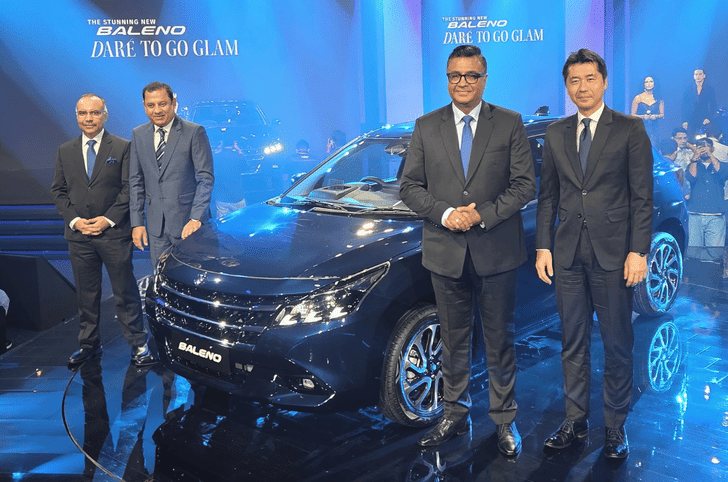

Maruti's new automatic S-CNG Swift (35.34 km/kg), Dzire (36.47 km/kg) and Baleno (34.47 km/kg) AMT variants launched in September 2026, with Baleno CNG AMT from ₹8.23 lakh ex-showroom.
Maruti Suzuki's new automatic S-CNG Swift, Dzire and Baleno — launched on 18 September 2026 under the company's 'Auto Green Mission' — are the first mass-market CNG cars in India to combine a factory-fitted CNG kit with an automated manual transmission (AMT), with ARAI-certified mileage figures ranging from 34.47 km/kg to 36.47 km/kg depending on the model.
Until now, buyers who wanted CNG running costs had to accept a manual gearbox. Maruti has changed that calculus across three of its bestselling nameplates simultaneously. Here is how the three new automatic S-CNG variants compare at a glance, alongside the manual CNG variants they sit above:
| Model | Transmission | ARAI Mileage (CNG) | Ex-Showroom Price (CNG variant) | Boot Space Trade-off | Key Weakness |
|---|---|---|---|---|---|
| Maruti Dzire S-CNG AMT | 5-speed AMT (factory-fitted CNG) | 36.47 km/kg | ~₹9.5–10 lakh (est.) | Single cylinder reduces boot | Lower power vs petrol AMT |
| Maruti Swift S-CNG AMT | 5-speed AMT (factory-fitted CNG) | 35.34 km/kg | ~₹8.5–9 lakh (est.) | Single cylinder reduces boot | Lower power vs petrol AMT |
| Maruti Baleno S-CNG AMT | 5-speed AMT (factory-fitted CNG) | 34.47 km/kg | ₹8.23 lakh (Delta CNG AMT, ex-showroom) | Single cylinder reduces boot | Single-cylinder kit vs Tata's twin-cylinder iCNG |
| Maruti Baleno S-CNG MT | 5-speed Manual (factory-fitted CNG) | ~34 km/kg (est.) | ₹7.92 lakh (Delta CNG MT, ex-showroom) | Single cylinder reduces boot | No clutchless convenience |
| Tata Altroz iCNG | 5-speed Manual (factory-fitted CNG) | 28.08 km/kg | ~₹8.5–10 lakh | Twin-cylinder, minimal boot loss | Manual only, no AMT option |
| Hyundai i20 CNG | 5-speed Manual (factory-fitted CNG) | 27.1 km/kg | ~₹9–10.5 lakh | Single cylinder | Manual only, no AMT option |
Prices are ex-showroom. Dzire and Swift CNG AMT prices are estimates pending full variant-wise disclosure. Baleno CNG AMT price sourced from Autocar India. ARAI mileage figures are manufacturer claims, not real-world tested results.
What exactly is the Maruti Auto Green Mission and what does it include?
The Auto Green Mission represents Maruti Suzuki's push to combine CNG powertrains with automatic transmissions across its mainstream model range, eliminating the historically binary choice between fuel efficiency and driving convenience. Announced on 18 September 2026, the initiative covers three models in its first phase: the Swift hatchback, Dzire compact sedan and Baleno premium hatchback.
All three share the same core powertrain: a 1.2-litre Z12E three-cylinder naturally aspirated petrol engine with Dual Variable Valve Timing (Dual VVT) and Idle Start Stop (ISS) technology, paired with a five-speed Auto Gear Shift (AGS) transmission — Maruti's branded AMT unit. The CNG kit is factory-fitted at Maruti's own plant, not retrofitted by a dealer, which matters for warranty and safety coverage.
Partho Banerjee, Senior Executive Officer, Marketing & Sales at Maruti Suzuki, noted at the launch: "Modern Indian cities experiencing rapid growth, new-age customers are looking for the convenience of an automatic car without compromising on fuel-efficiency and performance in traffic conditions." Sales figures back this sentiment: S-CNG vehicle sales jumped 58 per cent year-on-year in the first quarter of FY27, with July 2026 marking Maruti's highest monthly S-CNG sales at 83,000 units.
What are the ARAI mileage figures and how do they compare to rivals?
The ARAI-certified mileage figures for the three new automatic S-CNG models are:
- Dzire S-CNG AMT: 36.47 km/kg — claimed by Maruti to be India's most fuel-efficient sedan as certified by JATO Dynamics on 18 September 2026
- Swift S-CNG AMT: 35.34 km/kg
- Baleno S-CNG AMT: 34.47 km/kg
These figures come from testing under Rule 115 of the Central Motor Vehicles Rules, 1989 — the standard ARAI test cycle. Real-world CNG mileage in Indian city traffic typically runs 15–25 per cent lower than ARAI claims, so expect approximately 26–30 km/kg in mixed urban driving.
The Tata Altroz iCNG, the Baleno's most direct rival in the premium hatchback space, returns 28.08 km/kg on the ARAI cycle. The Hyundai i20 CNG delivers 27.1 km/kg. Neither offers an AMT option. The Maruti Baleno S-CNG AMT's 34.47 km/kg represents a substantial claimed efficiency gain, though independent real-world tests remain unavailable at the time of writing.
Power output tells a different story. The Baleno's petrol AMT variant delivers 83hp and 112Nm in petrol mode. In CNG mode, power drops to 70hp and torque to 102Nm — roughly a 16 per cent reduction in peak power. This is characteristic of all CNG engines, not a Maruti-specific limitation, but buyers who frequently use expressways or carry full loads should factor this in during test drives.
What are the exact prices of the Baleno, Swift and Dzire CNG AMT variants?
Baleno pricing is the most complete picture available. The model received its facelift in early September 2026, just before the Auto Green Mission launch.
Maruti Baleno CNG variants (ex-showroom, Delhi):
- Delta CNG MT: ₹7.92 lakh
- Delta CNG AMT: ₹8.23 lakh
- Zeta CNG MT: ₹8.92 lakh
- Zeta CNG AMT: ₹9.23 lakh
The on-road price in Delhi for the Delta CNG AMT works out to approximately ₹9.45 lakh after RTO, insurance and other charges, with an EMI of around ₹13,676 per month on a standard loan.
Swift S-CNG AMT and Dzire S-CNG AMT pricing had not been published at the time of this article. Based on the AMT premium the Baleno commands over its manual variant (approximately ₹30,000–₹31,000), similar premiums should apply to the Swift and Dzire CNG AMT models. Dealership networks are expected to announce full pricing shortly after the 18 September 2026 launch event.
For reference, the Baleno's petrol variants span ₹5.99 lakh (Sigma MT) to ₹9.99 lakh (Alpha(O) AMT) ex-showroom in Delhi — placing the CNG AMT variants in the middle of the overall Baleno range rather than at the premium end.
What is the running cost advantage of the automatic S-CNG variants versus petrol?
Running cost is where the CNG proposition becomes tangible. Using Delhi CNG prices as reference (CNG was approximately ₹75 per kg at the time of writing; petrol was approximately ₹95 per litre):
Baleno S-CNG AMT (ARAI: 34.47 km/kg):
- CNG cost per km = ₹75 ÷ 34.47 = ₹2.18 per km (ARAI basis)
- Real-world estimate (at ~26 km/kg): ₹75 ÷ 26 = ₹2.88 per km
Baleno petrol AMT (ARAI: ~22 km/l):
- Petrol cost per km = ₹95 ÷ 22 = ₹4.32 per km (ARAI basis)
- Real-world estimate (at ~16 km/l): ₹95 ÷ 16 = ₹5.94 per km
On a real-world basis, a Baleno CNG AMT owner driving 1,500 km per month saves approximately ₹4,590 per month versus the petrol AMT — enough to recover the roughly ₹73,000 price premium of the CNG AMT over the petrol AMT (Delta AMT at ₹7.50 lakh vs Delta CNG AMT at ₹8.23 lakh) in approximately 16 months of typical urban use.
The Dzire S-CNG AMT's 36.47 km/kg figure pushes running costs lower still — at ₹75/kg CNG, that translates to approximately ₹2.06 per km on the ARAI cycle, making it the most economical automatic car in its segment by claimed figures.
These savings matter most for high-mileage urban users — cab aggregator drivers, daily commuters covering 60–80 km per day, and small business owners. For drivers covering fewer than 800 km monthly, the payback period extends beyond two years, making the petrol AMT's lower purchase price more sensible.
What is Maruti's S-CNG technology and is it factory-fitted or dealer-fitted?
S-CNG is Maruti Suzuki's proprietary factory-integrated CNG system, developed and tested at the company's in-house Research & Development facility. Installation occurs on the production line, not at a dealership, meaning the full manufacturer warranty remains intact.
Key technical features of the S-CNG system, as detailed in Maruti's official press release, include:
- An Intelligent Injection System managing air-fuel ratio for optimal performance and efficiency
- Stainless steel pipes and joints throughout to prevent corrosion and leakage
- Integrated Wire Harnesses eliminating short-circuit risk
- A Microswitch preventing engine start during CNG refuelling
- Idle Start Stop (ISS) technology, which cuts the engine in stationary traffic and restarts silently — now extended to CNG variants for the first time
The ISS integration on CNG is significant because earlier S-CNG systems lacked stop-start capability in CNG mode. In heavy Delhi or Mumbai traffic, where a car can idle for 15–20 minutes per hour, this feature reduces fuel consumption beyond what the ARAI test cycle captures.
One limitation applies to all three new models: the CNG cylinder is a single unit mounted in the boot. Unlike Tata's twin-cylinder iCNG system — which splits CNG storage across two smaller cylinders under the boot floor — Maruti's single-cylinder layout occupies substantial luggage area. Tata claims its twin-cylinder setup in the Altroz iCNG preserves nearly full boot capacity. Maruti has not published separate boot space figures for the CNG variants, but expect a reduction of roughly 100–150 litres compared to the petrol versions.
How does the Baleno S-CNG AMT compare to the Tata Altroz iCNG and Hyundai i20 CNG?
This segment comparison matters most for premium hatchback buyers. The Baleno, Altroz and i20 are direct rivals targeting the same urban commuter.
Maruti Baleno S-CNG AMT (Delta CNG AMT, ₹8.23 lakh ex-showroom):
- Engine: 1.2L Z12E 3-cylinder, 70hp / 102Nm in CNG mode
- Transmission: 5-speed AMT (factory-fitted)
- ARAI mileage: 34.47 km/kg
- CNG cylinder: Single, in boot
- Key features (2026 facelift): Level 2 ADAS, ventilated front seats, 9-inch touchscreen, 360-degree camera, TPMS
- Weakness: Single-cylinder boot intrusion; power drop in CNG mode; AMT can feel jerky at low speeds
Tata Altroz iCNG (approximately ₹8.5–10 lakh ex-showroom):
- Engine: 1.2L naturally aspirated, 86hp in petrol mode (lower in CNG)
- Transmission: 5-speed Manual only — no AMT option
- ARAI mileage: 28.08 km/kg
- CNG cylinder: Twin-cylinder under boot floor — minimal boot space loss
- Weakness: No automatic option; lower claimed CNG mileage than Baleno
Hyundai i20 CNG (approximately ₹9–10.5 lakh ex-showroom):
- Engine: 1.2L Kappa, lower output in CNG mode
- Transmission: 5-speed Manual only — no AMT option
- ARAI mileage: 27.1 km/kg
- CNG cylinder: Single, in boot
- Weakness: No automatic option; lowest claimed CNG mileage in this trio
The Baleno CNG AMT's headline advantage is straightforward: it is the only premium hatchback in India offering both a factory-fitted CNG kit and an AMT gearbox. Its claimed mileage lead over the Altroz (34.47 vs 28.08 km/kg) is substantial on paper, though independent real-world testing remains unavailable.
The Altroz iCNG's twin-cylinder layout presents a genuine counter-argument for buyers who regularly carry luggage or use the boot for business. Tata's dual-cylinder CNG storage configuration positions two smaller cylinders beneath the boot floor rather than inside it, preserving usable cargo space. For families taking weekend trips or professionals carrying equipment, this is a practical advantage the Baleno cannot match.
The i20 CNG's 27.1 km/kg figure places it at the bottom of this comparison on efficiency, and without an AMT option, it offers the least for buyers specifically seeking automatic CNG convenience.
For broader CNG hatchback research, our guide to 7 Best CNG Hatchbacks Under ₹10 Lakh in India covers a wider price band including the WagonR and Celerio CNG.
What is the 2026 Baleno facelift and how does it affect the CNG variants?
The 2026 Baleno facelift — launched on 5 September 2026, two weeks before the Auto Green Mission — matters because it brought a new engine and features that carry directly into the CNG variants.
The most significant mechanical change replaces the outgoing 1.2-litre K12N four-cylinder engine (90hp, 113Nm) with the Z12E 1.2-litre three-cylinder unit (83hp, 112Nm in petrol mode). This is the same engine family used in the Swift and Dzire, enabling all three models to launch under the Auto Green Mission simultaneously. The Z12E has been tuned for better low-end torque in the Baleno application, according to Autocar India.
On the feature front, the 2026 Baleno introduces Level 2 ADAS — a first for the model and notably a first for any car in its segment. The ADAS suite includes adaptive cruise control, lane-keep assist, emergency braking and high-beam assist. Ventilated front seats, a tyre pressure monitoring system (TPMS) and a Clarion-branded audio system are also new. The 9-inch touchscreen, head-up display, wireless charger, 360-degree camera and automatic climate control carry over.
Exterior changes are restrained: a wider front grille housing the ADAS radar, a revised bumper, redesigned fog lamp housings, a shark-fin antenna and a new Enigmatic Teal colour option. The car's dimensions remain unchanged — 3,990mm long with a 2,520mm wheelbase.
The CNG AMT variants of the Baleno carry all these facelift features. A buyer choosing the Delta CNG AMT at ₹8.23 lakh gets the new engine, the AMT gearbox, the factory CNG kit and the core feature set — though Level 2 ADAS is expected to be restricted to higher trims (Zeta and above), consistent with Maruti's typical variant strategy.
Mint's coverage of the Baleno facelift confirmed that the updated model is the first Baleno to offer CNG with an AMT transmission, expanding gearbox choices for buyers who previously had to choose between CNG efficiency and automatic convenience.
What are the real-world trade-offs buyers should know before choosing the CNG AMT?
Several trade-offs deserve direct attention, since the Auto Green Mission's marketing narrative naturally emphasises the positives.
Power reduction in CNG mode is the most immediate concern. The Baleno's Z12E engine produces 83hp on petrol and drops to 70hp on CNG — a 16 per cent reduction. The Swift and Dzire experience similar drops. On a highway overtake or a steep flyover approach, this difference becomes noticeable, particularly when the AMT is in automatic mode and hunting for the right gear. Buyers who regularly use expressways or carry four adults should test-drive the CNG AMT variant specifically before committing.
AMT behaviour is a known characteristic of Maruti's AGS system. The gearbox performs competently in city traffic but can feel hesitant during gear changes, particularly at low throttle openings. This is not unique to the CNG variants, but combining AMT with reduced CNG power means the hesitation can feel more pronounced when pulling away from traffic lights on a gradient.
Boot space loss from the single CNG cylinder is a practical concern. Maruti has not published specific boot volume figures for the CNG variants, but the single-cylinder layout typically reduces usable boot space by 100–150 litres compared to the petrol variant. The Tata Altroz iCNG's twin-cylinder system, which stores CNG under the boot floor, is a genuine advantage here for buyers who prioritise luggage capacity.
CNG station availability remains uneven outside major metros and national highways. While Delhi, Mumbai, Pune, Ahmedabad and Bengaluru have dense CNG networks, buyers in tier-2 cities or those who travel frequently to rural areas may find range anxiety on CNG a real concern. The petrol fallback (all S-CNG cars run on petrol when CNG runs out) mitigates this, but it eliminates the running cost advantage for those kilometres.
Refuelling time for CNG is longer than petrol — typically 5–10 minutes at a busy station — and queues at CNG pumps during peak hours can add 15–30 minutes to the process in high-demand cities. This is a lifestyle consideration that does not appear in any spec sheet.
For buyers considering the broader CNG SUV segment, our roundup of Best CNG Compact SUVs Under ₹15 Lakh in India covers the Fronx CNG and its rivals.
Is the Dzire S-CNG AMT really India's most fuel-efficient sedan?
Maruti claims the Dzire S-CNG AMT is India's most fuel-efficient sedan, backed by a JATO Dynamics certification dated 18 September 2026. The 36.47 km/kg figure is the highest ARAI-certified CNG mileage for any sedan currently on sale in India.
For context, the Honda Amaze CNG (manual) returns approximately 30 km/kg, and the Hyundai Aura CNG (manual) delivers around 28 km/kg. Neither offers an AMT option. The Dzire's combination of the highest CNG mileage claim and an automatic gearbox in the compact sedan segment is genuinely new.
The JATO Dynamics certification provides third-party validation of the "most fuel-efficient" claim, lending it more credibility than a self-declared superlative. However, it remains based on the standardised test cycle, not real-world driving. Independent road tests will be the true measure, and those take time to appear after a launch.
For buyers who primarily drive in city traffic — where the AMT's stop-start convenience and the ISS system's fuel saving both apply — the Dzire S-CNG AMT is a compelling proposition. For highway-dominant users, the power reduction on CNG and the AMT's gear-hunting behaviour may make the manual CNG variant a more satisfying choice.
Should you buy the CNG AMT or wait for the manual CNG variant?
The AMT variant costs approximately ₹30,000–₹31,000 more than the equivalent manual CNG variant across the Baleno range. Whether that premium makes sense depends almost entirely on how and where you drive.
Buy the CNG AMT if:
- You drive primarily in city traffic with frequent stop-start conditions
- You or your co-driver find clutch operation fatiguing in congestion
- You are buying the car for a family member who is not comfortable with a manual gearbox
- You drive 1,200 km or more per month, making the running cost savings significant
Stick with the manual CNG if:
- You drive a mix of city and highway, where the AMT's gear-hunting is more noticeable
- You want the lowest possible purchase price
- You are an experienced driver who prefers direct control over gear selection
- You frequently carry four or five adults and need maximum available power
The manual CNG variants of all three models — Swift, Dzire and Baleno — remain on sale alongside the new AMT options. The Auto Green Mission adds a choice rather than replacing the existing lineup.
For a broader view of the best CNG cars across all segments in India, see our guide to the 5 Best CNG Cars in India (2026).
What does the S-CNG sales surge tell us about where the market is heading?
The sales data Maruti cited at the Auto Green Mission launch is striking. S-CNG vehicle sales rose 58 per cent year-on-year in Q1 FY27, with July 2026 recording 83,000 units — the highest monthly S-CNG sales in Maruti's history. That is not a niche segment anymore; 83,000 CNG units in a single month represents a meaningful share of Maruti's total monthly sales.
Two converging forces are driving the growth: persistently high petrol prices that make CNG's running cost advantage more visible, and an expanding CNG infrastructure network that reduces the range anxiety that historically deterred buyers outside metros. The government's push to expand CNG stations under the City Gas Distribution programme has added thousands of outlets across tier-2 and tier-3 cities over the past three years.
The Auto Green Mission's timing is deliberate. By adding AMT to CNG, Maruti is addressing the last significant objection from urban buyers who wanted CNG efficiency but found the manual gearbox a dealbreaker in congested city traffic. If the AMT CNG variants sell at even a fraction of the rate of the manual CNG cars, the volume impact on Maruti's overall sales mix will be substantial.
Maruti's broader S-CNG lineup — which includes the WagonR, Celerio, Alto K10, Ertiga, XL6 and Fronx in addition to the three new AMT models — means the company now covers virtually every mainstream segment with a factory-fitted CNG option. No other manufacturer in India comes close to that breadth of factory CNG coverage.
The Baleno's 2026 facelift also contributed to momentum: Maruti's total domestic passenger vehicle sales reached 1,76,971 units in August 2026, up 34.8 per cent year-on-year, suggesting strong product momentum heading into the festive season — when the new CNG AMT variants will face their first real sales test.
Sources
- Maruti Suzuki Launches Auto Green Mission with the introduction of Automatic S-CNG Swift, Dzire and Baleno — Maruti Suzuki Official Press Release
- Maruti Suzuki Unveils Automatic S-CNG Variants of Swift, Dzire, and Baleno — ETAuto
- 2026 Maruti Baleno facelift launched at Rs 6.10 lakh — Autocar India
- Maruti Suzuki Baleno On Road Price in Delhi (September 2026) — Autocar India
- Maruti Suzuki Baleno facelift launched in India at Rs. 6.10 lakh: Key features — Mint