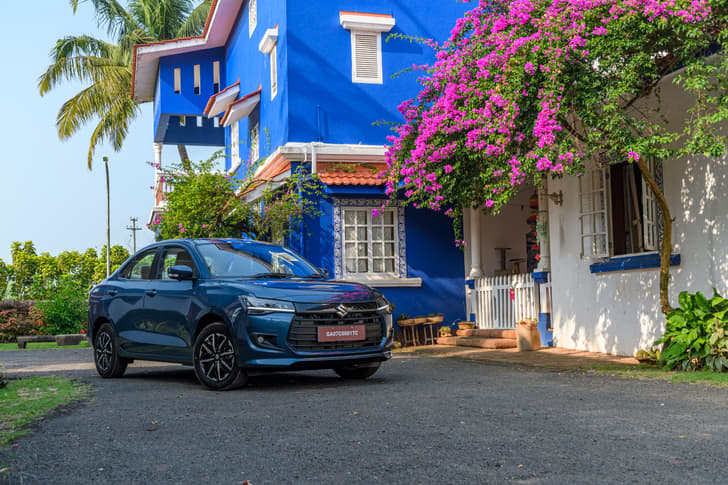

Maruti's new CNG-AMT Swift, Dzire and Baleno claim 35.34, 36.47 and 34.47 km/kg respectively (ARAI), with prices from ₹8.32 lakh, but all sacrifice significant boot space to a single boot-mounted CNG cylinder.
How Much Mileage Do Maruti's New CNG-AMT Swift, Dzire and Baleno Deliver in India 2026?
Maruti Suzuki's new S-CNG AMT range — launched under the company's 'Auto Green Mission' on 19 September 2026 — delivers ARAI-claimed mileage of 36.47 km/kg for the Dzire, 35.34 km/kg for the Swift, and 34.47 km/kg for the Baleno, making them among the most fuel-efficient automatic CNG cars currently on sale in India. All three are factory-fitted S-CNG models, meaning the CNG kit is integrated at the Maruti Suzuki plant rather than added by a dealer, which preserves the manufacturer warranty. The common powertrain is the 1.2-litre Z12E three-cylinder engine with Dual Variable Valve Timing (VVT) and Idle Start Stop technology, paired to a 5-speed Automated Manual Transmission (AMT) that also allows manual gear changes without a clutch pedal.
The headline numbers are compelling, but the real-world story involves boot space compromises, power drops on CNG, and how these cars stack up against rivals like the Tata Altroz iCNG AMT — the only other CNG-AMT hatchback in the segment.
At a Glance: Maruti CNG-AMT Trio vs Tata Altroz iCNG AMT
| Model | CNG Mileage (ARAI, km/kg) | Starting Price (CNG AMT, ex-showroom) | CNG Kit Type | Boot Space on CNG | CNG Cylinder Layout |
|---|---|---|---|---|---|
| Maruti Dzire S-CNG AMT | 36.47 km/kg | ~₹9.00–9.41 lakh (est.) | Factory-fitted | Severely reduced | Single boot-mounted |
| Maruti Swift S-CNG AMT | 35.34 km/kg | ~₹8.60–9.00 lakh (est.) | Factory-fitted | Severely reduced | Single boot-mounted |
| Maruti Baleno S-CNG AMT | 34.47 km/kg | ₹8.32 lakh onwards | Factory-fitted | Severely reduced | Single boot-mounted (55L water-equiv.) |
| Tata Altroz iCNG AMT | ~28.08 km/kg (ARAI) | ~₹8.99 lakh onwards | Factory-fitted | ~210 litres usable | Twin-cylinder (under boot floor) |
Prices are ex-showroom. Maruti Dzire and Swift CNG-AMT prices are estimates based on the Baleno CNG-AMT launch price and the existing CNG-MT price ladder; confirm at your local Arena dealer. Tata Altroz iCNG AMT mileage and price are manufacturer/market figures.
The table captures the core buying decision: Maruti's three models lead on claimed mileage by a significant margin, but Tata's twin-cylinder iCNG layout in the Altroz preserves around 210 litres of usable boot space even with both cylinders fitted — a practical advantage that matters every time you load luggage.
What Exactly Are the Maruti S-CNG AMT Variants and What Do They Cost?
Maruti Suzuki S-CNG is defined as the company's factory-integrated compressed natural gas system, where the CNG kit is installed on the assembly line rather than retrofitted at a dealership or by an aftermarket vendor. This distinction matters for warranty: because the S-CNG system is factory-fitted, the standard Maruti Suzuki warranty — 2 years / unlimited kilometres, extendable — applies to both the vehicle and the CNG system without caveats. Dealer-fitted or aftermarket CNG kits from vendors like Lovato or Tomasetto typically void the OEM powertrain warranty, which is a significant risk on a new car.
The three new CNG-AMT models are:
Maruti Baleno S-CNG AMT — Available in Delta and Zeta trims, starting at ₹8.32 lakh (ex-showroom). The Baleno is Maruti's premium hatchback, sold through the Nexa channel. The CNG-AMT variants carry over the same 1.2-litre Z12E engine and 5-speed AMT from the petrol variants, with the CNG system added. Claimed mileage is 34.47 km/kg — 0.86 km/kg better than the existing CNG-Manual variant, a marginal but real gain attributed to the AMT's optimised shift points.
Maruti Swift S-CNG AMT — The Swift is Maruti's best-known hatchback, sold through Arena dealerships. The CNG-AMT variant claims 35.34 km/kg (ARAI), placing it between the Baleno and the Dzire in efficiency terms. Exact variant pricing was not confirmed at launch but is expected to follow the Baleno CNG-AMT's premium over the MT equivalent.
Maruti Dzire S-CNG AMT — The Dzire is a compact sedan rather than a hatchback, which gives it a slightly different use case. Its 36.47 km/kg ARAI claim is the highest of the three, and the Dzire's existing price range runs from ₹6.31 lakh to ₹9.41 lakh (ex-showroom) across all variants including petrol and CNG. The Autocar India listing confirms the Dzire's top ARAI figure of 36.47 km/kg and notes the car has earned a 5-star rating from both Global NCAP and Bharat NCAP — a meaningful safety credential at this price point.
How Do the Running Costs Actually Work Out?
This is where CNG's advantage becomes concrete. The arithmetic below uses Delhi CNG retail price of approximately ₹76 per kg (as of September 2026; prices vary by city and are revised periodically by city gas distribution companies).
Dzire S-CNG AMT:
- ARAI claim: 36.47 km/kg
- Cost per km on CNG: ₹76 ÷ 36.47 = ₹2.08 per km
- For comparison, the Dzire petrol AMT claims 24.79 km/l (ARAI). At Delhi petrol price of ~₹95/litre: ₹95 ÷ 24.79 = ₹3.83 per km
- Saving per km: ~₹1.75 — or roughly ₹2,625 saved per 1,500 km of monthly city driving
Swift S-CNG AMT:
- ARAI claim: 35.34 km/kg
- Cost per km on CNG: ₹76 ÷ 35.34 = ₹2.15 per km
Baleno S-CNG AMT:
- ARAI claim: 34.47 km/kg
- Cost per km on CNG: ₹76 ÷ 34.47 = ₹2.20 per km
A few important caveats: ARAI figures are measured under controlled test conditions and almost always exceed real-world returns. Autocar India's real-world test of the Dzire petrol AMT recorded 11.61 km/l in city driving and 19.22 km/l on the highway — roughly 45–55% below the ARAI claim in city conditions. Expect a similar gap on CNG. A realistic city figure for the Dzire CNG-AMT might be closer to 22–26 km/kg, which still yields a cost per km of ₹2.92–₹3.45 — still cheaper than petrol but not as dramatic as the ARAI numbers suggest.
The running cost advantage compounds over time, particularly for high-mileage urban commuters. At 2,000 km/month, the Dzire CNG-AMT saves approximately ₹3,500 per month versus its petrol equivalent — enough to recover the CNG variant's price premium over the petrol AMT in roughly 18–24 months, depending on exact variant pricing.
What Is the Boot Space Trade-Off on These CNG Cars?
Boot space is the most significant real-world compromise on all three Maruti CNG-AMT models, and it deserves honest treatment.
All three — Swift, Dzire and Baleno — use a conventional boot-mounted CNG cylinder. The Baleno CNG-AMT, for instance, carries a 55-litre (water-equivalent) CNG tank in the boot, alongside the spare wheel. The result is that boot space in CNG mode is almost completely gone, leaving very little room for luggage. The Swift faces the same constraint. The Dzire, being a sedan with a separate boot lid, has a slightly more contained impact, but the CNG cylinder still eats significantly into the 378-litre boot that the petrol Dzire offers.
This contrasts sharply with Tata's approach. The Tata Altroz iCNG uses a twin-cylinder layout where two smaller cylinders are stored beneath the boot floor. Even with both cylinders in place, the Altroz iCNG retains approximately 210 litres of usable boot space — enough for a weekend bag and a few grocery runs. For buyers who regularly carry luggage, the Altroz iCNG AMT's packaging is demonstrably more practical, even though its claimed mileage of ~28 km/kg trails the Maruti trio.
Maruti has shown it can do better on packaging: the Moneycontrol report notes that the Victoris CNG and the Brezza Facelift CNG use an underbody CNG tank layout that preserves boot space entirely. The Baleno CNG-AMT does not get this treatment — a conscious product decision that prioritises cost and packaging simplicity over luggage practicality.
How Does the Engine Perform on CNG Versus Petrol?
The 1.2-litre Z12E engine is Maruti Suzuki's latest-generation three-cylinder unit, featuring Dual Variable Valve Timing (VVT) and Idle Start Stop technology. In petrol mode, it produces approximately 81.58 hp at 5,700 rpm and 111.7 Nm at 4,300 rpm (figures from the Dzire petrol spec sheet). In CNG mode, output drops — the Baleno CNG-AMT, for instance, makes 70 hp and 102 Nm in CNG mode, a reduction of roughly 14% in power and 9% in torque compared to petrol.
This power drop is characteristic of all CNG conversions, not specific to Maruti. CNG has a lower energy density per unit volume than petrol, and the stoichiometric air-fuel ratio is different, which reduces peak power output. In city driving — stop-start traffic, moderate acceleration — the difference is barely perceptible. On highways or when overtaking at speed, the reduced power becomes more noticeable. The AMT's optimised shift logic helps manage this by keeping the engine in its power band more consistently than a driver might with a manual gearbox, which partly explains why the CNG-AMT variants claim marginally better mileage than their MT equivalents.
The 5-speed AMT also supports manual gear selection without a clutch pedal, giving drivers the option to hold a gear when needed — useful when the CNG power deficit would otherwise cause the transmission to hunt for a lower ratio on a gradient.
Why Is Maruti Launching These Now — and What Does the Sales Data Say?
Maruti Suzuki's timing is deliberate. The company reported that S-CNG vehicle sales rose 58% year-on-year in the first quarter of FY2027, and that July 2026 recorded its highest-ever monthly S-CNG sales at 83,000 units. That is a substantial volume — roughly one in every five Maruti cars sold in that month was an S-CNG variant, based on the company's overall monthly sales scale.
The 'Auto Green Mission' branding signals that Maruti is positioning CNG-AMT as a mainstream, aspirational product rather than a budget fuel-saving measure. Partho Banerjee, Senior Executive Officer for Marketing & Sales at Maruti Suzuki, framed the launch as serving "aspirational customers who seek the best of both worlds" — automatic convenience combined with CNG running costs.
The commercial logic is straightforward: CNG penetration in India is highest in cities with well-developed city gas distribution (CGD) networks — Delhi-NCR, Mumbai, Pune, Ahmedabad, Surat, Lucknow, Kanpur, Hyderabad. In these cities, CNG pump density is sufficient for daily commuters. Outside these CGD-covered areas, CNG availability remains patchy, and the boot-space compromise becomes harder to justify if you also can't reliably fill up. Buyers in Tier-2 and Tier-3 cities should check CNG station availability on their specific routes before committing.
The Dzire's position as India's bestselling car in FY2026 — it crossed 30 lakh cumulative sales in March 2026 — means the CNG-AMT variant will reach a very large installed base of potential buyers who already know and trust the nameplate.
How Does the Dzire CNG-AMT Compare to Its Rivals in the Compact Sedan Segment?
The Dzire's direct rivals in the compact sedan space are the Hyundai Aura CNG, Honda Amaze CNG, and Tata Tigor iCNG. None of these currently offer a factory-fitted CNG with an AMT — making the Dzire CNG-AMT genuinely differentiated in its segment at launch.
The Hyundai Aura CNG is available with a manual gearbox only, claiming around 28.4 km/kg (ARAI). The Honda Amaze CNG, similarly, is manual-only and claims approximately 30.48 km/kg. The Tata Tigor iCNG uses a twin-cylinder setup (preserving more boot space) and claims around 26.49 km/kg, again with a manual gearbox. Against all three, the Dzire CNG-AMT's 36.47 km/kg and automatic transmission represent a meaningful step up — assuming the ARAI figure holds up reasonably well in real-world use.
The Dzire's 5-star NCAP rating (both Global and Bharat NCAP) also gives it a safety edge over some rivals in this segment, where crash test performance has historically been inconsistent.
How Does the Swift CNG-AMT Compare to the Tata Altroz iCNG AMT?
In the hatchback segment, the Swift CNG-AMT's most direct CNG-AMT rival is the Tata Altroz iCNG AMT. This is a genuinely competitive matchup worth examining in detail.
The Swift CNG-AMT claims 35.34 km/kg — significantly higher than the Altroz iCNG AMT's ~28 km/kg. At Delhi CNG prices of ₹76/kg, the Swift costs approximately ₹2.15/km versus the Altroz's ~₹2.71/km. Over 2,000 km/month, that is a saving of roughly ₹1,120 per month in favour of the Swift.
However, the Altroz iCNG AMT's twin-cylinder underbody layout preserves ~210 litres of usable boot space, while the Swift's boot-mounted single cylinder leaves almost no room for luggage. If you regularly carry bags, the Altroz's packaging is more liveable.
On features and safety, both are competitive. The Altroz has a 5-star Global NCAP rating. The Swift's Z12E engine is newer and more refined than the Altroz's 1.2-litre Revotron unit. The Swift's AMT is smoother in city use than earlier-generation Maruti AMTs, though both cars share the characteristic AMT head-nod during low-speed gear changes.
The Baleno CNG-AMT enters this comparison as the premium hatchback option — it adds Nexa-channel features like a larger touchscreen, better interior materials and a more upmarket cabin over the Swift, at a slightly higher price and with marginally lower mileage (34.47 km/kg versus 35.34 km/kg for the Swift). The boot space compromise is identical.
For buyers who prioritise mileage and running costs above all else, and who can live with minimal boot space, the Maruti trio wins. For buyers who need to carry luggage regularly, the Altroz iCNG AMT is the more practical choice despite its lower claimed mileage.
What Should You Check Before Buying a CNG-AMT Car in India?
Several practical considerations apply regardless of which model you choose:
CNG station availability on your route is the first filter. CNG is compressed natural gas dispensed at dedicated CNG stations operated by city gas distribution companies such as IGL (Delhi), MGL (Mumbai), GAIL Gas, and others. In cities with dense CGD networks, filling up is convenient. In cities where CNG infrastructure is still developing, you may find yourself driving out of your way to fill up — which erodes the cost advantage.
Boot space versus your actual luggage needs. If you travel frequently with family and luggage, the Maruti trio's boot compromise is a real daily inconvenience. Consider whether you can live with it before signing the booking form. The Tata Altroz iCNG AMT's twin-cylinder layout is the only current alternative in the hatchback segment that solves this problem.
ARAI versus real-world mileage. The figures quoted — 36.47, 35.34 and 34.47 km/kg — are ARAI-certified claims measured under standardised test conditions. Real-world city mileage, particularly in heavy stop-start traffic, will be lower. A reasonable expectation for city driving is 60–70% of the ARAI figure, or roughly 22–25 km/kg. Highway driving will be closer to the ARAI number.
Factory-fitted versus dealer-fitted CNG. All three Maruti models covered here are factory-fitted S-CNG — the kit is installed at the plant and the warranty is intact. If a dealer offers to fit CNG on a petrol variant as an aftermarket conversion, that is a different product entirely and typically voids the OEM powertrain warranty. Always confirm the S-CNG badge and factory documentation before purchase.
AMT behaviour in traffic. AMTs are not torque-converter automatics or dual-clutch transmissions. They are mechanically automated manual gearboxes and exhibit a characteristic pause and lurch during gear changes, especially at low speeds. This is more pronounced in CNG mode due to the lower power output. Test drive the specific CNG-AMT variant — not just the petrol AMT — before deciding.
Is the Maruti CNG-AMT Range the Right Buy for You?
The Swift, Dzire and Baleno S-CNG AMT variants make the most sense for urban commuters in CNG-covered cities who drive 1,500–2,500 km per month, want automatic convenience, and can accept minimal boot space. The running cost savings are real and compound meaningfully over 3–5 years of ownership.
The Dzire CNG-AMT is the strongest proposition of the three for buyers who want a sedan body style — it leads on mileage at 36.47 km/kg, has the segment's only CNG-AMT option at launch, and carries a 5-star NCAP rating. For hatchback buyers, the Swift CNG-AMT edges out the Baleno on mileage (35.34 vs 34.47 km/kg) at a lower price, while the Baleno justifies its premium with a more premium cabin and Nexa-channel service experience.
If boot space is non-negotiable, the Tata Altroz iCNG AMT remains the only alternative with a twin-cylinder layout that preserves usable luggage room — at the cost of lower claimed mileage and a slightly different feature set.
For a broader look at how these models fit into the wider CNG space, see our guides on the 5 Best CNG Cars in India (2026) and 7 Best CNG Hatchbacks Under ₹10 Lakh in India.
Maruti Suzuki's S-CNG vehicle sales rising 58% year-on-year tells you the market has already voted. The CNG-AMT launch is the company's answer to the one remaining objection — that CNG cars required a clutch. That objection is now gone. Whether the boot space trade-off is acceptable is the question only you can answer.
Sources
- Maruti Suzuki Launches Automatic S-CNG Variants of Swift, Dzire and Baleno, ETAuto
- Maruti Suzuki Dzire – Official Model Page
- Maruti Suzuki Swift – Official Model Page
- Maruti Baleno CNG-AMT Launched, Prices Start at ₹8.32 Lakh – Moneycontrol Hindi
- Maruti Suzuki Dzire (2026) – Price, Mileage & Expert Reviews, Autocar India