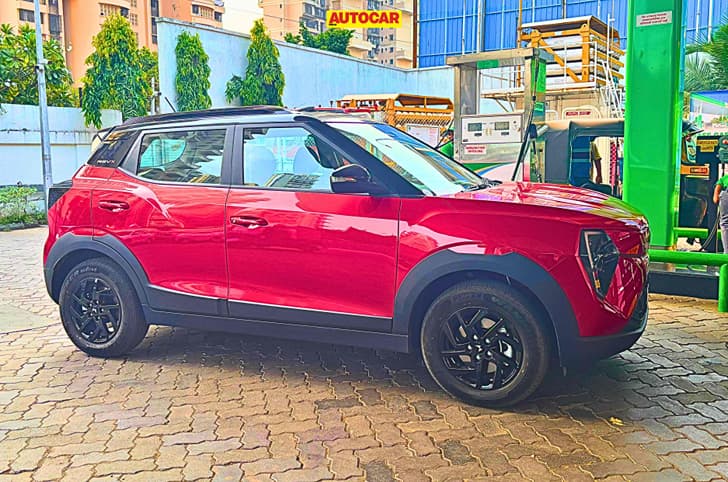

The Mahindra XUV 3XO CNG returns 19.52 km/kg in real-world testing (ARAI claim: 24.7 km/kg), priced from ₹9.99 lakh with a factory-fitted twin-cylinder CNG kit and 270-litre boot.
The Mahindra XUV 3XO CNG — officially badged the XUV 3XO ZNG — delivers a real-world mileage of 19.52 km/kg in Autocar India's standardised tests, against an ARAI-certified claim of 24.7 km/kg. Launched on 15 October 2026 at a starting price of ₹9.99 lakh (ex-showroom), it is Mahindra's first mainstream factory-fitted CNG vehicle aimed at private buyers, a segment long dominated by Maruti Suzuki's S-CNG range and, more recently, Tata's iCNG twins.
Before diving into the numbers, here is how the XUV 3XO ZNG stacks up against its two closest factory-fitted CNG compact SUV rivals:
| Model | CNG Kit | ARAI km/kg | Real-World km/kg (tested) | CNG Variant Price (ex-showroom, entry) | Boot Space (CNG) | Power (CNG mode) |
|---|---|---|---|---|---|---|
| Mahindra XUV 3XO ZNG | Factory-fitted, twin-cylinder underfloor | 24.7 km/kg | 19.52 km/kg | ₹9.99 lakh | 270 litres | 111 hp / 200 Nm |
| Maruti Suzuki Brezza S-CNG | Factory-fitted, single-cylinder | ~25.51 km/kg (ARAI) | ~18–19 km/kg (owner reports) | ~₹9.40 lakh | ~~328 litres (reduced vs petrol) | ~89 hp / 122 Nm |
| Tata Nexon iCNG | Factory-fitted, twin-cylinder | ~24.0 km/kg (ARAI) | ~18–20 km/kg (owner reports) | ~₹8.35 lakh | ~~350 litres (reduced vs petrol) | ~100 hp / 170 Nm |
ARAI figures are manufacturer claims. Real-world figures for Brezza CNG and Nexon iCNG are indicative based on owner community data; only the XUV 3XO ZNG figure is from a controlled Autocar India test. Prices as of October 2026.
What exactly is the Mahindra XUV 3XO ZNG, and what makes it different from other CNG SUVs?
The XUV 3XO ZNG is Mahindra's first factory-fitted CNG compact SUV designed for private buyers, using a turbocharged multi-point fuel injection (MPFi) engine paired with a 10-bar CNG injection system — a pressure level that is higher than the conventional 8-bar systems used in most rival CNG cars. This higher injection pressure allows the 1.2-litre mStallion TCMPFi engine to produce 111 hp and 200 Nm of torque in both petrol and CNG modes, a claim that is genuinely unusual in the CNG segment where power drops of 10–15% on gas are the norm.
The Maruti Suzuki Brezza S-CNG, which uses a naturally aspirated 1.5-litre K-series engine, drops from around 103 hp on petrol to approximately 89 hp on CNG. The Tata Nexon iCNG similarly sees a reduction from its petrol output. Mahindra's turbo-CNG combination sidesteps this trade-off through optimised turbocharger calibration and ECU mapping, though real-world throttle response on CNG can still feel slightly different from petrol, regardless of peak figures.
The "ZNG" badge on the tailgate is the only exterior tell. Interior, design, and safety equipment remain identical to the petrol XUV 3XO — which matters because the petrol version already holds a 5-star Bharat NCAP rating for both adult and child occupant protection.
What do the real-world mileage numbers actually mean for daily running costs?
Autocar India's tested figures — 16.75 km/kg in the city and 22.29 km/kg on the highway — are the most reliable numbers available for this car. The ARAI-certified 24.7 km/kg is a laboratory figure; the real-world overall average of 19.52 km/kg is what a typical private buyer in a metro city will experience.
Using Mumbai CNG prices as a reference point (CNG in Mumbai is approximately ₹76 per kg as of October 2026, though this varies by city and changes with government pricing):
On CNG:
- City (16.75 km/kg): ₹76 ÷ 16.75 = ₹4.54 per km
- Highway (22.29 km/kg): ₹76 ÷ 22.29 = ₹3.41 per km
- Overall average (19.52 km/kg): ₹76 ÷ 19.52 = ₹3.89 per km
On petrol (using Mumbai petrol price of approximately ₹106 per litre):
- City (9.68 km/l): ₹106 ÷ 9.68 = ₹10.95 per km
- Highway (14.47 km/l): ₹106 ÷ 14.47 = ₹7.33 per km
- Overall average (12.07 km/l): ₹106 ÷ 12.07 = ₹8.78 per km
The saving on CNG versus petrol in city driving is approximately ₹6.40 per km — substantial for a daily commuter covering 40–60 km a day. At 50 km/day over 250 working days, that translates to roughly ₹80,000 per year in city running costs alone. The CNG premium over the equivalent petrol variant is ₹1–1.2 lakh, meaning the payback period on CNG fuel savings alone is around 15–18 months for a city commuter — a reasonable proposition.
These are indicative calculations. CNG prices differ by city (Delhi is typically cheaper than Mumbai; Pune and Ahmedabad fall in between), and actual savings depend on the proportion of city versus highway driving.
How does the twin-cylinder CNG setup affect boot space and practicality?
The twin-cylinder underfloor packaging mounts two smaller CNG cylinders beneath the boot floor rather than a single large cylinder sitting inside the boot. This is the same philosophy Tata uses in its iCNG lineup (Nexon iCNG, Tiago iCNG, Tigor iCNG), and it is a meaningful practical advantage over single-cylinder setups.
The XUV 3XO ZNG retains 270 litres of usable boot space with a flat loading floor. The spare wheel is relocated to an under-body mount. By comparison, the Maruti Suzuki Brezza S-CNG uses a single cylinder that sits inside the boot, reducing usable space more significantly — Maruti's own figures put the Brezza CNG boot at around 328 litres, but the cylinder intrudes into the loading area and the floor is not flat, making large items harder to load.
The trade-off with twin-cylinder underfloor packaging is total CNG capacity. The XUV 3XO ZNG's twin tanks hold a combined 60 litres of water-equivalent volume, which translated to approximately 7.94 kg of CNG in Autocar India's fill test (this figure varies with pump pressure and ambient temperature). At 19.52 km/kg overall, that gives a CNG-only range of roughly 150–160 km per fill — not generous by any measure. The Brezza CNG's single cylinder, while less boot-friendly, can hold more gas and offers a longer CNG-only range before the car switches to petrol.
The XUV 3XO ZNG's 42-litre petrol tank compensates: combined petrol and CNG range works out to approximately 650–660 km in real-world conditions, which is more than adequate for most buyers who use CNG for daily city runs and petrol for longer trips.
The Fronx S-CNG, Maruti's other factory-fitted CNG compact SUV (positioned slightly below the Brezza in footprint), also uses a single-cylinder setup and faces the same boot-space trade-off. Neither the Fronx CNG nor the Brezza CNG can match the XUV 3XO ZNG's flat loading floor.
How does the XUV 3XO ZNG's CNG mileage compare to the Maruti Brezza S-CNG and Fronx S-CNG?
The Maruti Suzuki Brezza S-CNG is the segment's volume leader — it has been the default choice for buyers wanting a factory-fitted CNG compact SUV since Maruti's S-CNG programme is the most established in India, with wide service network coverage and a strong resale value track record.
The Brezza S-CNG's ARAI-certified efficiency of approximately 25.51 km/kg is marginally higher than the XUV 3XO ZNG's 24.7 km/kg claim. However, the Brezza CNG's naturally aspirated engine produces around 89 hp on CNG versus the XUV 3XO ZNG's 111 hp — a gap of over 20 hp that is noticeable in real-world driving, especially on expressways or when overtaking. The Brezza CNG is also only available with a manual gearbox in CNG mode; Maruti does not offer an automatic CNG variant in the Brezza.
The Fronx S-CNG, Maruti's turbocharged compact SUV, is a closer performance match to the XUV 3XO ZNG. The Fronx CNG uses a 1.0-litre Boosterjet turbo engine and is available with both manual and AMT options. Its ARAI-certified efficiency is around 22.89 km/kg — lower than the XUV 3XO ZNG's 24.7 km/kg claim. The Fronx CNG starts at approximately ₹9.30 lakh, making it the most direct price competitor to the XUV 3XO ZNG's entry variant.
Maruti's S-CNG range has a genuine advantage in service network. Maruti has over 4,000 service touchpoints across India, and S-CNG vehicles are serviced at all of them. Mahindra's network, while growing, is smaller — and the XUV 3XO ZNG, being a new CNG product, will take time to accumulate the kind of long-term reliability data that Maruti's CNG cars have built up over years.
Resale value is another area where Maruti typically outperforms. Brezza and Fronx CNG models hold their value well in the used-car market. The XUV 3XO ZNG is too new to have established resale benchmarks.
Is the XUV 3XO ZNG's CNG kit factory-fitted, and what does that mean for warranty?
Yes — the XUV 3XO ZNG's CNG kit is factory-fitted at Mahindra's plant, not dealer-installed. This distinction matters. A factory-fitted CNG kit is installed during vehicle manufacture, tested and validated by the OEM, and covered under the vehicle's standard manufacturer warranty. A dealer-fitted or aftermarket CNG kit typically voids the engine warranty and is not covered under the manufacturer's warranty framework.
The XUV 3XO ZNG's CNG system is covered under Mahindra's standard vehicle warranty. The 10-bar CNG injection system, twin cylinders, and all associated components are OEM-validated. This also means the car's Bharat NCAP 5-star safety rating applies to the CNG variant — the crash structure and airbag deployment logic have been tested with the CNG system in place.
Mahindra has included dedicated CNG safety features: an integrated gas-leak detection system that can identify a leak and automatically switch the vehicle to petrol mode. This is a meaningful safety addition that aftermarket CNG kits do not offer.
What are the XUV 3XO ZNG's honest weaknesses that buyers should know?
CNG-only range is limited. At 150–160 km per full CNG tank, the XUV 3XO ZNG requires more frequent CNG stops than rivals with larger single cylinders. For buyers in cities where CNG stations are sparse or queues are long — smaller tier-2 and tier-3 cities, or highways between cities — this is a real inconvenience. The car automatically switches to petrol when CNG runs low, so you will never be stranded, but you will be burning more expensive petrol if CNG infrastructure near you is thin.
No automatic gearbox option. All four XUV 3XO ZNG variants are manual-only. The petrol XUV 3XO is available with an automatic; the CNG version is not. For buyers in congested city traffic — precisely the use case where CNG makes the most economic sense — the absence of an automatic is a genuine limitation. The Fronx S-CNG offers an AMT option; the Brezza CNG does not, but Maruti has a broader CNG automatic portfolio (the Baleno S-CNG is available with an AMT).
Petrol mileage on the CNG variant is lower. The XUV 3XO ZNG returned 12.07 km/l overall in petrol mode in Autocar India's test — lower than the standard petrol XUV 3XO's figures. This is expected (the CNG hardware adds weight), but buyers who end up using petrol frequently will notice the difference.
Price premium over petrol. At ₹1–1.2 lakh more than the equivalent petrol variant, the ZNG's payback period depends entirely on how much CNG driving you actually do. If your city has unreliable CNG supply, or if you use the car primarily for highway trips, the economics weaken significantly.
New product, limited long-term data. The XUV 3XO ZNG was launched in October 2026 and deliveries began on October 20. There is no long-term reliability data, no established service history for this specific powertrain combination, and no resale benchmarks. Buyers who value proven dependability may prefer to wait a year.
How does Autocar India test CNG mileage, and how reliable are these figures?
Autocar India's CNG testing methodology differs from their standard petrol/diesel tankful-to-tankful test. Since CNG tanks are more difficult to fill consistently due to variables such as ambient temperature and pump pressure, they empty the CNG tank and refill it with 2 kg of CNG, then drive the vehicle in fixed city and highway loops in and around Navi Mumbai until the gas is exhausted. The same process is repeated for the highway run.
Test conditions include one person in the car, AC set to 22°C in full-auto mode, tyre pressures per manufacturer recommendations, and periodic driver swaps to neutralise individual driving style variations. The city and highway loops are fixed routes, enabling comparison across different cars tested under the same conditions.
This methodology is more controlled than owner-reported figures but less representative of a buyer's specific driving pattern. A buyer who drives aggressively, carries four passengers regularly, or lives in a city with stop-and-go traffic worse than Navi Mumbai will see lower numbers. A buyer with a smooth, consistent highway commute may approach the ARAI claim more closely — the XUV 3XO ZNG's 22.29 km/kg highway figure is already close to the 24.7 km/kg ARAI claim, which is genuinely impressive for a turbocharged SUV.
The stop-start system, which Mahindra has retained even in CNG mode, contributes meaningfully to city efficiency. The car shuts off at traffic lights and restarts when the clutch is pressed — a feature that is not universal in CNG cars and that Autocar India specifically credits for the city figure.
Which variant of the XUV 3XO ZNG should you buy?
The XUV 3XO ZNG is available in four variants: MX Edge (₹9.99 lakh), RevX Edge O (₹10.79 lakh), AX5 (₹11.19 lakh), and RevX A (₹12.27 lakh), all ex-showroom.
Even the entry MX Edge variant comes with a 10.25-inch touchscreen, cruise control, rear AC vents, and 60:40 split rear seats — a stronger base specification than the Brezza CNG's entry trim. The top RevX A variant adds the panoramic Skyroof, dual 10.25-inch screens, Dolby Atmos audio, black leatherette seats, and 16-inch painted black alloy wheels.
For most buyers, the AX5 at ₹11.19 lakh represents the sweet spot — it adds meaningful features over the base without reaching the RevX A's price, which starts to compete with petrol variants of larger SUVs. Six airbags, ESC, and ISOFIX child-seat mounts are standard across all variants, which is a meaningful commitment to safety at the entry level.
Buyers considering the XUV 3XO ZNG against the Maruti Brezza S-CNG should weigh the Brezza's lower entry price (around ₹9.40 lakh), stronger resale value, and wider service network against the ZNG's higher power output, better boot packaging, and more premium feature set. The Fronx S-CNG is the right comparison for buyers who prioritise a turbocharged CNG car at a slightly lower price point — though the Fronx is smaller inside and offers less SUV presence.
For a broader look at how the XUV 3XO ZNG fits into the wider CNG SUV market, see our guide to the best SUVs with a CNG option under ₹30 lakh in India, and for buyers still deciding between segments, our best CNG compact SUVs under ₹10 lakh guide covers the entry end of the market.
What is the XUV 3XO ZNG's total driving range, and is it enough for Indian buyers?
The total driving range — CNG plus petrol — is approximately 650–660 km in real-world conditions. This breaks down as roughly 150–160 km on a full CNG tank (7.94 kg at 19.52 km/kg) and approximately 500 km on the 42-litre petrol tank (at 12.07 km/l overall). The car automatically switches to petrol when CNG runs low, so the transition is smooth.
For a buyer who uses CNG for their daily city commute (say, 30–40 km per day) and petrol for weekend highway trips, the combined range is more than adequate. The CNG tank will last 4–5 days of city commuting before needing a refill, and the petrol tank provides a comfortable highway buffer.
India's CNG network has expanded significantly — there are now over 6,500 CNG stations across the country — but distribution remains uneven. Major metros (Delhi-NCR, Mumbai, Pune, Ahmedabad, Surat, Hyderabad) have dense networks; smaller cities and most highways between cities have sparse coverage. A buyer in Delhi or Mumbai will find the 150–160 km CNG range perfectly manageable; a buyer in a city with three or four CNG stations may find it more stressful.
This is a segment-wide issue, not specific to the XUV 3XO ZNG. But given the car's shorter CNG-only range compared to single-cylinder rivals, it is worth assessing your local CNG infrastructure before committing.
Final verdict: Is the Mahindra XUV 3XO ZNG worth buying over the Brezza CNG or Fronx CNG?
The XUV 3XO ZNG makes a compelling case in specific scenarios. If you want the most powerful factory-fitted CNG compact SUV available in India, the 111 hp / 200 Nm output — identical in both fuel modes — is unmatched in this segment. If you want a flat boot floor and usable boot space without the cylinder intrusion that plagues single-cylinder CNG cars, the twin-cylinder underfloor setup delivers. If you want a feature-rich, 5-star safety-rated SUV with a factory warranty covering the CNG system, the ZNG ticks those boxes.
Where the Maruti Brezza S-CNG and Fronx S-CNG retain advantages: proven long-term reliability, a wider service network, stronger resale value, and — in the Fronx's case — an AMT option for city driving. The Tata Nexon iCNG, with its twin-cylinder setup and competitive pricing from ₹8.35 lakh, is also worth considering for buyers who prioritise boot space and are comfortable with Tata's service network.
The XUV 3XO ZNG is a genuinely impressive first attempt at a mainstream CNG SUV from Mahindra. The real-world mileage of 19.52 km/kg is honest — not class-leading, but competitive — and the running cost savings over petrol are real and quantifiable. The limitations (no automatic, limited CNG range, no long-term reliability data) are real too, and buyers should weigh them against their specific usage patterns before signing.
For buyers already in the Mahindra space, or those who have been waiting for a CNG SUV with proper SUV performance, the XUV 3XO ZNG is worth a serious test drive. For buyers who prioritise peace of mind above all else, the Brezza S-CNG's track record remains hard to argue with.
Browse our 5 best CNG cars in India guide for a segment-spanning overview, or check the best CNG compact SUVs under ₹10 lakh if the ZNG's pricing stretches your budget.
Sources
- Mahindra XUV 3XO CNG real world mileage tested, explained | Autocar India
- Mahindra launches XUV 3XO ZNG — official press release | Mahindra Newsroom
- Mahindra XUV 3XO ZNG launched at Rs 9.99 lakh | Autocar India
- Mahindra XUV 3XO CNG launched at Rs 9.99 lakh, claims 24.7km/kg mileage | India Today
- Best SUVs With a CNG Option Under 30 Lakh in India (2026) | AutoForumIndia
- Best CNG Compact SUVs Under ₹10 Lakh in India | AutoForumIndia
- 5 Best CNG Cars in India (2026) | AutoForumIndia