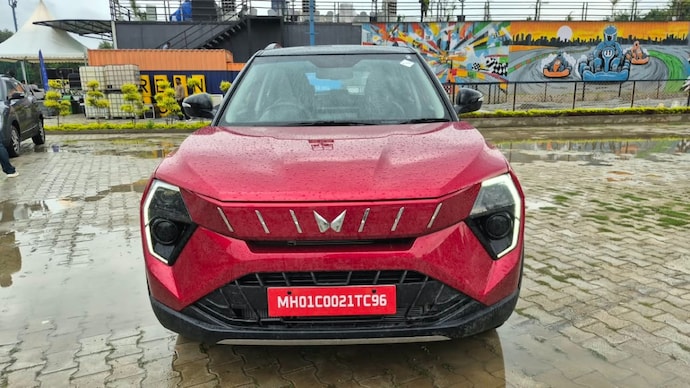

Mahindra's first mainstream CNG SUV, the XUV 3XO ZNG, starts at ₹9.99 lakh with 24.7 km/kg ARAI efficiency, 82 kW turbo power and a twin-cylinder underfloor CNG system preserving 270 litres of boot space.
Mahindra XUV 3XO ZNG CNG SUV Launched at ₹9.99 Lakh in India 2026: 24.7 km/kg Mileage and Running Cost vs Maruti Brezza CNG
Mahindra's first mainstream factory-fitted CNG passenger vehicle, the XUV 3XO ZNG, arrived on 15 October 2026 with a starting price of ₹9.99 lakh (ex-showroom) across four variants up to ₹12.27 lakh. The 1.2-litre mStallion TCMPFi turbocharged engine produces 82 kW (approximately 113 hp) and 200 Nm of torque in both CNG and petrol modes, with an ARAI-certified CNG efficiency of 24.7 km/kg — putting it squarely in competition with the Maruti Suzuki Brezza CNG and Tata Nexon iCNG in India's fast-growing compact SUV CNG segment.
The table below compares the three main factory-fitted CNG compact SUVs available to Indian buyers in late 2026.
| Feature | Mahindra XUV 3XO ZNG | Maruti Suzuki Brezza S-CNG | Tata Nexon iCNG |
|---|---|---|---|
| CNG kit type | Factory-fitted | Factory-fitted (S-CNG) | Factory-fitted (iCNG) |
| Engine | 1.2L turbo (mStallion TCMPFi) | 1.5L naturally aspirated K15C | 1.2L turbo Revotron |
| Power (CNG mode) | 82 kW / 200 Nm | ~77 PS / 136.8 Nm | ~100 PS / ~170 Nm (est.) |
| ARAI CNG efficiency | 24.7 km/kg (manufacturer claim) | ~25.51 km/kg (ARAI claim) | ~24 km/kg (ARAI claim) |
| CNG cylinder setup | Twin-cylinder (underfloor) | Single-cylinder (boot) | Twin-cylinder (underfloor) |
| Usable boot space (CNG) | 270 litres (flat floor) | ~108 litres (significantly reduced) | ~240 litres (approx.) |
| Starting CNG variant price | ₹9.99 lakh (ex-showroom) | ~₹9.40 lakh (ex-showroom, est.) | ~₹10.00 lakh (ex-showroom, est.) |
| 0–60 km/h (CNG mode) | 4.9 seconds (manufacturer claim) | Not claimed | Not claimed |
| Bharat NCAP rating | 5-star (base XUV 3XO) | Not rated under Bharat NCAP | 5-star |
| Automatic gearbox option | No (6-speed MT only) | No (5-speed MT only) | No (6-speed MT only) |
Prices and efficiency figures for Brezza CNG and Nexon iCNG are approximate/ARAI claims as of October 2026. Always verify current ex-showroom prices at the respective brand's official website before purchase.
What exactly is the XUV 3XO ZNG, and how does it differ from the standard XUV 3XO?
The XUV 3XO ZNG is a dedicated CNG derivative of the XUV 3XO compact SUV, built as a factory-integrated bi-fuel vehicle rather than a dealer-fitted aftermarket conversion. Mahindra engineered the ZNG from the ground up with CNG-specific calibration, turbocharger mapping and cylinder packaging — all handled at the factory, not by a third-party installer. This distinction matters for warranty: factory-fitted CNG systems carry manufacturer coverage, whereas dealer-fitted or aftermarket kits can void the OEM powertrain warranty.
A ZNG badge adorns the tailgate, but the real changes lie beneath. The 1.2-litre mStallion engine has been recalibrated with revised turbocharger mapping and a first-in-segment 10-bar CNG injection pressure system that Mahindra credits with improving combustion quality and fuel delivery responsiveness. Twin CNG cylinders mount beneath the luggage floor rather than inside the boot, preserving a flat loading surface and 270 litres of usable cargo space.
The standard XUV 3XO spans petrol, diesel and electric powertrains. The ZNG adds CNG to that lineup but comes exclusively with a six-speed manual gearbox — no automatic option exists in the CNG range, a genuine limitation for urban buyers preferring automatics.
What are the XUV 3XO ZNG variants and prices?
The XUV 3XO ZNG spans four variants between ₹9.99 lakh and ₹12.27 lakh (all ex-showroom):
- MX Edge ZNG — ₹9.99 lakh
- RevX Edge (O) ZNG — ₹10.79 lakh
- AX5 ZNG — ₹11.19 lakh
- RevX A ZNG — ₹12.27 lakh
The entry MX Edge variant avoids being stripped down. Standard equipment includes a 26.03 cm HD touchscreen, cruise control, rear AC vents, a 60:40 split-folding rear seat and six airbags. Moving up the range adds features such as a Skyroof panoramic sunroof, a 10.25-inch digital instrument cluster, dual-zone climate control, Dolby Atmos audio, black leatherette seats, a 360-degree camera and R16 painted black alloy wheels.
Bookings opened on 20 October 2026 through authorised Mahindra dealerships and the company's website, with deliveries beginning the same date. Test drives commenced on 15 October 2026.
How does the 24.7 km/kg efficiency translate into real running costs?
The CNG case becomes concrete when you do the math. Using Delhi CNG pump prices as a reference point (approximately ₹75–76 per kg as of late 2026, though prices vary by city and are revised periodically by state governments), the numbers break down as follows:
XUV 3XO ZNG on CNG (ARAI claim: 24.7 km/kg):
- Cost per km on CNG = ₹75 ÷ 24.7 = approximately ₹3.04 per km
XUV 3XO petrol equivalent (assume ~14 km/l ARAI, petrol at ~₹95/l in Delhi):
- Cost per km on petrol = ₹95 ÷ 14 = approximately ₹6.79 per km
That translates to a saving of roughly ₹3.75 per km on CNG versus petrol — or about ₹5,625 per month for a driver covering 1,500 km monthly. Over a year, that is approximately ₹67,500 in fuel savings, which meaningfully offsets the premium that CNG variants typically carry over their petrol counterparts.
Several important caveats apply: the 24.7 km/kg figure is Mahindra's certified efficiency claim, not a real-world test result. Real-world CNG mileage on any car typically runs 15–20% lower than ARAI figures, depending on traffic conditions, air-conditioning load, driving style and CNG pump pressure (low pump pressure reduces effective fill and apparent efficiency). Independent road tests of the ZNG had not been published at the time of this article's writing; treat the 24.7 km/kg as an upper-bound reference.
CNG prices also differ significantly across Indian cities. Mumbai and Pune tend to be lower than Delhi; cities without piped gas infrastructure can have higher prices or no CNG stations at all. For buyers in Tier 2 and Tier 3 cities with limited CNG infrastructure, the running-cost advantage shrinks considerably — and the dual-fuel petrol fallback becomes more important.
How does the XUV 3XO ZNG compare with the Maruti Brezza CNG on running costs?
The Maruti Suzuki Brezza S-CNG holds the incumbent position in the CNG compact SUV segment with a strong case on paper. Maruti claims approximately 25.51 km/kg for the Brezza S-CNG — marginally better than the ZNG's 24.7 km/kg on the ARAI cycle. Using the same Delhi CNG price of ₹75/kg:
- Brezza S-CNG cost per km = ₹75 ÷ 25.51 ≈ ₹2.94 per km
- XUV 3XO ZNG cost per km = ₹75 ÷ 24.7 ≈ ₹3.04 per km
The difference amounts to about 10 paise per km — negligible in daily use and well within the margin of real-world variation. Performance and packaging matter more in practice.
The Brezza S-CNG uses Maruti's 1.5-litre naturally aspirated K15C engine, producing around 77 PS in CNG mode — noticeably less than the ZNG's 82 kW (approximately 113 hp). Its single-cylinder CNG unit mounts inside the boot, which reduces usable boot space substantially — typically to around 108 litres, compared to the ZNG's 270 litres with its underfloor twin-cylinder setup. That is a real-world compromise that Brezza CNG owners navigate every day.
The Brezza's advantage lies in maturity. Maruti's S-CNG badge represents a proven system with an extensive service network across India, including Tier 2 and Tier 3 cities. Mahindra's ZNG is a first-generation CNG product for the brand, and long-term reliability data does not yet exist. Maruti's dealership density — over 3,500 outlets nationally — also means servicing convenience that Mahindra's network, while growing, has not yet matched in every pocket of the country.
The Brezza S-CNG carries no Bharat NCAP rating, though Maruti's Global NCAP history with the Brezza offers some safety confidence. The ZNG, built on the 5-star Bharat NCAP-rated XUV 3XO platform, has a clearer safety credential — though Mahindra notes that the 5-star rating is for the base XUV 3XO and should not automatically be assumed to extend to the CNG variant without independent confirmation.
What is the twin-cylinder CNG system, and why does it matter for boot space?
A twin-cylinder CNG system uses two smaller cylinders in place of one large one, allowing packaging in spaces a conventional cylinder cannot occupy — typically beneath the floor of the luggage area or under the vehicle body. This contrasts with single-cylinder setups, which typically mount upright or horizontally inside the boot, consuming significant cargo space.
Mahindra's twin-cylinder setup in the XUV 3XO ZNG positions the cylinders beneath the luggage area, with the spare wheel mounted under the body. The result is a flat loading floor and 270 litres of usable boot space — competitive with the petrol version of the XUV 3XO and far ahead of the Brezza S-CNG's boot capacity in CNG configuration.
Tata's iCNG system in the Nexon iCNG employs the same twin-cylinder underfloor arrangement, making it a direct technological peer to the ZNG. Both approaches solve the same problem: preserving cargo utility in a CNG SUV. The Brezza S-CNG, using a single-cylinder setup, has not adopted this approach, which remains its most significant practical disadvantage versus both the ZNG and the Nexon iCNG.
One trade-off to consider: the combined capacity of two smaller cylinders may be slightly less than a single large cylinder, which can affect total CNG range per fill. Mahindra has not published the total CNG tank capacity in kg for the ZNG at the time of writing; this figure should be confirmed at the dealership before purchase, as it directly affects how often you need to stop for CNG.
How does the turbocharged CNG engine perform versus naturally aspirated rivals?
Most CNG cars in India use naturally aspirated engines, where CNG operation typically results in a 10–15% power drop compared to petrol mode — a well-known limitation of port-injected CNG systems. The XUV 3XO ZNG departs from this pattern.
Mahindra's 1.2-litre mStallion TCMPFi engine delivers identical 82 kW power and 200 Nm torque in both CNG and petrol modes, achieved through revised turbocharger calibration and ECU mapping. The 10-bar CNG injection pressure system — which Mahindra claims is a first in its segment — plays a central role: higher injection pressure improves the charge density and combustion quality of CNG, helping the turbocharged engine compensate for CNG's lower energy density compared to petrol.
The claimed 0–60 km/h time of 4.9 seconds in CNG mode is genuinely quick for a factory CNG car. The Brezza S-CNG with its naturally aspirated engine does not publish a 0–60 figure, but its real-world acceleration in CNG mode is noticeably leisurely. The Nexon iCNG, also turbocharged, is a closer performance peer.
The 200 Nm torque figure, available from 1,500–3,500 rpm, is what Mahindra calls best-in-class among CNG passenger vehicles in India. This broad torque band proves particularly useful in city traffic, where CNG cars see the most use.
All performance figures cited here are manufacturer claims. Independent road tests had not been conducted and published at the time of writing. Real-world performance in CNG mode, particularly at high altitudes or in extreme heat, may differ from the manufacturer's numbers.
What safety features does the XUV 3XO ZNG offer, and how CNG-specific are they?
Six airbags, Electronic Stability Control (ESC) and ISOFIX child-seat mounts are standard across all four variants — not just the top trim. This represents a meaningful commitment in a segment where some rivals reserve ESC for higher variants.
CNG-specific safety provisions include an integrated gas-leak detection system that can identify a leak and automatically switch the engine to petrol mode. This is an important safety measure: CNG is flammable, and a leak in an enclosed space (such as a parking garage) poses a genuine hazard. The automatic switch to petrol mode also means the car does not simply cut out if a leak is detected — it continues to run on petrol, allowing the driver to safely exit traffic.
The XUV 3XO ZNG also features automatic switching to petrol when CNG levels run low, preventing unexpected stalling. An NGV (Natural Gas Vehicle) fast-filling valve is included for quicker refuelling at compatible CNG stations.
The base XUV 3XO has received a 5-star Bharat NCAP rating for both Adult Occupant Protection and Child Occupant Protection. However, as India Today's coverage correctly notes, this rating is for the standard XUV 3XO and should not automatically be treated as confirmed for the CNG variant without independent Bharat NCAP testing of the ZNG specifically. Buyers should watch for an official Bharat NCAP test of the ZNG variant.
What features do you get across the variant range?
The XUV 3XO ZNG's feature spread is one of its stronger selling points. The entry MX Edge ZNG at ₹9.99 lakh includes:
- 26.03 cm HD touchscreen infotainment
- Cruise control
- Rear AC vents
- 60:40 split-folding rear seat
- Six airbags, ESC, ISOFIX
- Push-button start-stop
- Rear wiper
- Height-adjustable front seat belts
- Three-point seat belts for all occupants
- Reverse parking sensors
Higher variants progressively add:
- Twin 26.03 cm screens (infotainment + digital instrument cluster)
- Skyroof panoramic sunroof
- 360-degree camera
- Tyre pressure monitoring system (TPMS)
- Dual-zone climate control
- Dolby Atmos audio system
- Black leatherette upholstery
- Front and rear armrests
- Connected LED tail lamps
- R16 painted black alloy wheels
- Dual-tone roof and gunmetal grey grille options
The top RevX A ZNG at ₹12.27 lakh is the most comprehensively equipped CNG compact SUV available in India at this price point. Whether buyers need all of this equipment in a CNG car — which is primarily bought for running-cost efficiency — remains a personal decision, but the option exists.
Who is the XUV 3XO ZNG competing against, and where does it win or lose?
The compact CNG SUV segment now has three serious factory-fitted contenders: the XUV 3XO ZNG, the Maruti Brezza S-CNG and the Tata Nexon iCNG. Each brings distinct strengths.
Where the XUV 3XO ZNG wins:
- Highest torque (200 Nm) among CNG compact SUVs in India, per Mahindra's claim
- Identical power output in CNG and petrol modes — no performance penalty for choosing CNG
- Best boot space retention (270 litres with flat floor) among CNG compact SUVs
- 5-star Bharat NCAP platform (base XUV 3XO)
- Richest feature set at each price point
- First-in-segment 10-bar CNG injection pressure
Where the XUV 3XO ZNG faces challenges:
- No automatic gearbox option — a significant gap for urban buyers
- Mahindra's CNG is a first-generation product; long-term reliability is unproven
- Mahindra's service network, while growing, is less dense than Maruti's in smaller cities
- The 5-star NCAP rating has not been independently confirmed for the ZNG variant specifically
- Total CNG tank capacity (in kg) was not published at launch — affects range planning
- Real-world mileage from independent tests was not available at the time of writing
Maruti Brezza S-CNG remains the choice for buyers prioritising service network reach, Maruti's proven S-CNG reliability track record and the lowest possible entry price. Its boot space compromise and lower power in CNG mode are genuine weaknesses, but Maruti's ownership experience — particularly in cities outside the top 10 metros — is hard to match.
Tata Nexon iCNG is the closest technological peer to the ZNG, with a turbocharged engine and twin-cylinder underfloor packaging. It competes at a similar price point and offers Tata's iCNG twin-cylinder advantage. Buyers choosing between the Nexon iCNG and the ZNG will largely be deciding on brand preference, feature preferences and dealership experience.
Should you buy the XUV 3XO ZNG now, or wait for real-world test data?
This is a legitimate question for a first-generation CNG product from a manufacturer that has not previously offered factory-fitted CNG in the mainstream passenger vehicle segment.
The XUV 3XO ZNG's specifications are genuinely impressive: the turbocharged engine with no CNG power penalty, the twin-cylinder underfloor packaging, the 270-litre boot space and the 5-star platform are all real advantages over the Brezza S-CNG. The 24.7 km/kg ARAI efficiency claim, if it holds up to within 15–20% in real-world use, translates to a running cost of roughly ₹3.50–3.60 per km on CNG in Delhi — still meaningfully cheaper than petrol.
The risks are also real. Mahindra has no track record with factory CNG systems. The 10-bar injection pressure system is new technology in this segment. The absence of an automatic gearbox limits the car's appeal for stop-start city commuting. And the service network, while adequate in major cities, may leave buyers in smaller towns with fewer options.
For buyers in metro cities with good CNG infrastructure and Mahindra dealership access, the XUV 3XO ZNG is a compelling proposition — particularly the AX5 ZNG at ₹11.19 lakh, which hits a sweet spot of features and price. For buyers in cities with patchy CNG availability or limited Mahindra service presence, the Brezza S-CNG's network advantage may outweigh the ZNG's performance and space benefits.
Mahindra's cumulative XUV 3XO sales crossing 2.5 lakh units in under 2.5 years suggests a healthy parts and service infrastructure is already in place for the platform — the CNG-specific components remain the unknown variable.
For the most up-to-date comparison of CNG compact SUVs in India, see our guide to Best SUVs With a CNG Option Under 30 Lakh in India and Best CNG Compact SUVs Under ₹10 Lakh in India.
Key specifications summary
| Specification | Detail |
|---|---|
| Engine | 1.2L mStallion TCMPFi turbocharged |
| Power | 82 kW (approx. 113 hp) in CNG and petrol modes |
| Torque | 200 Nm (1,500–3,500 rpm) in CNG and petrol modes |
| Gearbox | 6-speed manual only |
| CNG efficiency (ARAI claim) | 24.7 km/kg |
| CNG system | Factory-fitted twin-cylinder, underfloor |
| CNG injection pressure | 10 bar (first-in-segment, per Mahindra) |
| Boot space (CNG) | 270 litres (flat floor) |
| 0–60 km/h (CNG mode) | 4.9 seconds (manufacturer claim) |
| 0–100 km/h (CNG mode) | 11.8 seconds (manufacturer claim) |
| Safety | 6 airbags, ESC, ISOFIX, gas-leak detection (all variants) |
| NCAP | 5-star Bharat NCAP (base XUV 3XO platform) |
| Price range | ₹9.99 lakh – ₹12.27 lakh (ex-showroom) |
| Bookings/Deliveries | From 20 October 2026 |
All performance and efficiency figures are manufacturer claims (ARAI certified where stated). Real-world results will vary.
Sources
- Mahindra Unveils XUV 3XO ZNG CNG SUV Starting at ₹9.99 Lakh, ETAuto
- Mahindra launches XUV 3XO ZNG — Official Press Release, Mahindra Newsroom
- Mahindra XUV 3XO ZNG bookings open tomorrow: Price, mileage & more, Times of India
- Mahindra XUV 3XO CNG: Know the fuel efficiency, performance and other details, India Today
- Mahindra XUV 3XO ZNG Official PDF Press Kit, Mahindra
- Best SUVs With a CNG Option Under 30 Lakh in India (2026), AutoForumIndia
- Best CNG Compact SUVs Under ₹10 Lakh in India, AutoForumIndia