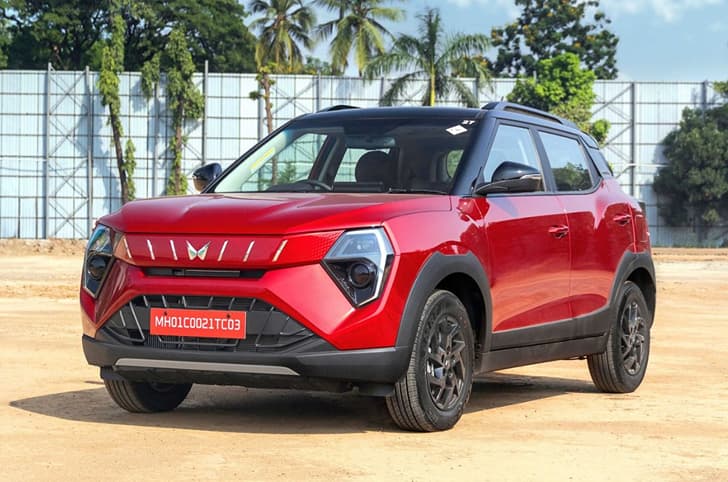

The XUV 3XO CNG leads the compact CNG SUV segment on power (111 hp) and mileage claim (24.7 km/kg) but loses on boot space (270 L), trim choice, and gearbox options.
The Mahindra XUV 3XO CNG — officially called the XUV 3XO ZNG — is priced from ₹9.99 lakh to ₹12.27 lakh (ex-showroom) and claims an ARAI-certified 24.7 km/kg on CNG, which Mahindra positions as the highest figure in the compact CNG SUV segment. It carries a factory-fitted CNG kit, not a dealer-fitted aftermarket unit, which means the warranty remains intact and the system is integrated at the ECU level. Whether that headline figure and the segment-first power output justify the purchase over the Tata Nexon iCNG or the Maruti Brezza CNG depends on what you prioritise.
How does the XUV 3XO CNG compare with the Nexon iCNG and Brezza CNG at a glance?
| Feature | Mahindra XUV 3XO ZNG | Tata Nexon iCNG | Maruti Brezza CNG |
|---|---|---|---|
| CNG kit type | Factory-fitted | Factory-fitted | Factory-fitted (S-CNG) |
| Engine output (CNG mode) | 111 hp / 200 Nm | ~100 hp / ~170 Nm (approx.) | 88.5 hp / 121.5 Nm |
| ARAI CNG mileage claim | 24.7 km/kg | ~24 km/kg (approx.) | 25.51 km/kg |
| Price range (CNG, ex-showroom) | ₹9.99 L – ₹12.27 L | ₹10.00 L – ₹13.00 L (approx.) | ₹9.40 L – ₹12.00 L (approx.) |
| Boot space (CNG variant) | 270 litres | ~350 litres (twin-cylinder iCNG) | ~318 litres (approx.) |
| CNG cylinder setup | Twin, under boot floor | Twin (iCNG) | Single, in boot |
| Gearbox options | 6-speed MT only | 6-speed MT only | 5-speed MT only |
| Top trim available in CNG | Mid-spec (RevX A) | Higher trims available | Mid-spec trims |
| 360-degree camera | Not on CNG trims | Available on iCNG | Not standard |
| Ventilated front seats | No | Available on iCNG | No |
Note: Nexon iCNG and Brezza CNG figures are approximate or manufacturer-claimed where exact ARAI data was not available in the research bundle. Brezza CNG mileage is Maruti S-CNG ARAI claim. Always verify current pricing at the dealership.
The Maruti Brezza CNG is a factory-fitted S-CNG model, meaning Maruti Suzuki installs the CNG system at the plant, preserving the full manufacturer warranty — the same assurance Mahindra offers with the ZNG. The Brezza CNG's 25.51 km/kg ARAI claim edges the XUV 3XO ZNG's 24.7 km/kg, but the Brezza achieves this with a naturally aspirated 1.5-litre engine producing considerably less power. The XUV 3XO ZNG's turbocharged setup becomes a meaningful differentiator for buyers who want CNG economy without sacrificing drivability.
For a broader look at your options, see our guide to the best SUVs with a CNG option under 30 lakh in India (2026) and our roundup of best CNG compact SUVs under ₹10 lakh.
What makes the XUV 3XO CNG's engine genuinely different from rivals?
The XUV 3XO ZNG uses Mahindra's 1.2-litre mStallion TCMPFi turbocharged petrol engine — the same unit found in the lower and mid-spec petrol trims of the XUV 3XO. It develops 111 hp and 200 Nm of torque in both petrol and CNG modes. That is the key claim: no power drop when running on gas.
Most CNG cars — including the Brezza CNG — suffer a noticeable power deficit in CNG mode because naturally aspirated engines lose volumetric efficiency when running on a gaseous fuel. The XUV 3XO ZNG sidesteps this by using a 10-bar CNG injection system with optimised turbocharger calibration and ECU mapping. The turbo compensates for the lower energy density of CNG by forcing more charge into the cylinders.
There is some turbo lag below 2,000 rpm, which matters in real-world driving. Below that threshold, the engine can feel sluggish — particularly relevant in stop-start city traffic where CNG use is most economical. Once past 2,000 rpm, the engine pulls eagerly and the transition between petrol and CNG modes is described as smooth. Few drivers would be able to tell which fuel the car is running on at any given moment.
Mahindra also claims a 0–100 km/h time of 11.8 seconds in CNG mode, per the XUV 3XO specifications page on Autocar India. That is a manufacturer claim, not an independently tested figure.
What does the running cost arithmetic actually look like?
Running cost is defined as the fuel expenditure per kilometre driven, calculated using the prevailing CNG price, the ARAI mileage claim, and a comparison with the petrol equivalent.
Using Delhi CNG prices as a reference (approximately ₹75 per kg as of mid-2026, though prices vary by city and change frequently):
- XUV 3XO ZNG on CNG: ₹75 ÷ 24.7 km/kg = approximately ₹3.04 per km (ARAI claim)
- XUV 3XO petrol (1.2 MPFI, ~17.96 km/l ARAI): At ₹96/litre petrol = approximately ₹5.35 per km
- Brezza CNG (25.51 km/kg ARAI): ₹75 ÷ 25.51 = approximately ₹2.94 per km
The Brezza CNG edges the XUV 3XO ZNG on pure running cost by about 10 paise per km — a small margin that adds up to roughly ₹1,000 per 10,000 km. The XUV 3XO ZNG's ₹1–1.2 lakh premium over its petrol equivalent means the CNG payback period depends on annual mileage. At 20,000 km per year, the fuel saving versus petrol is approximately ₹46,200 annually, meaning the CNG premium is recovered in roughly 2.5 years — a reasonable proposition for high-mileage urban commuters.
These are ARAI claims, not real-world figures. Real-world CNG mileage typically runs 10–15% lower than ARAI numbers, and CNG prices vary significantly between cities — Mumbai, Pune, and Ahmedabad tend to have lower CNG prices than Delhi, while smaller towns may have fewer CNG stations altogether.
Is the ride and handling actually better than rivals?
The CNG hardware adds approximately 100 kg to the XUV 3XO's kerb weight, with most of that mass concentrated over the rear axle because of the twin cylinders positioned beneath the boot floor. Mahindra has reworked the suspension specifically to compensate for this added weight. The result is a slightly firmer ride than the standard petrol XUV 3XO, but one that handles bad roads competently.
The 16-inch wheels with high-profile tyres help absorb sharp bumps — a deliberate choice that sacrifices some visual flair for ride quality. Three steering modes (Normal, Comfort, Sport) give drivers flexibility, and the car reportedly feels planted around corners despite the extra rear weight.
This is a genuine strength relative to rivals. The Brezza CNG, with its single CNG cylinder mounted in the boot, does not require the same suspension rework, but the single-cylinder setup means the Brezza's boot intrusion is more visible (the cylinder sits in the cargo area rather than beneath the floor). The XUV 3XO ZNG's twin-cylinder-under-floor arrangement is more elegant in packaging terms, even if the 270-litre result is still the smallest boot in the segment.
How good is the cabin, and what features does the CNG version actually get?
The interior of the XUV 3XO ZNG is largely identical to the standard petrol versions at equivalent trim levels. The CNG switch mounted next to the steering wheel is the most obvious addition. The top-spec RevX A trim — priced at ₹12.27 lakh — gets twin 10.25-inch screens (infotainment and digital instrument cluster), a panoramic sunroof, leatherette seats, a 6-speaker Dolby Atmos audio system, connected LED tail lamps, and a push-button start. Safety equipment across all CNG variants includes 6 airbags, electronic stability control, ABS with EBD, four-wheel disc brakes, ISOFIX child-seat mounts, and an integrated gas-leak detection system that automatically switches the engine to petrol mode if a leak is detected.
Mahindra says the CNG version is engineered to match the five-star Bharat NCAP rating of the standard combustion XUV 3XO — though this is a manufacturer claim, not a separately tested CNG-specific result.
The rear seat is genuinely spacious for the class and can accommodate three adults without significant discomfort. The dual-tone dashboard and gloss black accents give the cabin a premium feel that is above average for this price point.
What are the honest weaknesses buyers need to know before deciding?
Boot space is the most significant compromise. The standard XUV 3XO already had the smallest boot in the compact SUV segment at 295 litres. The ZNG reduces that further to 270 litres. The spare wheel has been relocated under the body to free up floor space, and the twin cylinders sit beneath the boot floor rather than inside it — which is why the loading floor remains flat. But 270 litres is still tight. Only the boot's width saves it, allowing up to four cabin-sized bags. Families who regularly carry luggage for multiple people will feel this constraint.
Ergonomic niggles are real. The front seats lack ventilation — a notable omission given India's climate and the fact that the Nexon iCNG offers ventilated seats on higher trims. The leatherette upholstery will heat up quickly on sunny days. The steering wheel has no reach adjustment, which makes finding a comfortable driving position harder for taller or shorter drivers. The driver's footwell is cramped and there is no dead pedal — a fatigue factor on long drives. These are not deal-breakers, but they are daily irritants that rivals handle better.
Trim and feature limitations are a structural problem. The XUV 3XO ZNG is sold in only four variants — MX Edge (₹9.99 lakh), RevX Edge O (₹10.79 lakh), AX5 (₹11.19 lakh), and RevX A (₹12.27 lakh) — all of which sit in the mid-spec range of the broader XUV 3XO lineup. This means no 360-degree camera, no ventilated seats, and no wireless charging pad on the CNG version, even though these features are available on the Nexon iCNG. There are also no fog lamps on any CNG variant. The gearbox is a 6-speed manual only; no automatic option exists for the ZNG. The manual itself has long throws and significant clutch travel, which will be tiring in heavy city traffic where CNG makes the most economic sense.
How does the Brezza CNG's value compare in detail?
The Maruti Brezza CNG is a factory-fitted S-CNG model — Maruti Suzuki installs the CNG system at the manufacturing stage, which preserves the full warranty and ensures the system is calibrated to the car's ECU from the outset. This is the same assurance the XUV 3XO ZNG offers, and both are preferable to dealer-fitted aftermarket kits that can void warranties and vary in quality.
Where the Brezza CNG differs meaningfully is in its engine character. The 1.5-litre naturally aspirated K-series engine produces 88.5 hp and 121.5 Nm in CNG mode — substantially less than the XUV 3XO ZNG's 111 hp and 200 Nm. For buyers who do most of their driving in the city at moderate speeds, this power gap matters less. For those who regularly use expressways or need confident overtaking ability, the XUV 3XO ZNG's turbocharged setup is a clear advantage.
The Brezza CNG's 25.51 km/kg ARAI claim is slightly better than the ZNG's 24.7 km/kg, translating to a marginally lower running cost per kilometre. The Brezza also tends to offer a larger effective cargo area in its CNG configuration because its single cylinder sits in the boot rather than under the floor — but this comes at the cost of a less flat loading surface and visible intrusion into the cargo space.
The Brezza CNG's pricing is competitive and Maruti's service network is the widest in India — a practical advantage in smaller cities and towns where Mahindra's service reach is thinner. For buyers in Tier 2 and Tier 3 cities, this is a genuine consideration.
What about CNG station availability and the practical reality of running a CNG car?
CNG infrastructure in India is defined as the network of compressed natural gas dispensing stations operated primarily by city gas distribution companies under the Petroleum and Natural Gas Regulatory Board (PNGRB) framework. As of 2026, CNG is well-established in major metros — Delhi-NCR, Mumbai, Pune, Ahmedabad, Surat, Hyderabad — but coverage thins significantly outside these corridors.
The XUV 3XO ZNG has a 10-kg CNG tank capacity (twin cylinders), giving a theoretical CNG range of approximately 247 km at the ARAI-claimed 24.7 km/kg. When the CNG runs out, the car automatically switches to petrol — the 42-litre petrol tank provides a backup range. This dual-fuel capability is the defining practical advantage of any factory-fitted CNG car: you are never stranded, even in areas without CNG stations.
For buyers who live and commute within a well-served CNG city, the ZNG's economics are compelling. For buyers who frequently travel to smaller towns or on highways where CNG stations are sparse, the petrol backup matters more than the CNG mileage figure.
Who should buy the XUV 3XO ZNG, and who should look elsewhere?
The XUV 3XO ZNG makes the most sense for someone who commutes daily in a metro or large city with good CNG infrastructure, values performance on gas (the 111 hp figure is genuinely class-leading), and wants a premium cabin feel without paying diesel prices. The five-star Bharat NCAP safety rating, the factory-fitted CNG kit with its warranty assurance, and the retuned suspension that handles the extra weight well are all genuine strengths.
It is a harder sell if you regularly carry luggage for a family of four or five — 270 litres is tight. It is also a harder sell if you want an automatic gearbox (none available), top-spec features like a 360-degree camera or ventilated seats (not offered on CNG trims), or if your daily driving involves a lot of low-speed crawling where the turbo lag below 2,000 rpm will be a constant companion.
The Nexon iCNG is the better choice if features and trim flexibility matter more than outright CNG performance. The Brezza CNG is the better choice if running cost optimisation, Maruti's service network, and a lower entry price are the priorities — though buyers accept a significant power compromise in exchange.
For buyers still weighing CNG options more broadly, our 5 best CNG cars in India (2026) guide covers the full spectrum from hatchbacks to SUVs, and the best CNG compact SUVs under ₹10 lakh is worth reading if the MX Edge variant's entry price is the ceiling.
The XUV 3XO ZNG is a well-engineered first attempt at a performance-oriented CNG compact SUV. Mahindra has solved the power-drop problem that plagues most CNG cars, packaged the cylinders intelligently under the boot floor, and retuned the suspension to handle the extra weight. The compromises — boot space, ergonomics, trim restrictions, manual-only gearbox — are real and should not be glossed over. Whether those trade-offs are acceptable depends entirely on how you use the car every day.
Sources
- 3 reasons to buy the Mahindra XUV 3XO CNG and 3 reasons not to | Autocar India
- Mahindra XUV 3XO CNG launched: Price, changes in most powerful CNG car in segment | Times of India
- Mahindra takes on Tata, Maruti in CNG SUV race with XUV 3XO | The Hindu BusinessLine
- Mahindra XUV 3XO Specifications (2026) | Autocar India
- Mahindra XUV 3XO — Official Model Page | Mahindra
- Best SUVs With a CNG Option Under 30 Lakh in India (2026) | AutoForumIndia
- Best CNG Compact SUVs Under ₹10 Lakh in India | AutoForumIndia
- 5 Best CNG Cars in India (2026) | AutoForumIndia