
Hyundai's Bayon (codenamed Bc4i) will launch in India in festive season 2026 with a 1.5L NA petrol engine and a factory-fitted CNG variant with underbody tank arriving shortly after, priced ₹9–14 lakh.
Hyundai's Bayon is confirmed to launch in India during the 2026 festive season at an expected price of ₹9 lakh to ₹14 lakh (ex-showroom), powered by a 1.5-litre naturally aspirated petrol engine paired with manual and CVT (iVT) gearboxes — and a factory-fitted CNG variant with an underbody-mounted tank is set to follow shortly after, according to Autocar India. No diesel or hybrid powertrain is planned for this model.
This makes the Bayon the first Hyundai SUV over four metres in length to offer CNG power. Until now, Hyundai's CNG lineup in India has been limited to sub-4-metre models — the Exter, Grand i10 Nios, and Aura. The Bayon, at approximately 4.18 metres in length, changes that calculus entirely.
For buyers in the compact-to-midsize SUV segment who want factory-fitted CNG, the Bayon will arrive into a market where only one rival currently occupies that space: the Maruti Suzuki Victoris. The Maruti Suzuki Fronx CNG, meanwhile, is the direct sub-4-metre compact SUV rival from Maruti's S-CNG stable. Here is how the key CNG players in and around this segment compare on the data we have today:
| Model | Engine | CNG Mileage (ARAI, km/kg) | CNG Kit Type | Approx. CNG Variant Price (ex-sh.) | Boot Space Trade-off | Key Weakness |
|---|---|---|---|---|---|---|
| Hyundai Bayon CNG (expected) | 1.5L NA petrol | Not yet rated | Factory-fitted, underbody tank | ~₹12–14 lakh (estimated) | Spare wheel retained (underbody tank) | Specs/pricing unconfirmed; CVT not confirmed for CNG variant |
| Maruti Suzuki Fronx CNG (S-CNG) | 1.2L NA (K-Series) | ~28.51 km/kg | Factory-fitted, single cylinder in boot | ~₹9.5–10.5 lakh | Reduced boot space (~40L usable) | No automatic option on CNG; lower highway punch |
| Maruti Suzuki Victoris CNG (S-CNG) | 1.5L NA | ~26.68 km/kg | Factory-fitted, underbody kit | ~₹13–15 lakh | Boot space retained; no spare wheel | No spare wheel; limited variant choice on CNG |
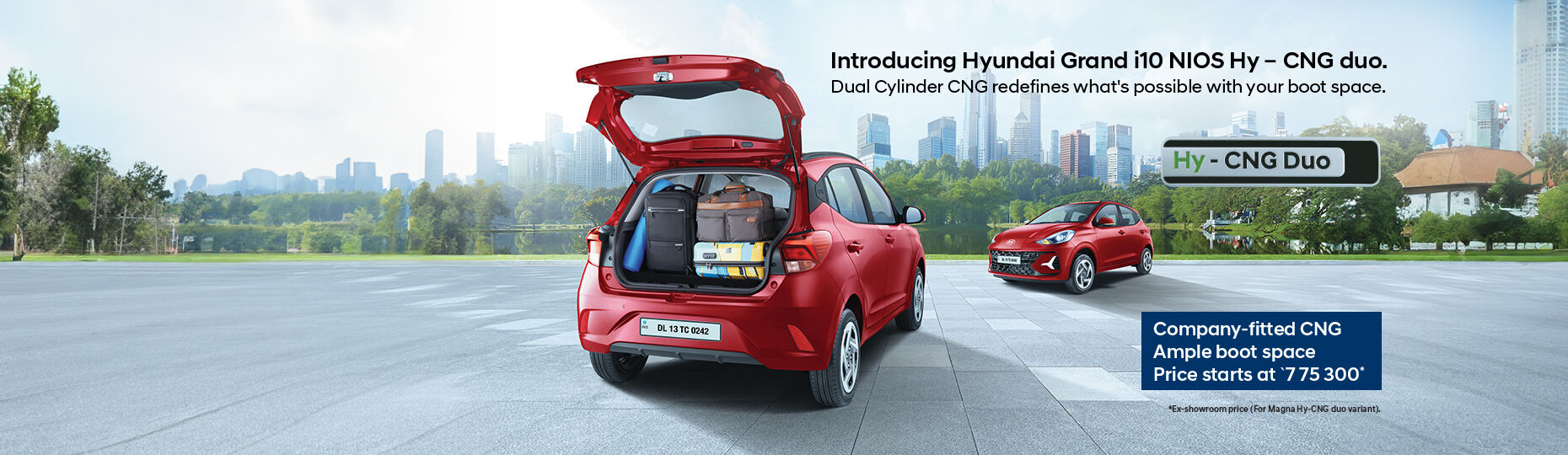
| Hyundai Grand i10 Nios Hy-CNG Duo | 1.2L NA | ~24 km/kg (ARAI claim) | Factory-fitted, dual cylinder | ~₹7.5–8.5 lakh | Better than single-cylinder rivals | Hatchback segment; not an SUV |
| Tata Nexon iCNG | 1.2L turbo petrol | ~24 km/kg (ARAI) | Factory-fitted, twin cylinder in boot | ~₹10.5–12 lakh | Twin cylinders reduce boot depth | Turbo CNG is rare; some reliability questions remain |
All CNG mileage figures are manufacturer ARAI claims. Real-world figures are typically 15–20% lower. Bayon CNG pricing and mileage are estimates pending official announcement.
What engine will the Hyundai Bayon CNG use?
The Bayon CNG is defined as a factory-fitted CNG variant of the Bayon's 1.5-litre, four-cylinder naturally aspirated petrol engine — the same unit that currently powers the Hyundai Creta in its base and mid configurations. In the Creta, this engine produces around 115 PS and 144 Nm on petrol. On CNG, output will be lower — typically 10–15% less power and torque compared to the petrol mode, a trade-off inherent to all CNG conversions regardless of brand.
Autocar India's reporting confirms that the CNG variant will get manual and CVT (iVT) gearbox options, though most CNG cars in India are currently offered only with manual gearboxes — Maruti's S-CNG lineup, for example, does not offer an automatic on any CNG variant including the Fronx. If Hyundai brings a CVT with the Bayon CNG, that would be a genuine segment first and a meaningful differentiator for city buyers who want the running-cost benefits of CNG without a manual gearbox.
This detail remains unconfirmed. The Reddit discussion around this launch flagged the same uncertainty, with some enthusiasts noting that a 1.2-litre turbo petrol — as originally rumoured — would have been a more exciting option. The 1.5L NA is the commercially pragmatic choice: it is already homologated, proven in the Creta, and easier to tune for CNG compliance.
What is the Bayon's underbody CNG tank, and why does it matter?
The underbody CNG tank is defined as a CNG storage cylinder mounted beneath the vehicle's floor — rather than inside the boot — allowing the car to retain its full cargo area and, in the Bayon's case, a spare wheel. This is a significant engineering distinction from the more common approach of placing a single or twin CNG cylinder inside the boot.
Currently, only the Maruti Suzuki Victoris offers an underbody CNG kit among SUVs in India. But the Victoris's underbody setup comes with a notable compromise: it deletes the spare wheel. Autocar India notes that the Bayon's underbody tank is expected to retain the spare wheel — which, if confirmed, would give it a meaningful practical edge over the Victoris CNG on this specific point.
For context on how boot-space trade-offs play out in practice: the Maruti Fronx CNG uses a single cylinder mounted in the boot, reducing usable cargo space to roughly 40 litres — enough for a couple of soft bags, but not a family's weekend luggage. The Tata Nexon iCNG uses twin cylinders in the boot, which similarly cuts into cargo depth. The underbody approach, if executed well, sidesteps this problem entirely.
Underbody tanks do have their own considerations. They sit lower to the ground, which can raise concerns about ground clearance on rough roads and the structural integrity of the tank in the event of a severe underbody impact. Hyundai's execution of the underbody design will be worth watching once independent tests are conducted.
How does the Bayon CNG's expected running cost compare to petrol and rivals?
Running cost arithmetic is where CNG cars make their strongest case. Using Delhi CNG prices as a reference point (approximately ₹75–78 per kg as of mid-2026), and assuming the Bayon CNG achieves a real-world figure of around 18–20 km/kg (versus an ARAI claim that may come in around 24–26 km/kg, based on comparable 1.5L NA CNG engines), the cost per km on CNG works out to roughly ₹3.75–4.33 per km.
On petrol, assuming the Bayon's 1.5L NA returns a real-world 13–15 km/l and petrol costs approximately ₹95–100 per litre in Delhi, the cost per km is around ₹6.33–7.69 per km. That is a saving of roughly ₹2.50–3.50 per km on CNG — which, over 1,500 km per month, translates to ₹3,750–5,250 in monthly fuel savings. The CNG premium over the petrol variant (typically ₹80,000–1,00,000 for factory-fitted kits) pays itself back in roughly 18–24 months for a high-mileage urban user.
Compare this to the Maruti Fronx CNG, which claims 28.51 km/kg (ARAI) — a higher figure than what the Bayon's larger 1.5L engine is likely to achieve. Real-world Fronx CNG figures tend to land around 20–22 km/kg in mixed driving. At those numbers, the Fronx CNG costs approximately ₹3.41–3.75 per km on CNG, which is marginally better than the Bayon's likely figure. However, the Fronx is a sub-4-metre car at a lower price point — buyers choosing the Bayon are paying for the extra length, features, and the underbody tank's boot-space advantage.
The Tata Nexon iCNG claims around 24 km/kg (ARAI) from its 1.2-litre turbo petrol engine on CNG — a figure that sounds impressive but comes from a smaller, lower-displacement engine. Real-world Nexon iCNG figures hover around 17–19 km/kg in city conditions.
What do we know about the Bayon's design and features?
Hyundai released the first official design sketches of the Bayon in September 2026, confirming a crossover-esque silhouette rather than a boxy, upright SUV stance. Key design elements include:
- A split headlamp setup with H-shaped LED DRLs on the upper section and main headlamps integrated into the lower bumper
- A rugged skid plate on the front fascia
- A rising window line with a distinct kink at the C-pillar
- Prominently flared wheel arches, similar to the Exter
- Functional roof rails and regular pull-type door handles
- A slim rear LED light band and a pronounced roof spoiler
The interior, based on the sketches, looks closely related to the new fourth-generation i20 that debuted in Brazil. It features twin connected screens (instrument cluster and infotainment), a central dropdown HVAC panel with physical dials and knobs, a wireless charging pad, and steering-mounted paddle shifters. Hyundai is expected to offer ADAS (advanced driver assistance systems) on higher variants — a feature that neither the Fronx CNG nor the Victoris CNG currently offers in their CNG trims.
The Bayon is codenamed Bc4i internally and will measure approximately 4.18 metres in length, slotting between the Venue (sub-4-metre) and the Creta (4.3 metres) in Hyundai's SUV lineup.
How does the Bayon CNG compare to the Maruti Fronx CNG?
The Maruti Suzuki Fronx CNG is Maruti's factory-fitted S-CNG answer in the compact SUV space, and it is the most direct rival to the Bayon CNG for buyers who prioritise running costs. The Fronx CNG uses Maruti's 1.2-litre K-Series NA engine with a single CNG cylinder mounted in the boot.
Here is where the two diverge meaningfully:
Size and positioning: The Fronx measures under 4 metres (3,995 mm), which means it qualifies for lower GST rates — a structural cost advantage that keeps its price lower. The Bayon at 4.18 metres does not get this benefit, which partly explains the higher expected price band.
Boot space: The Fronx CNG's single boot-mounted cylinder reduces usable boot space significantly — to around 40 litres, which is tight for family use. The Bayon's underbody tank, if it retains the spare wheel as reported, would offer a full-sized boot. This is a genuine quality-of-life advantage for buyers who actually use the boot.
Transmission: The Fronx CNG is only available with a 5-speed manual gearbox. The Bayon CNG may offer a CVT option — though this is not yet confirmed. If it does, it would be the only factory-fitted CNG SUV in India with an automatic gearbox.
Mileage: The Fronx CNG claims 28.51 km/kg (ARAI), which is higher than what the Bayon's 1.5L engine is likely to achieve. Buyers who prioritise pure fuel economy over features and space should factor this in.
Features: The Bayon is expected to be more generously equipped, with ADAS, twin connected screens, and wireless charging — features the Fronx CNG does not offer. Whether those features justify the price premium depends on the buyer's priorities.
The Bayon CNG's weakness lies in its larger, heavier frame with a bigger engine, which means its CNG mileage will likely trail the Fronx CNG. Its price will also be higher. And until Hyundai confirms the CVT-on-CNG detail, the transmission advantage remains speculative.
For buyers who want the best CNG compact SUV under ₹15 lakh, the Fronx CNG remains the safer, proven choice today. The Bayon CNG is the more ambitious option for buyers willing to wait and pay more.
How does the Bayon CNG compare to the Maruti Victoris CNG?
The Maruti Victoris CNG is the more direct size-for-size rival to the Bayon CNG, since both are over 4 metres and use underbody CNG tanks. The Victoris CNG uses an underbody-mounted CNG cylinder that preserves boot space but deletes the spare wheel.
The Victoris CNG claims approximately 26.68 km/kg (ARAI) — a figure derived from its 1.5-litre NA engine. Since the Bayon CNG uses the same displacement engine, their ARAI figures may end up in a similar range, though Hyundai's specific tuning and vehicle weight will determine the final number.
Where the Bayon is expected to have an edge: it reportedly retains the spare wheel with its underbody setup, which the Victoris does not. It is also expected to be more feature-rich, with ADAS and a more modern interior architecture. Hyundai's strategy is to position the Bayon as the value-focused, economy-powertrain model while the Creta handles the premium end — mirroring exactly how Maruti uses the Victoris and Grand Vitara as a two-pronged approach.
The Victoris CNG's advantage is that it is available now, with a known price, known real-world mileage data, and an established service network. The Bayon CNG is still months away from launch, and its final specifications could differ from what has been reported.
Is the Bayon CNG a good fit for CNG station availability in India?
CNG infrastructure in India is defined as the network of compressed natural gas dispensing stations operated primarily by city gas distribution (CGD) companies, concentrated in metro cities and along major national highways. As of 2026, India has over 6,500 CNG stations, with the densest coverage in Delhi-NCR, Mumbai, Pune, Ahmedabad, and Surat.
For a car like the Bayon CNG — positioned as a midsize SUV with urban and semi-urban appeal — CNG availability is a real-world constraint that buyers must evaluate based on their home city and daily commute. In Delhi, Mumbai, or Ahmedabad, CNG infrastructure is mature enough that range anxiety is minimal. In tier-2 cities or on long highway drives, the picture is less comfortable.
The underbody tank's capacity has not been officially confirmed, but comparable underbody setups (like the Victoris) typically hold around 60 litres water-equivalent of CNG. At a real-world 18–20 km/kg, that translates to a CNG range of roughly 250–300 km before needing to switch to petrol. The Bayon, like all CNG cars, is a bi-fuel vehicle — it can run on petrol when CNG is unavailable, which removes the hard range constraint but does erode the running-cost advantage on those legs.
For buyers in cities with good CNG coverage who cover 1,200–1,500 km per month, the Bayon CNG's economics are compelling. For buyers in cities with sparse CNG infrastructure, the petrol variant is the more practical choice — and the Bayon's 1.5L NA petrol with CVT is a perfectly capable everyday car on its own terms.
What are the honest weaknesses of the Hyundai Bayon CNG?
No buying guide is complete without a clear-eyed look at the downsides. Here are the Bayon CNG's weaknesses as they stand today:
Unconfirmed specifications: Almost every detail about the Bayon CNG — its ARAI mileage, exact tank capacity, whether the CVT is available on CNG, and its final variant lineup — is based on pre-launch reporting and source-based leaks. None of it is official. Buyers should treat all figures as indicative until Hyundai's official launch.
1.5L NA is not exciting: The Reddit community's reaction to the engine choice was pointed — a 1.2-litre turbo petrol would have given the Bayon a more distinctive performance identity. The 1.5L NA is smooth and refined but not quick. On CNG, with the inherent power loss, it will feel even more relaxed. Buyers who want a spirited drive should look elsewhere.
No diesel, no hybrid at launch: Hyundai has confirmed no diesel and no hybrid for the Bayon. The Creta's strong hybrid is a genuinely efficient option for high-mileage buyers who want to avoid CNG infrastructure dependence. The Bayon does not offer that choice.
Price premium over Fronx CNG: The Bayon CNG will almost certainly cost ₹2–3 lakh more than the Fronx CNG. Whether the larger boot, extra features, and potential CVT option justify that premium is a question each buyer must answer based on their priorities.
CNG station dependency: Like all CNG cars, the Bayon CNG's running-cost advantage only materialises if you can actually fill CNG regularly. In cities with thin infrastructure, the economics erode quickly.
No real-world data yet: The Fronx CNG, Nexon iCNG, and Victoris CNG all have real-world owner data available. The Bayon CNG does not — and first-generation CNG implementations sometimes have teething issues with fuel delivery, cold-start behaviour, and long-term reliability.
When will the Hyundai Bayon launch in India, and what should buyers do now?
Autocar India's September 2026 report on the Bayon's design sketches confirms a festive season 2026 launch target — which means the petrol variant could arrive by October or November 2026. The CNG variant is expected to follow "soon after," which in Hyundai's typical product cadence means three to six months post-launch.
Bookings for the Bayon have already commenced, as confirmed by Autocar India's booking report. Buyers specifically interested in the CNG variant should wait for the official CNG launch rather than booking the petrol variant and retrofitting — a dealer-fitted CNG kit on a car with a factory warranty can complicate warranty claims, and the Bayon's underbody tank design is not something a dealer-fitted kit can replicate.
For buyers who cannot wait and need a CNG SUV today, the best CNG compact SUVs under ₹20 lakh currently available include the Fronx CNG, Victoris CNG, and Nexon iCNG — each with its own set of trade-offs documented in our detailed comparison guides. The best SUVs with a CNG option under ₹30 lakh guide covers the broader segment if your budget allows more flexibility.
The Bayon CNG, when it arrives, will be the most feature-rich factory-fitted CNG SUV over 4 metres in India — assuming Hyundai delivers on the underbody-tank-with-spare-wheel promise and the potential CVT option. That is a meaningful proposition. But it is still a promise, not a product. Watch the official launch closely before committing.
Sources
- Hyundai Bayon-based SUV to offer petrol and CNG engine options | Autocar India
- Hyundai reveals first design sketches of upcoming Bayon SUV | Autocar India
- Hyundai Bayon bookings commence | Autocar India
- Reddit – Bayon to get 1.5 NA from Creta and CNG option (No turbo petrol and diesel); Manual and iVT Transmissions!
- Hyundai Grand i10 NIOS – Highlights | Hyundai India
- Best CNG Compact SUVs Under ₹15 Lakh in India (2026) | AutoForumIndia
- 6 Best CNG Compact SUVs Under ₹20 Lakh in India | AutoForumIndia
- Best SUVs With a CNG Option Under 30 Lakh in India (2026) | AutoForumIndia