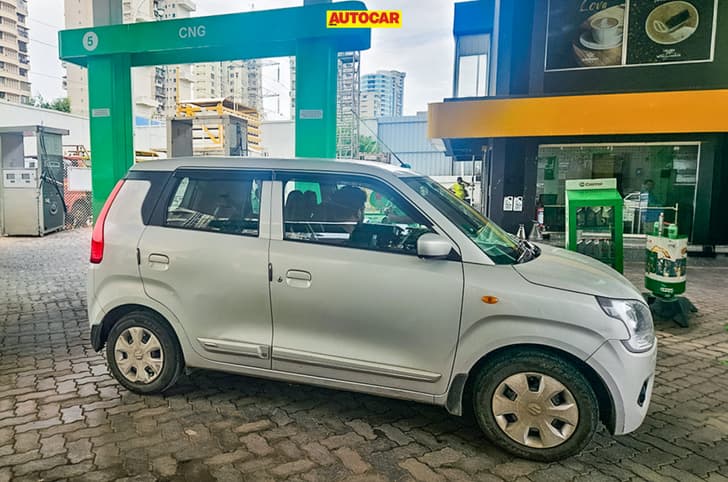

The 2026 WagonR CNG facelift may get Maruti's newer Z12E three-cylinder engine and an underbody CNG tank, improving on the current 33.47 km/kg ARAI claim and freeing up boot space.
Will the 2026 Maruti WagonR CNG Facelift Deliver Better Mileage? What We Know So Far
The 2026 Maruti WagonR CNG facelift is a mid-cycle update to India's highest-selling CNG car — a model Maruti Suzuki claims has crossed 7 lakh CNG-specific sales since its 1999 debut — and spy shots from September 2026 suggest the biggest change will be under the bonnet, not on the body panels. A fully camouflaged test mule was spotted on public roads with its tall-boy silhouette unchanged, pointing to a powertrain-led facelift rather than a full redesign. Two specific upgrades are being discussed: a switch to Maruti's newer Z12E 1.2-litre three-cylinder engine, and a possible underbody CNG tank arrangement that could reclaim the boot space currently eaten up by the 60-litre boot-mounted cylinder.
Before diving into what the facelift might change, here is where the current WagonR CNG stands against its key rivals in the hatchback CNG segment:
| Model | CNG Kit Type | ARAI Claimed (km/kg) | Real-World (km/kg) | CNG Variant Price (ex-sh) | Boot Space Trade-off |
|---|---|---|---|---|---|
| Maruti WagonR CNG (current, 1.0L 3-cyl) | Factory-fitted S-CNG | 33.47 | ~28.24 (Autocar India) | ₹5.94–6.47 lakh | 60L boot-mounted cylinder; ~95–100 kg heavier than petrol |
| Maruti Celerio CNG | Factory-fitted S-CNG | 35.60 | Not independently tested | ~₹6.16 lakh | Boot-mounted cylinder; smaller overall boot |
| Tata Tiago iCNG | Factory-fitted iCNG | 26.49 | Not independently tested | ~₹6.55–7.49 lakh | Twin-cylinder under floor; boot space largely preserved |
| Hyundai Grand i10 Nios CNG | Factory-fitted | 31.59 | Not independently tested | ~₹7.68 lakh | Boot-mounted cylinder; reduced boot volume |
Prices are approximate ex-showroom figures as of September 2026. Mileage figures are manufacturer ARAI claims unless stated otherwise.
The WagonR CNG's 33.47 km/kg claim is competitive but not class-leading — Celerio CNG edges it on paper. Tata's twin-cylinder iCNG setup in the Tiago uses two smaller cylinders mounted under the floor rather than in the boot, preserving usable luggage space at the cost of a slightly lower claimed efficiency of 26.49 km/kg. The WagonR's boot-mounted single cylinder is its most tangible daily inconvenience for CNG buyers.
What engine does the 2026 WagonR facelift likely get?
The Z12E is Maruti's newest 1.2-litre three-cylinder naturally aspirated petrol engine, already replacing the older four-cylinder K12 unit in the Swift, Dzire, and most recently the 2026 Baleno facelift. In the Baleno, the Z12E produces 83 hp and 112 Nm — marginally lower than the outgoing four-cylinder's 90 hp and 113 Nm — yet the Baleno's ARAI petrol mileage improved to 24.77 kmpl despite the power reduction.
Maruti's pattern with every Z12E transition is consistent: slightly lower peak power, meaningfully better fuel efficiency. If WagonR follows suit, buyers should expect a petrol mileage improvement on the 1.2-litre variant. For CNG buyers, the more pressing question is what the Z12E does to the CNG efficiency figure.
Currently, the WagonR CNG uses the 1.0-litre three-cylinder K10C engine, which produces 67.7 hp and 91.1 Nm on petrol and drops to 56.6 hp and 82.1 Nm on CNG. That power drop — roughly 16% — reflects a structural characteristic of CNG combustion: the lower energy density of compressed natural gas compared to petrol means less power from the same displacement. A larger 1.2-litre Z12E in CNG mode would likely produce more absolute power than the current 1.0-litre CNG setup, reducing the perceived performance penalty that CNG buyers currently accept.
Whether Maruti will offer the Z12E in CNG specification remains unconfirmed. The spy shots do not reveal enough under-bonnet detail to confirm the engine configuration. Maruti may retain the 1.0-litre engine for entry CNG variants and introduce the Z12E only on higher petrol trims — a restructuring of the engine lineup that Rushlane notes remains to be seen.
How does the current WagonR CNG actually perform in real-world mileage tests?
The current WagonR CNG's ARAI-claimed efficiency of 33.47 km/kg is a manufacturer claim tested under controlled laboratory conditions. Real-world performance, as tested by Autocar India, paints a different picture:
- City driving: 23.39 km/kg
- Highway driving: 33.09 km/kg
- Overall average: 28.24 km/kg
The highway figure of 33.09 km/kg is remarkably close to the ARAI claim, which is unusual — most cars fall further short on highways due to higher sustained speeds. City driving at 23.39 km/kg, however, is about 30% below the ARAI number and more representative for urban buyers who make up the bulk of WagonR CNG customers.
To put running costs in perspective: at Delhi's current CNG retail price of approximately ₹76 per kg, the WagonR CNG costs roughly ₹2.69 per km in city driving (₹76 ÷ 28.24 km/kg overall average) versus approximately ₹5.50–6.00 per km for a comparable petrol hatchback running on petrol at ₹95–100 per litre and returning 15–17 kmpl in city conditions. That gap — roughly ₹2.80–3.30 per km — is what makes the WagonR CNG compelling despite its ₹95,000 premium over the equivalent petrol variant.
The 60-litre CNG cylinder accepts approximately 7.4 kg when filled from empty in real-world conditions (the theoretical maximum is closer to 8 kg, depending on ambient temperature and dispenser pressure). At 28.24 km/kg overall, a realistic full-tank range is 210–220 km on CNG alone, after which the car switches to its petrol tank.
What is the underbody CNG tank, and why does it matter?
An underbody CNG tank arrangement mounts the compressed natural gas cylinder beneath the vehicle's floor — integrated into the chassis — rather than occupying space inside the boot. Maruti has already introduced this layout on the 2026 Brezza CNG, and the WagonR facelift test mule may be testing a similar setup.
For WagonR CNG buyers, this matters enormously. The current boot-mounted 60-litre cylinder reduces the WagonR's already modest boot space to a level many owners describe as barely functional for weekly grocery runs, let alone family travel. Moving the cylinder underbody would restore a usable boot — a quality-of-life improvement addressing one of the most consistent criticisms of the current car.
A trade-off exists: underbody tanks can be slightly smaller in volume due to packaging constraints under the floor, which could reduce total CNG capacity and therefore per-fill range. Whether Maruti can maintain the current 60-litre (approximately 8 kg) capacity in an underbody layout for a small hatchback platform is an engineering question the spy shots cannot answer. The Brezza CNG's underbody tank experience will be instructive — if Maruti has managed capacity without significant compromise on a compact SUV, the WagonR's lower floor height may present a tighter challenge.
Tata's approach with the Tiago iCNG merits comparison: the twin-cylinder iCNG setup uses two smaller cylinders mounted under the rear seat and boot floor, preserving the boot at 242 litres — close to the petrol version's figure. The claimed efficiency of 26.49 km/kg is lower than the WagonR's 33.47 km/kg claim, but the packaging solution is more practical for daily use. If Maruti's underbody tank on the WagonR can match or beat the iCNG's boot preservation while keeping efficiency closer to the current 33.47 km/kg claim, it would be a significant competitive advantage.
How does the WagonR CNG compare to rivals if you're buying today?
If you're in the market now and cannot wait for the facelift, the WagonR CNG's position in the segment deserves clear understanding.
The WagonR CNG is available in two variants: LXi CNG at ₹5.94 lakh and VXi CNG at ₹6.47 lakh (ex-showroom). Both are factory-fitted S-CNG units — Maruti's terminology for its in-house CNG integration — which means the warranty is unaffected, unlike dealer-fitted aftermarket CNG kits where the standard manufacturer warranty typically does not cover CNG-related components or damage.
The Tata Tiago iCNG, at ₹6.55–7.49 lakh depending on variant, costs more but offers the twin-cylinder advantage. Tata's iCNG is also factory-fitted, and the twin-cylinder setup means the boot is largely preserved. The trade-off is a lower claimed efficiency of 26.49 km/kg versus the WagonR's 33.47 km/kg — a difference that translates to a meaningful running cost gap at current CNG prices.
The Hyundai Grand i10 Nios CNG, starting around ₹7.68 lakh, is priced significantly higher and targets a slightly more premium buyer. Its claimed 31.59 km/kg is competitive but trails the WagonR on paper.
The Maruti Celerio CNG, at approximately ₹6.16 lakh, is the closest rival within Maruti's own lineup. Its claimed 35.60 km/kg is the highest in the segment on paper, but the Celerio's smaller dimensions and more basic feature set make it a different proposition from the WagonR's taller, more spacious cabin.
For buyers who prioritise running cost efficiency above all else, the current WagonR CNG's 33.47 km/kg claim and real-world 28.24 km/kg average make it the most sensible choice in the segment today. For buyers who need boot space, the Tiago iCNG's twin-cylinder layout is the more practical option despite the efficiency trade-off.
What are the WagonR CNG's honest weaknesses that the facelift may or may not fix?
The WagonR CNG's weaknesses deserve attention alongside its strengths. Here is what buyers live with today, and what the facelift may or may not address:
Power drop on CNG: The current 1.0-litre engine loses about 11 hp when switching from petrol to CNG mode — from 67.7 hp to 56.6 hp. On city roads this is manageable, but highway overtaking and hill climbs feel noticeably sluggish. The facelift's potential Z12E engine, if offered in CNG spec, would likely have a higher petrol baseline and therefore a less severe absolute power drop, but the percentage drop on CNG is a physics constant that no engine swap eliminates.
Boot space: The 60-litre boot-mounted cylinder is the WagonR CNG's most significant practical disadvantage. The underbody tank possibility could fix this, but it is not confirmed from the spy shots.
No AMT on CNG: The current WagonR CNG is available only with a 5-speed manual gearbox. The petrol variants get an AMT option. For urban buyers who want the convenience of an automatic — precisely the buyers most likely to choose CNG for city running cost savings — this is a meaningful gap. There is no indication the facelift will address this.
Weight penalty: The CNG hardware adds approximately 95–100 kg over the equivalent petrol model, which affects ride quality, handling, and braking distances. This is a structural trade-off inherent to CNG packaging and is unlikely to change significantly with the facelift.
NCAP safety rating: Tested by Global NCAP in 2023, the WagonR scored 1 star for adult occupant protection and 0 stars for child occupant protection. The facelift's test mule shows no obvious structural changes, so a significant safety improvement is not expected unless Maruti makes undisclosed structural reinforcements.
CNG station availability: This is a segment-wide constraint, not specific to the WagonR. CNG infrastructure in India remains concentrated in major cities and along national highways. Buyers in smaller towns or those who frequently travel to areas without CNG stations must rely on the petrol tank for those stretches, which reduces the running cost advantage.
Is the WagonR still worth buying as India's best-selling CNG car?
The WagonR's sales dominance is not accidental. Maruti Suzuki's August 2026 sales rose 35% year-on-year to 1.77 lakh units, with the WagonR leading the charge — a consistent pattern across FY22, FY23, FY24, and FY25, during which it was India's best-selling car four years running. The CNG variant is a significant contributor to that volume, with over 7 lakh CNG units sold since launch.
The combination of factory-fitted CNG (warranty intact), Maruti's dense service network, strong resale value, and a sub-₹6.50 lakh price ceiling for the CNG range makes the WagonR CNG a rational choice for high-mileage urban commuters. The running cost arithmetic — roughly ₹2.69 per km on CNG versus ₹5.50+ per km on petrol — means the ₹95,000 CNG premium pays back in approximately 30,000–35,000 km of CNG-dominant driving, which most WagonR buyers cover within 18–24 months.
Whether to wait for the facelift depends on how much the underbody tank and engine upgrade matter to you. If boot space is your primary frustration with the current car, waiting makes sense — the underbody tank possibility, if confirmed, would be a genuine quality-of-life upgrade. If you need a car now and can live with the boot compromise, the current WagonR CNG at ₹5.94 lakh for the LXi CNG is a hard value to argue against in the hatchback segment.
For buyers considering the broader CNG hatchback segment, our guide to 7 Best CNG Hatchbacks Under ₹10 Lakh in India covers the full competitive space, and if you're open to stepping up to a compact SUV body style, the Best CNG Compact SUVs Under ₹10 Lakh guide is worth reading alongside this one.
When will the 2026 WagonR facelift launch, and what will it cost?
Based on the test mule activity spotted in September 2026, a launch before the end of calendar year 2026 appears likely. Maruti typically moves from active testing to launch within two to four months for a facelift-level update. The current WagonR range runs from ₹4.99 lakh to ₹6.97 lakh (ex-showroom), with the CNG variants at ₹5.94–6.47 lakh. A price increase is expected with the facelift, particularly if the Z12E engine and underbody CNG tank are confirmed — both represent genuine engineering upgrades that carry cost.
A reasonable estimate would put the facelifted WagonR CNG at ₹6.20–6.80 lakh for the entry CNG variant, though this is speculative until Maruti announces official pricing. The visual changes are expected to be minor — the test mule's camouflage concealed the grille and bumper, but the overall body shape, tail lamp positioning, and cabin layout appeared largely unchanged. The powertrain and CNG packaging updates are where the real story lies.
Maruti's demonstrated engineering philosophy with the Z12E transition in Baleno and Swift is clear: accept a modest power reduction in exchange for a meaningful efficiency gain. If that philosophy carries through to the WagonR CNG — and the spy evidence suggests it will — the 2026 facelift could push the ARAI CNG claim meaningfully above the current 33.47 km/kg figure, making India's best-selling CNG car even more compelling for the urban commuter who runs primarily on gas.
Sources
- 2026 Maruti WagonR Facelift Spied - New 3 Cyl Engine, Underbody CNG Likely
- Maruti Suzuki WagonR - Official Page
- Maruti Wagon R CNG real world fuel economy tested, explained - Autocar India
- Maruti Suzuki Wagon R (2026) - Price, Mileage & Expert Reviews - Autocar India
- Maruti Suzuki August 2026 sales rise 35% YoY to 1.77 lakh units, WagonR leads - Mint
- 2026 Maruti Baleno mileage revealed: Up to 24.77 kmpl despite less power - Mint