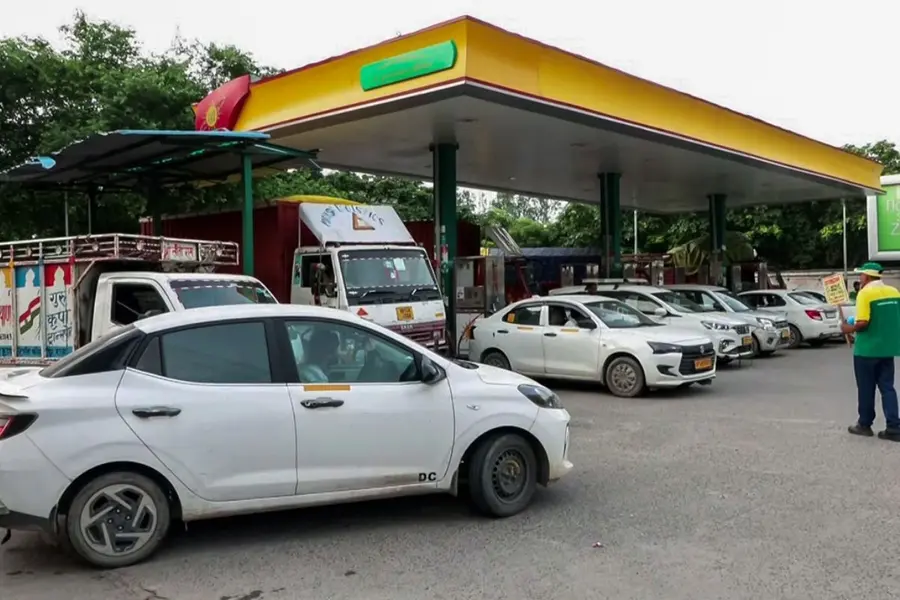

Mumbai CNG is now ₹89/kg from October 1, 2026, MGL's third hike this year, driven by higher domestic gas and imported RLNG costs.
CNG in Mumbai is now priced at ₹89 per kg, effective from midnight on September 30, 2026, after Mahanagar Gas Limited (MGL) raised its retail rate by ₹1/kg. This marks the third revision in 2026 and directly impacts the city's 12 lakh-plus CNG vehicle owners.
For private car owners running a Maruti Suzuki S-CNG model, this is a good moment to stress-test the fuel-cost arithmetic that made CNG attractive in the first place. The numbers still favour CNG over petrol, but the margin is narrowing with each successive hike.
How does ₹89/kg change the running cost for popular CNG cars in Mumbai?
The table below uses Mumbai's current petrol price of approximately ₹104/litre (as of October 2026) and the new CNG price of ₹89/kg to calculate cost per km. ARAI-claimed mileage figures are manufacturer claims; real-world figures typically run 15–20% lower.
| Model | Fuel type | ARAI claim | CNG kit type | Cost per km (ARAI) | Boot space trade-off |
|---|---|---|---|---|---|
| Maruti Suzuki Baleno S-CNG | CNG | 30.61 km/kg | Factory-fitted | ₹2.91/km | 40 L (vs 318 L on petrol) |
| Maruti Suzuki Fronx S-CNG | CNG | 28.51 km/kg | Factory-fitted | ₹3.12/km | Reduced; spare under floor |
| Tata Tiago iCNG | CNG | 26.49 km/kg | Factory-fitted (twin-cylinder) | ₹3.36/km | Minimal loss (twin-cyl) |
| Tata Nexon iCNG | CNG | 24.00 km/kg | Factory-fitted (twin-cylinder) | ₹3.71/km | Minimal loss (twin-cyl) |
| Hyundai Exter CNG | CNG | 27.10 km/kg | Factory-fitted | ₹3.28/km | Reduced single cylinder |
| Maruti Suzuki Baleno (petrol) | Petrol | 22.35 km/l | — | ₹4.65/km | 318 L (full) |
Cost per km = fuel price ÷ ARAI mileage. CNG at ₹89/kg, petrol at ₹104/l. All figures are manufacturer ARAI claims, not real-world verified.
Even at ₹89/kg, CNG delivers a meaningful saving over petrol. A Baleno S-CNG at its ARAI claim costs ₹2.91/km versus ₹4.65/km for the petrol Baleno — a saving of roughly ₹1.74/km. Over 1,500 km a month (a typical Mumbai commuter), that translates to a monthly saving of about ₹2,610. The gap has compressed from what it was when CNG was at ₹84/kg in May.
Why did MGL raise CNG prices three times in 2026?
MGL's explanation across all three 2026 hikes points to the same structural pressure: the cost of procuring natural gas has risen faster than the company can absorb.
The first hike, to ₹84/kg in May 2026, stemmed from reduced allocation of domestically produced gas and rupee depreciation against the US dollar, which made imported RLNG more expensive in rupee terms. A second ₹2/kg increase followed later in May, taking the price to ₹86/kg, citing geopolitical disruptions to global energy supply chains and rising crude oil prices.
The September hike — a ₹2/kg jump to ₹88/kg — and the October 1 increase to ₹89/kg both reflect higher domestic gas prices and increased dependence on spot RLNG linked to the ongoing crisis in West Asia. MGL has been explicit that imported RLNG prices track international gas markets, so when global prices spike, Mumbai's CNG price follows.
The trajectory in 2026 reflects a series of cost-pass-through events: MGL absorbs part of the input-cost increase and passes the remainder to consumers. The company has stated the October ₹1/kg hike only partially offsets its higher procurement costs.
What is the full 2026 price history for Mumbai CNG?
| Date | CNG price (₹/kg) | Change | Reason cited |
|---|---|---|---|
| Before May 13, 2026 | ₹82/kg | — | Baseline |
| May 13, 2026 | ₹84/kg | +₹2 | Reduced domestic gas allocation, rupee depreciation |
| Late May 2026 | ₹86/kg | +₹2 | Geopolitical disruptions, RLNG costs, crude oil prices |
| September 1, 2026 | ₹88/kg | +₹2 | Higher international gas costs |
| October 1, 2026 | ₹89/kg | +₹1 | Domestic gas price rise, spot RLNG costs, West Asia crisis |
Mumbai CNG has risen by ₹7/kg across 2026 so far — a roughly 8.5% increase from the pre-May baseline of ₹82/kg. For context, MGL supplies CNG to more than 1.3 million vehicles through a network of over 500 CNG stations across Mumbai, Thane, Navi Mumbai, Raigarh, Ratnagiri, Latur, Dharashiv, Chitradurga and Davangere.
Who is most affected by the October hike?
The October 1 increase affects every vehicle running on MGL-supplied CNG across the Mumbai Metropolitan Region (MMR). That includes approximately 4.7 lakh auto-rickshaws, over 1.6 lakh taxis, more than 5 lakh private cars, and 1,969 buses operated by BEST, TMT, MSRTC and NMMT, along with 51,311 private buses and tempos.
For commercial operators, the arithmetic is starker. An auto-rickshaw covering 150 km a day at a real-world 20 km/kg consumes about 7.5 kg of CNG daily. At ₹89/kg, that is ₹667.50/day in fuel alone — ₹7.50 more per day than at ₹88/kg, or roughly ₹225 more per month. Multiplied across 4.7 lakh rickshaws, the aggregate cost increase across the fleet is substantial. The Mumbai Rickshawmen's Union had already flagged the need for a fare revision after the May hikes; the October increase adds fresh pressure.
Private car owners feel the pinch less acutely per day, but the cumulative ₹7/kg rise across 2026 has meaningfully eroded the fuel-cost advantage that made CNG cars attractive at purchase.
How does the October hike affect Maruti S-CNG owners specifically?
Maruti Suzuki's S-CNG range uses a factory-fitted CNG system integrated at the manufacturing stage, meaning the kit carries the same warranty as the rest of the car and does not void Maruti's standard service terms. This distinction matters: dealer-fitted or aftermarket CNG kits often see warranty coverage on engine components contested.
The Baleno S-CNG and Fronx S-CNG are the two most relevant models for Mumbai buyers in the hatchback and compact-SUV segments. At ₹89/kg and the Baleno's ARAI claim of 30.61 km/kg, the cost per km works out to ₹2.91. At the May baseline of ₹82/kg, the same car cost ₹2.68/km. The difference is ₹0.23/km — small in isolation, but over 18,000 km a year it adds up to roughly ₹4,140 in additional annual fuel spend.
The Fronx S-CNG, with its ARAI claim of 28.51 km/kg, now costs ₹3.12/km versus ₹2.88/km at ₹82/kg. The annual additional cost at 18,000 km is approximately ₹4,320.
These remain comfortable savings over petrol. The Baleno petrol at 22.35 km/l and ₹104/l costs ₹4.65/km — a gap of ₹1.74/km over the CNG variant. The Fronx petrol at around 21.5 km/l costs approximately ₹4.84/km, leaving a gap of ₹1.72/km over the CNG version.
The Maruti S-CNG models carry real weaknesses. The Baleno S-CNG loses the most boot space of any car in its class: the single CNG cylinder reduces usable boot volume to just 40 litres, down from 318 litres in the petrol version. That dramatic cut makes the car impractical for families who regularly carry luggage. The Fronx S-CNG similarly sacrifices boot space, though the impact is slightly less severe given the SUV body style. Both models also produce lower power on CNG than on petrol — the Baleno S-CNG drops from 90 PS (petrol) to around 77 PS effective on CNG — which is noticeable on Mumbai's expressways and flyovers.
Tata's twin-cylinder iCNG system — used in the Tiago iCNG and Nexon iCNG — takes a different approach. The dual-tank configuration stores CNG in two smaller cylinders placed under the boot floor, preserving most of the usable boot space. The Tiago iCNG retains a usable boot, and the Nexon iCNG keeps its full-size boot largely intact. The trade-off is a slightly lower ARAI mileage claim compared to the Baleno S-CNG, and Tata's iCNG models carry a price premium over equivalent Maruti variants.
If boot space is a priority, the Tata twin-cylinder approach wins. If headline mileage and brand service network density matter more, the Maruti S-CNG models remain competitive. Mumbai has one of the densest Maruti service networks in India, a practical consideration for CNG owners who need regular maintenance.
Is CNG still cheaper than petrol and diesel in Mumbai after the hike?
Yes, but the gap is narrower than it was a year ago. MGL stated after the May ₹86/kg hike that CNG provides approximately 45% savings compared to petrol and 12% savings compared to diesel at Mumbai prices. At ₹89/kg, those percentages have tightened slightly, but CNG remains the cheapest per-km fuel option for most vehicle types in Mumbai.
A simple comparison using current Mumbai fuel prices:
- CNG at ₹89/kg: A car returning 28 km/kg (conservative real-world estimate) costs ₹3.18/km
- Petrol at ₹104/l: A car returning 15 km/l (real-world city driving) costs ₹6.93/km
- Diesel at ₹92/l: A car returning 18 km/l (real-world city driving) costs ₹5.11/km
CNG is still roughly 54% cheaper per km than petrol and 38% cheaper than diesel in this scenario. The advantage is real, even if it has compressed from where it stood when CNG was at ₹75–80/kg two years ago.
One caveat: these savings assume the car runs on CNG, not petrol. Most factory-fitted CNG cars — including the entire Maruti S-CNG range — start on petrol and switch to CNG automatically once the engine warms up. If a driver frequently makes short trips where the car never fully switches to CNG mode, the real-world savings will be lower than the arithmetic suggests.
What is driving CNG prices higher across India, not just Mumbai?
The root cause is the mismatch between India's domestic natural gas production and the demand from city gas distribution (CGD) networks. India's domestic gas — allocated at administered prices — is insufficient to meet the full CNG demand in major cities. The shortfall is covered by imported RLNG, which is priced at international market rates.
When international gas prices rise — as they have in 2026, partly due to the West Asia crisis disrupting supply routes and partly due to higher European demand — the cost of imported RLNG rises in dollar terms. When the rupee also weakens against the dollar, the rupee cost of that imported gas rises further. Both factors have been at play in 2026.
This structural dependency on imported gas means that Mumbai's CNG price is now partly a function of geopolitical events thousands of kilometres away. MGL has acknowledged this explicitly in its communications around each 2026 hike. The company has said it will continue to explore ways to optimise gas procurement, but the levers available to a city gas distributor are limited when international prices move sharply.
Should you still buy a CNG car in Mumbai given rising prices?
The case for a CNG car in Mumbai rests on three pillars: fuel cost savings, lower emissions compared to petrol and diesel, and the density of CNG refuelling infrastructure in the MMR. All three still hold in October 2026, but each deserves scrutiny.
On fuel costs: the savings are real but have compressed. A buyer who purchased a Baleno S-CNG when CNG was at ₹75/kg was saving around ₹2.30/km over petrol. At ₹89/kg, that saving is around ₹1.74/km. The payback period on the CNG premium (typically ₹90,000–₹1,10,000 over the equivalent petrol variant) has lengthened. At 18,000 km a year and ₹1.74/km saving, the payback period is now roughly 3–3.5 years, up from around 2.5 years at lower CNG prices.
On infrastructure: MGL's network of over 500 CNG stations across the MMR is one of the densest in India. Range anxiety is less of an issue in Mumbai than in smaller cities or on highway routes. Queuing at busy CNG stations during peak hours remains a practical inconvenience that petrol and diesel drivers do not face.
On emissions: CNG produces lower particulate matter and NOx than petrol or diesel. For buyers who weight environmental impact in their purchase decision, this advantage is unchanged by the price hike.
A CNG car still makes financial sense for a Mumbai buyer covering more than 1,200–1,500 km per month, provided they can live with the boot-space compromise (especially on Maruti S-CNG models with single cylinders) and the occasional queuing at CNG stations. Buyers who do fewer kilometres, or who frequently travel on routes with sparse CNG coverage, should recalculate carefully.
For more on which CNG models offer the best value in 2026, see our guides to the best CNG cars in India, the best CNG hatchbacks under ₹25 lakh, and the best CNG compact SUVs under ₹15 lakh.
What does the October hike mean for auto and taxi fares in Mumbai?
The fare question remains unresolved as of October 1. Mumbai's auto-rickshaw and taxi fares are set by the Maharashtra Motor Vehicle Road Tax Authority (MMRTA), not by MGL or the transport operators themselves. After the May hikes, the Mumbai Rickshawmen's Union calculated that the fare formula indicated a need for a hike of around ₹1.12 per km on base fare, rounded to ₹1. Taxi unions had demanded a minimum ₹2–3 hike on base fare.
The October ₹1/kg increase adds to that pressure. Whether MMRTA approves a fare revision — and when — will determine how much of the fuel cost increase is absorbed by operators versus passed to commuters. In the interim, commercial CNG vehicle operators are bearing the full cost increase.
For private car owners, the October hike is a direct cost with no offset mechanism. The ₹1/kg increase on a 40-litre fill (roughly 8–9 kg of CNG) adds about ₹8–9 to each refuelling visit — a modest but cumulative addition over a year of driving.
What should Mumbai CNG car owners do now?
Three practical steps are worth considering.
First, verify your real-world mileage. ARAI claims for CNG cars are measured under controlled conditions. Mumbai's stop-start traffic, air conditioning use, and the frequency of short trips (where the car may not fully switch from petrol to CNG) all reduce real-world efficiency. If your Baleno S-CNG is returning 22–24 km/kg rather than the claimed 30.61 km/kg, your actual cost per km is closer to ₹3.71–₹4.05 — still better than petrol, but the margin is thinner than the ARAI numbers suggest.
Second, use MGL's CNG station locator to plan refuelling during off-peak hours. Queue times at busy stations add to the effective cost of CNG ownership in time, even if not in rupees.
Third, if you are considering a new CNG car purchase, factor the current ₹89/kg price — not a lower historical price — into your payback calculation. Assuming CNG prices will revert to earlier levels is a risk given the structural pressures MGL has described. Planning at current prices gives a more conservative and realistic picture of the savings on offer.
For buyers weighing CNG SUVs, our guide to the best SUVs with a CNG option under ₹30 lakh covers the Fronx S-CNG, Nexon iCNG, and Hyundai Exter CNG with updated pricing and mileage data.
Sources
- Mumbai CNG Price Rises to ₹89 per kg from October 1: MGL Rate Hike | Mathrubhumi English
- Mahanagar Gas hikes CNG price by ₹2, PNG by ₹1 | The Hindu BusinessLine
- CNG Price Hike Today: MGL increases CNG price by Rs 2/kg to Rs 84 in Mumbai | Moneycontrol
- CNG price hiked to Rs 86 per kg in Mumbai, piped gas to Rs 52 per unit | Times of India
- Maruti Suzuki S-CNG Cars — Official Page
- 5 Best CNG Cars in India (2026) | AutoForumIndia
- Best CNG Hatchbacks Under 25 Lakh in India (2026) | AutoForumIndia
- Best CNG Compact SUVs Under ₹15 Lakh in India (2026) | AutoForumIndia
- Best SUVs With a CNG Option Under 30 Lakh in India (2026) | AutoForumIndia