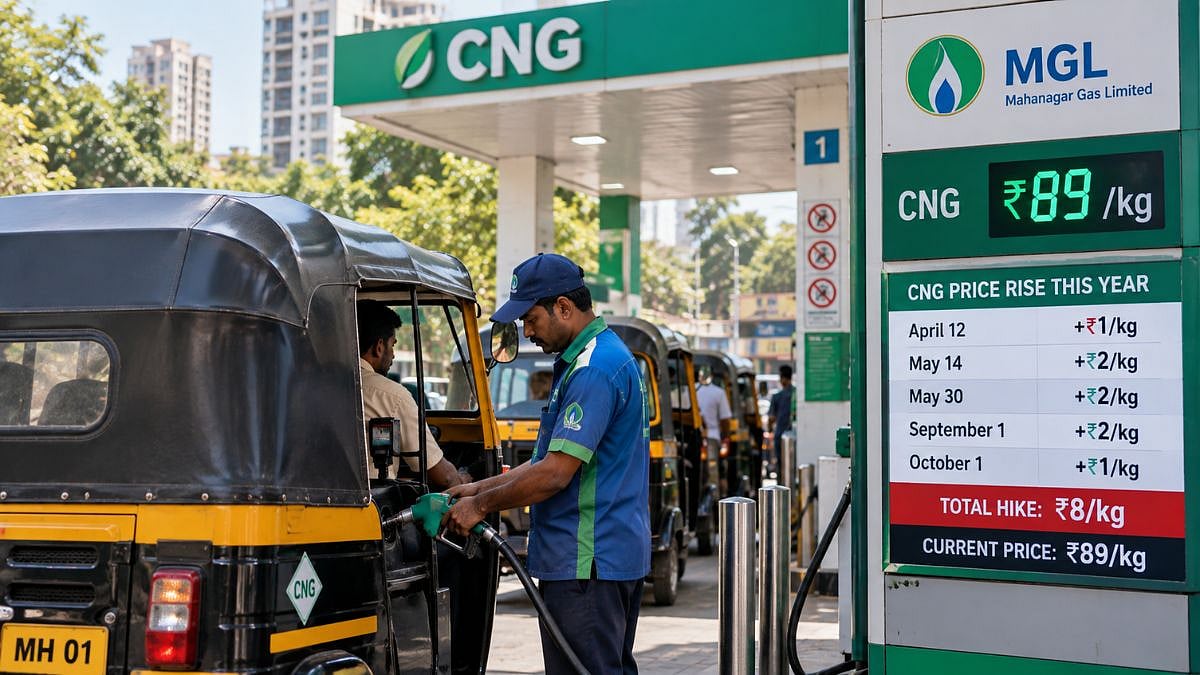

Mumbai CNG hit ₹89/kg on October 1, 2026 — up ₹8/kg since April — after five MGL hikes driven by rising imported RLNG costs amid the Middle East conflict.
Mumbai's CNG price is now defined as ₹89 per kg, effective October 1, 2026 — a cumulative ₹8 per kg increase across five separate hikes since April, all executed by Mahanagar Gas Limited (MGL), the city's sole piped and compressed natural gas distributor.
The ₹8/kg rise has arrived in instalments over six months, each one small enough to avoid headlines but collectively large enough to meaningfully alter the running-cost arithmetic for the roughly 12.93 lakh vehicles that run on CNG across the Mumbai Metropolitan Region (MMR). For private car buyers — particularly those who chose a Maruti Suzuki S-CNG model precisely to escape petrol price volatility — the trend demands a fresh look at the numbers.
Mumbai CNG Price Hike Timeline: April–October 2026
| Date | Hike (₹/kg) | Cumulative Rise | New Price (₹/kg) |
|---|---|---|---|
| April 12, 2026 | +₹1 | ₹1 | ₹81.50 (from ~₹80.50) |
| May 14, 2026 | +₹2 | ₹3 | ₹83.50 |
| May 30, 2026 | +₹2 | ₹5 | ₹85.50 |
| September 1, 2026 | +₹2 | ₹7 | ₹87.50 |
| October 1, 2026 | +₹1 | ₹8 | ₹89.00 |
Source: Free Press Journal / The Hindu
The starting price in January 2026 was ₹80.50/kg, per The Hindu's reporting. The total year-to-date increase is therefore ₹8.50/kg, with ₹8 of that arriving since April alone.
For context, Delhi-NCR's CNG supplier Indraprastha Gas Limited (IGL) raised prices by ₹3.89/kg in a single revision on August 29, 2026, taking Delhi's CNG to ₹86.98/kg — still below Mumbai's ₹89/kg. Noida and Ghaziabad consumers pay even more at ₹95.59/kg, reflecting higher state VAT structures.
Why Is MGL Raising CNG Prices This Frequently?
MGL's stated reason for each hike is the same: rising input gas costs, specifically the cost of imported Regasified Liquefied Natural Gas (RLNG). RLNG is liquefied natural gas that has been imported, stored, and then converted back into gaseous form for pipeline distribution — its price is indexed to international gas benchmarks, which have risen sharply since the Middle East conflict escalated.
The Petroleum Planning & Analysis Cell (PPAC), a Government of India body, publishes domestic natural gas prices on a monthly basis. The PPAC gas price page shows that ceiling prices for domestically produced gas were revised for the October 2026–March 2027 period, and a new Price Adjustment Factor (PAF) was notified from October 1, 2026. These upstream revisions feed directly into what city gas distributors like MGL pay for their gas supply — and ultimately into what consumers pay at the pump.
IGL made the same argument in August: "With international LNG prices remaining elevated and the cost impact becoming increasingly significant, a calibrated revision of Rs 3.89 per kg has now become necessary to partially offset the increase in input gas cost." MGL's language in October was nearly identical, citing "the rising cost of input gas and to ensure the continuity of supply."
The key word in both statements is "partially offset." City gas distributors are absorbing some of the upstream cost increase rather than passing it all through — which means further hikes remain possible if international LNG prices stay elevated.
What Does ₹89/kg Mean for Your Running Costs?
Running cost per kilometre is the total fuel expenditure divided by the distance covered — the single most important number for a CNG car buyer's ownership calculation. Here is the arithmetic at ₹89/kg for three popular Maruti Suzuki S-CNG models, all of which carry factory-fitted CNG kits (meaning the warranty remains intact and no third-party kit maker is involved):
Maruti Swift S-CNG (ARAI claim: 32.85 km/kg)
- Cost per km on CNG: ₹89 ÷ 32.85 = ₹2.71/km
- At the April start price of ₹81/kg: ₹81 ÷ 32.85 = ₹2.47/km
- Increase: ₹0.24/km
Maruti Dzire S-CNG (ARAI claim: 33.73 km/kg)
- Cost per km on CNG: ₹89 ÷ 33.73 = ₹2.64/km
- At ₹81/kg: ₹81 ÷ 33.73 = ₹2.40/km
- Increase: ₹0.24/km
Maruti Baleno S-CNG (ARAI claim: 30.61 km/kg)
- Cost per km on CNG: ₹89 ÷ 30.61 = ₹2.91/km
- At ₹81/kg: ₹81 ÷ 30.61 = ₹2.65/km
- Increase: ₹0.26/km
For a driver covering 1,500 km per month, that ₹0.24–₹0.26/km increase translates to an additional ₹360–₹390 per month in fuel costs, or roughly ₹4,320–₹4,680 per year compared to April 2026. That is not trivial, but it still leaves CNG comfortably cheaper than petrol. Mumbai petrol is currently around ₹106–₹108/litre; a petrol Swift with a real-world efficiency of ~18 km/l costs approximately ₹5.94–₹6.00/km — more than double the CNG running cost even at ₹89/kg.
The savings advantage has narrowed, but it has not disappeared.
How Does the ₹8/kg Rise Affect Annual Fuel Savings vs Petrol?
To understand the erosion of the CNG advantage, model annual savings at two price points — April 2026 and October 2026 — for a buyer covering 18,000 km per year (a reasonable Mumbai commuter figure):
Maruti Dzire S-CNG (33.73 km/kg ARAI claim) vs Dzire Petrol (~22 km/l real-world)
| Scenario | CNG cost/km | Petrol cost/km | Annual saving (18,000 km) |
|---|---|---|---|
| April 2026 (₹81/kg CNG, ₹106/l petrol) | ₹2.40 | ₹4.82 | ~₹43,560 |
| October 2026 (₹89/kg CNG, ₹106/l petrol) | ₹2.64 | ₹4.82 | ~₹39,240 |
| Difference | — | — | ₹4,320 less per year |
The ₹8/kg hike has reduced the annual CNG saving by approximately ₹4,320 for a Dzire owner. The CNG variant still saves around ₹39,000 per year over petrol — enough to recover the CNG premium in the purchase price within the first year of ownership for most variants — but the trajectory matters. If prices reach ₹97/kg (another ₹8 hike), the annual saving drops to roughly ₹34,920. The payback case weakens with each hike.
Note: ARAI figures are manufacturer claims under controlled test conditions. Real-world CNG mileage is typically 10–15% lower, which would push the actual cost per km higher than the figures above. Use these numbers as directional guidance, not guarantees.
Which Maruti S-CNG Models Are Most Affected — and What Are Their Trade-offs?
The three Maruti models most relevant to Mumbai private car buyers are the Swift, Dzire, and Baleno — all sold with factory-fitted S-CNG kits. Factory-fitted means a CNG system installed at the manufacturing plant before the car leaves the factory, as opposed to a dealer-fitted or aftermarket retrofit. Factory-fitted kits preserve the manufacturer warranty and typically use purpose-built cylinders integrated into the boot floor.
The trade-off is boot space. All three models use a single large CNG cylinder mounted in the boot:
Swift S-CNG loses boot space from 268 litres (petrol) to approximately 141 litres with the CNG cylinder. The car also loses around 8–10 bhp on CNG versus petrol mode, and the CNG-only variant is available in limited trims.
Dzire S-CNG faces a similar boot penalty; the cylinder takes up a significant portion of the 382-litre petrol boot. The Dzire's longer wheelbase means rear passenger space is unaffected, but luggage capacity is a real constraint for family trips.
Baleno S-CNG sees its 318-litre petrol boot shrink considerably. At ₹89/kg, the Baleno's lower ARAI claim of 30.61 km/kg (versus Dzire's 33.73 km/kg) means it is the least efficient of the three on CNG, costing ₹2.91/km versus the Dzire's ₹2.64/km.
None of these models offer a twin-cylinder CNG setup. Tata Motors' iCNG cars (Tiago iCNG, Tigor iCNG, Punch iCNG) use a twin-cylinder layout that splits the CNG storage between two smaller cylinders, preserving more usable boot space. The Tiago iCNG, for instance, retains a more practical boot configuration than the Swift S-CNG, though its ARAI CNG mileage claim of around 26.49 km/kg is lower than the Swift's 32.85 km/kg — meaning at ₹89/kg, the Tiago costs approximately ₹3.36/km on CNG versus the Swift's ₹2.71/km. The Maruti models win on efficiency; the Tata models win on boot practicality.
How Does Mumbai's ₹89/kg Compare to Other Indian Cities?
CNG prices vary significantly across India because city gas distribution is managed by different entities under different cost structures, and state VAT rates differ. As of early October 2026:
| City | CNG Price (₹/kg) | Distributor |
|---|---|---|
| Mumbai (MMR) | ₹89.00 | MGL |
| Delhi | ₹86.98 | IGL |
| Gurugram | ₹92.01 | IGL |
| Noida / Ghaziabad | ₹95.59 | IGL |
| Kanpur | ₹98.31 | IGL |
Source: Times of India
Mumbai sits in the middle of this range — cheaper than Noida or Kanpur, more expensive than Delhi. The gap between Mumbai and Delhi has narrowed since August, when IGL's ₹3.89/kg hike pushed Delhi up sharply. Before that revision, Delhi was significantly cheaper.
The variation matters for buyers who commute across city limits or who are evaluating a CNG car purchase in multiple cities. A Noida buyer paying ₹95.59/kg for the same Swift S-CNG faces a running cost of ₹2.91/km — identical to what a Mumbai Baleno S-CNG owner pays, despite the Swift's superior efficiency rating.
Will Auto Fares Rise in Mumbai Because of CNG Hikes?
Auto-rickshaw unions in Mumbai have flagged the cumulative impact of the 2026 hikes. Thampi Kurien, president of an auto-rickshaw union, told Free Press Journal that the latest ₹1/kg increase adds around 3.9 paise per kilometre to operating costs, with the total additional burden from recent hikes at around 12 paise per km. He estimated that the ₹3 increase in CNG prices (from the September and October hikes combined) translates to an impact of around ₹3 on fares.
The union's position is that a fare revision will be sought if CNG prices rise further and result in a 25% increase in overall operating costs, subject to conditions — a threshold that has not yet been crossed. However, the direction of travel is clear: if MGL raises prices again before year-end, the pressure on the Maharashtra government to revise auto and taxi fares will intensify.
For private car owners, fare hikes in autos and taxis are a secondary concern. The primary impact is direct: every ₹1/kg increase in CNG price costs a Dzire S-CNG owner about ₹0.03/km more. That sounds small, but across 18,000 km per year, each ₹1/kg hike costs an additional ₹540 annually.
Should You Still Buy a CNG Car in Mumbai Given Rising Prices?
The case for CNG cars in Mumbai remains intact, but it is weaker than it was at the start of 2026. The honest answer depends on three variables: how much you drive, what the alternative fuel costs, and whether you can tolerate the boot-space and refuelling constraints.
The case for CNG still holds if:
- You drive more than 1,200–1,500 km per month. At that volume, the running cost saving over petrol (still around ₹2.00–₹2.20/km at current prices) recovers the CNG premium on the car's purchase price within 12–18 months.
- You live or work near one of MGL's 500+ CNG stations across the MMR. MGL's network is one of India's densest, which reduces the range-anxiety problem that plagues CNG buyers in smaller cities.
- You are buying a factory-fitted S-CNG model like the Swift, Dzire, or Baleno, where the warranty is unaffected and the kit quality is consistent.
The case weakens if:
- You drive fewer than 800 km per month. The payback period stretches beyond two years, and the boot-space sacrifice becomes harder to justify.
- You frequently carry luggage or travel with family on long trips. The single-cylinder layout in all three Maruti S-CNG models leaves limited boot space, and CNG range on a full tank is typically 250–300 km before needing a refill — highway CNG availability outside the MMR is patchy.
- You are comparing against a diesel car. Mumbai diesel is around ₹97.83/litre (per The Hindu Business Line), and a diesel hatchback achieving 22–24 km/l costs ₹4.08–₹4.45/km — still more expensive than CNG at ₹2.64–₹2.91/km, but the gap is smaller than versus petrol.
The ₹8/kg rise since April has not flipped the economics. It has, however, reduced the margin of safety. A buyer who was borderline on the CNG payback calculation in April 2026 should redo the maths at ₹89/kg — and factor in the possibility of further hikes before the year ends.
What Is MGL's Network Coverage and Does It Matter for CNG Car Buyers?
MGL is Maharashtra's largest CNG supplier, operating across Mumbai, Thane, Raigad, Ratnagiri, Latur, and Dharashiv, as well as Chitradurga and Davangere in Karnataka. It supplies CNG through a network of over 500 CNG stations and has connected around 3.2 million households to piped natural gas.
For a Mumbai-based private car buyer, 500+ stations across the MMR means CNG availability is rarely a problem within city limits. The challenge arises on intercity travel — the Pune highway has reasonable coverage, but routes toward Nashik, Goa, or Konkan are thinner. This is a structural limitation of CNG as a fuel type, not specific to the current price environment.
Buyers who primarily use their car for city commuting — which describes the majority of Mumbai's Maruti Swift, Dzire, and Baleno owners — are unlikely to find the network a significant constraint.
How to Project Your Annual Fuel Cost at ₹89/kg
For buyers who want to build their own projection, here is the framework:
- Take the ARAI CNG mileage claim for your model (treat it as an optimistic ceiling, not a guarantee).
- Apply a real-world discount of 10–15% to get a realistic km/kg figure.
- Divide ₹89 by the realistic km/kg figure to get cost per km.
- Multiply by your annual kilometres.
Example — Maruti Swift S-CNG:
- ARAI claim: 32.85 km/kg
- Real-world estimate (15% discount): ~27.9 km/kg
- Cost per km at ₹89/kg: ₹89 ÷ 27.9 = ₹3.19/km
- Annual cost at 18,000 km: ₹57,420
Compare that to the same distance in a petrol Swift at 18 km/l real-world and ₹107/l petrol:
- Cost per km: ₹107 ÷ 18 = ₹5.94/km
- Annual cost: ₹1,06,920
- Annual saving on CNG: ~₹49,500
Even with the real-world efficiency discount applied, the Swift S-CNG saves close to ₹50,000 per year over its petrol sibling in Mumbai. The ₹8/kg hike since April has reduced this saving by roughly ₹4,000–₹5,000 annually — meaningful, but not enough to reverse the fundamental economics for a high-mileage city driver.
For more on how these models stack up across the full CNG hatchback segment, see our guide to Best CNG Hatchbacks Under 25 Lakh in India, and for the broader picture, 5 Best CNG Cars in India (2026).
What Should Mumbai CNG Car Buyers Watch for Next?
Three signals are worth tracking:
PPAC domestic gas price revisions. The PPAC publishes monthly domestic natural gas prices and a new Gas Price Ceiling was set for October 2026–March 2027. If the ceiling rises in the April 2027 revision, MGL will face higher input costs again and further hikes become likely.
International LNG spot prices. Both MGL and IGL have explicitly linked their hikes to imported RLNG costs tied to the Middle East conflict. If the conflict de-escalates or global LNG supply increases, the pressure on city gas distributors eases. If it intensifies, ₹95/kg in Mumbai is not inconceivable by mid-2027.
Maharashtra government fare revision decisions. If auto unions formally petition for a fare hike and the state government grants one, it signals that the government itself acknowledges CNG costs have risen materially — which could also trigger a political push to moderate MGL's pricing.
For now, the ₹89/kg price is live and the arithmetic still favours CNG over petrol for most Mumbai commuters. The trend since January 2026 — from ₹80.50 to ₹89, a 10.5% increase in nine months — is a reminder that CNG is not immune to the same global energy market forces that drive petrol prices. Buyers who assumed CNG prices were structurally stable should update that assumption.
Sources
- Mumbai CNG Price Rises ₹8 Per Kg Since April, Hits ₹89; Auto Fares Under Pressure — Free Press Journal
- Mumbai CNG price rises ₹1/kg to ₹89, fifth hike in six months — The Hindu
- CNG price hike: Compressed natural gas gets costlier; check city-wise rates — Times of India
- Gas Price | Petroleum Planning & Analysis Cell | Government of India
- Diesel Price in Mumbai Today — The Hindu Business Line
- Maruti Suzuki S-CNG Cars — Official Maruti Suzuki India
- Best CNG Hatchbacks Under 25 Lakh in India (2026) — AutoForumIndia
- 5 Best CNG Cars in India (2026) — AutoForumIndia