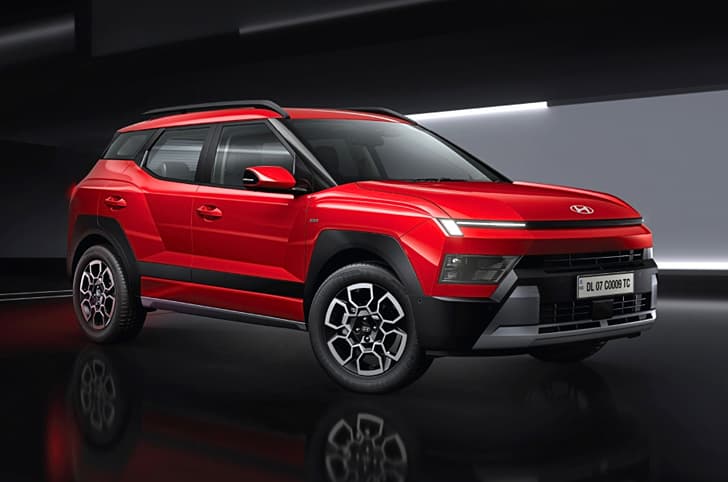

Hyundai Bayon CNG launches January 2027 with a factory-fitted underbody tank, expected price around Rs 11–12 lakh ex-showroom, rivalling Maruti Fronx CNG and Venue CNG.
When Does Hyundai's Bayon CNG Launch in India 2027? Expected Price, Mileage and Running Cost vs Venue
The Hyundai Bayon CNG is confirmed for a January 2027 launch in India, as reported by Autocar India and corroborated by Rushlane's launch coverage — making it the first factory-fitted CNG Hyundai model in the above-4-metre SUV segment. The petrol Bayon launched on 26 October 2026 at Rs 9,99,900 ex-showroom; the CNG version is expected to command a premium of approximately Rs 80,000–1,00,000 over equivalent petrol trims, putting entry-level CNG variants in the Rs 11–12 lakh bracket.
Before diving into the details, here is how the Bayon CNG stacks up against its most direct rivals at a glance:
| Model | Segment / Length | CNG Kit Type | Expected/Claimed Mileage (km/kg) | CNG Variant Starting Price (ex-sh) | Boot Space (CNG) | Gearbox Options (CNG) | Key Weakness |
|---|---|---|---|---|---|---|---|
| Hyundai Bayon CNG (Jan 2027) | Mid-size SUV / 4,245 mm | Factory-fitted | Not yet certified (ARAI pending) | ~Rs 11–12 lakh (expected) | ~505 L (underbody tank, unchanged) | 6MT (CVT TBC) | ARAI mileage unconfirmed; CVT on CNG unconfirmed |
| Hyundai Venue CNG | Sub-4m SUV / 3,995 mm | Factory-fitted | 27.07 km/kg (ARAI) | ~Rs 10.15 lakh | Reduced (tank in boot) | 6MT only | No automatic on CNG; smaller boot |
| Maruti Suzuki Fronx CNG | Sub-4m SUV / 3,995 mm | Factory-fitted S-CNG | 28.51 km/kg (ARAI) | ~Rs 9.50 lakh | Reduced (tank in boot) | 6MT only | Manual-only CNG; no iVT option |
| Maruti Suzuki Victoris CNG | Mid-size SUV / 4,300 mm | Factory-fitted S-CNG | ~26 km/kg (ARAI, claimed) | ~Rs 12.50 lakh | Preserved (underbody tank) | 6MT only | No automatic on CNG |
| Toyota Urban Cruiser Hyryder CNG | Mid-size SUV / 4,365 mm | Factory-fitted | ~26 km/kg (ARAI, claimed) | ~Rs 12.50 lakh | Preserved (underbody tank) | 6MT only | No automatic on CNG |
Prices are ex-showroom estimates based on petrol pricing and segment norms. ARAI figures are manufacturer claims and real-world mileage is typically 15–20% lower.
What exactly is the Hyundai Bayon CNG, and why does it matter?
The Hyundai Bayon CNG is a factory-fitted bi-fuel SUV that runs on both compressed natural gas and petrol, with the CNG system integrated at the manufacturing stage rather than retrofitted by a dealer or third-party installer. This distinction carries enormous weight for buyers: factory-fitted CNG kits preserve the manufacturer's full warranty, whereas dealer-fitted or aftermarket kits — even from reputable names like Lovato or Tomasetto — typically void the engine warranty on affected components.
Hyundai Motor India confirmed at the Bayon's October 26 launch that the CNG variant is in development, and Autocar India's reporting pins the launch at January 2027. The structural significance runs deep: Hyundai has deliberately kept CNG off the Creta — its premium mid-size SUV — to protect that model's positioning. The Bayon absorbs CNG demand in the above-4-metre space, as Financial Express noted, mirroring Maruti Suzuki's dual-model strategy with the Victoris and Grand Vitara.
The Bayon becomes the largest Hyundai in India to offer CNG — the current ceiling is the Venue, which sits in the sub-4-metre segment. Moving CNG into the 4,245 mm class opens the door to buyers who need more cabin room and a larger boot but still want the running-cost advantages of CNG.
What engine will the Bayon CNG use, and how much power will it make?
The petrol Bayon uses a 1,497cc four-cylinder naturally aspirated MPi engine producing 115 PS at 6,300 rpm and 143.8 Nm at 4,500 rpm, paired with either a 6-speed manual or an Intelligent Variable Transmission (iVT). Autocar India expects the CNG variant to retain this engine but with a slightly lower output — a standard engineering trade-off when a bi-fuel system is integrated, because CNG combustion characteristics differ from petrol and the engine is typically detuned for reliability and emissions compliance.
For reference, the Hyundai Venue CNG uses a 1.2-litre kappa engine producing around 69 PS on CNG versus 83 PS on petrol — a drop of roughly 17%. If the Bayon CNG follows a similar derating pattern on its 1.5-litre engine, buyers could expect somewhere around 95–100 PS on CNG. This remains adequate for urban commuting but noticeably less responsive than the petrol version, particularly during highway overtaking. Hyundai's iVT includes a Dash Boost Mode for overtaking responsiveness on the petrol Bayon — whether that feature carries over to the CNG variant, or whether CNG will be manual-only, remains unconfirmed.
The 6-speed manual gearbox is the near-certain pairing for the CNG Bayon. Whether the iVT automatic will also be offered on CNG is the key open question. Autocar India notes that "it remains to be seen if a CVT automatic will also be available." Every major CNG SUV currently on sale in India — Maruti Fronx CNG, Victoris CNG, Grand Vitara CNG, Toyota Hyryder CNG — is manual-only on CNG. A CNG automatic in this segment would be a genuine first.
What is the expected mileage of the Bayon CNG, and how does it compare to rivals?
ARAI certification for the Bayon CNG has not been published as of October 2026. Any figure circulating online before the January 2027 launch should be treated as speculation. The competitive context, however, provides a reasonable range.
The Hyundai Venue CNG, which uses a smaller 1.2-litre engine, returns 27.07 km/kg as per ARAI certification. The Maruti Fronx CNG, with its 1.2-litre engine and factory S-CNG system, claims 28.51 km/kg (ARAI). The Maruti Victoris CNG and Toyota Hyryder CNG, both using larger 1.5-litre engines, claim approximately 26 km/kg (ARAI). The Bayon CNG's 1.5-litre engine is likely to land in the 25–27 km/kg range on ARAI testing — an informed estimate, not a confirmed figure.
Running cost arithmetic (illustrative, Delhi CNG price ~Rs 76/kg as of October 2026):
- Bayon CNG at 26 km/kg (estimated ARAI): Rs 76 ÷ 26 = ~Rs 2.92 per km
- Bayon petrol at 18.6 km/l (ARAI claimed): Rs 96/l ÷ 18.6 = ~Rs 5.16 per km
- Saving per km on CNG vs petrol: ~Rs 2.24
- At 1,500 km/month: monthly saving of approximately Rs 3,360
- Break-even on a ~Rs 90,000 CNG premium over petrol: roughly 27 months
Real-world mileage on CNG typically runs 15–20% below ARAI claims due to traffic conditions, AC use, and tank pressure variations. A more realistic real-world figure might be 21–23 km/kg, pushing the cost per km to around Rs 3.30–3.60 — still well below petrol but less dramatic than the ARAI arithmetic suggests.
How does the Bayon CNG's boot space compare to the Venue CNG and Fronx CNG?
Boot space is where the Bayon CNG makes its most compelling case. The petrol Bayon offers 505 litres of boot space (measured using the V215 method with a tyre mobility kit), and Autocar India reports that the CNG variant is expected to use an underbody-mounted tank — the same approach Maruti uses on the Victoris CNG — which means boot space is preserved rather than sacrificed.
This is a significant differentiator. The Hyundai Venue CNG and Maruti Fronx CNG both use a boot-mounted CNG cylinder, which cuts usable luggage space considerably. The Fronx CNG's boot shrinks from 308 litres to a cramped figure that makes family road trips genuinely inconvenient. The Venue CNG faces the same constraint. For a buyer who needs CNG economics but also needs to carry luggage, a pram, or sports equipment, the Bayon CNG's underbody tank approach is a practical advantage.
The Maruti Fronx CNG is the closest S-CNG rival in the compact SUV space, and its manual-only CNG configuration is a real limitation. The Fronx CNG claims 28.51 km/kg (ARAI) — likely marginally better than the Bayon CNG will achieve given the Fronx's smaller, lighter 1.2-litre engine — but the Fronx's reduced boot and manual-only gearbox mean the Bayon CNG, if it offers an automatic option, would occupy a meaningfully different position in the market. The Fronx CNG's S-CNG badge also signals factory fitment and full warranty retention, which is a genuine strength it shares with the Bayon CNG.
What is the expected price of the Hyundai Bayon CNG?
The petrol Bayon starts at Rs 9,99,900 ex-showroom for the base HX2 variant and runs up to approximately Rs 16 lakh for the fully loaded HX10 iVT. Autocar India notes that "CNG variants are expected to command a slight premium over petrol versions."
Factory-fitted CNG premiums in India typically run Rs 75,000–1,10,000 over the equivalent petrol trim. Using that range, the Bayon CNG is likely to start somewhere between Rs 10.75 lakh and Rs 11.10 lakh ex-showroom for the entry CNG trim, with mid-spec variants in the Rs 12–13 lakh range.
That would place it above the Maruti Fronx CNG (starting ~Rs 9.50 lakh) and roughly in line with the Maruti Victoris CNG and Toyota Hyryder CNG (both starting ~Rs 12.50 lakh). The Bayon CNG's positioning is therefore between the sub-4-metre CNG compact SUVs and the full mid-size CNG SUVs — a gap that currently has no direct occupant, which is precisely why Hyundai is filling it.
Hyundai has not yet published variant-wise pricing for the CNG Bayon. Confirmed pricing will only be available at the January 2027 launch.
How does the Bayon CNG compare to the Hyundai Venue CNG?
The Venue CNG is Hyundai's existing factory-fitted CNG offering in the sub-4-metre SUV segment, using a 1.2-litre kappa engine producing 69 PS on CNG, paired with a 6-speed manual gearbox, and returning 27.07 km/kg as per ARAI. It starts at approximately Rs 10.15 lakh ex-showroom for the CNG variant.
The Bayon CNG will be larger in every dimension — 4,245 mm versus 3,995 mm in length, a 2,600 mm wheelbase versus the Venue's 2,500 mm, and a substantially larger boot (505 L versus a reduced figure on the Venue CNG due to the boot-mounted tank). The Bayon also brings the 1.5-litre engine, which means more low-end torque for highway driving and overtaking — relevant for buyers who use CNG cars on expressways, not just city streets.
The trade-off is price. The Bayon CNG will cost more than the Venue CNG, and buyers who primarily drive within city limits where the Venue's smaller dimensions make parking easier may find the Venue CNG the more practical choice. The Venue's 27.07 km/kg ARAI figure is also a known quantity; the Bayon CNG's mileage remains unconfirmed.
For buyers who want CNG economics with a larger cabin and preserved boot space, the Bayon CNG is the logical upgrade. For buyers on a tighter budget who primarily navigate urban traffic, the Venue CNG remains the more cost-effective entry point into Hyundai's CNG lineup.
What features does the Bayon CNG carry over from the petrol version?
The Bayon's feature set is defined by its technology stack, and most of it is expected to carry over to the CNG variants. Hyundai's official press material highlights the following on the petrol model:
- Dual 12.3-inch curved panoramic displays (ccNC system, NVIDIA-accelerated)
- HMIL's first generative AI voice assistant (Perplexity intelligence + SoundHound AI voice)
- Over 70 Hyundai Bluelink connected features
- OTA updates across up to 19 vehicle controllers
- Hyundai SmartSense Level 2 Pro ADAS with 23 features including Highway Driving Assist
- Ventilated front seats, 8-way electrically adjustable driver's seat
- Panoramic sunroof
- Six airbags, ESC, hill-start assist, rollover sensor, TPMS as standard
- Wireless Android Auto and Apple CarPlay, Bose sound system
CNG variants typically come in lower-to-mid trims in India — Maruti, for instance, restricts S-CNG to specific variants rather than offering it across the full lineup. Autocar India notes that Hyundai could "go the Maruti/Toyota route and make CNG available in a few lower-spec trims or offer it as a true petrol alternative across most of, if not the entire, Bayon line-up." The answer to this will determine whether Bayon CNG buyers get access to ADAS, the panoramic sunroof, and the generative AI assistant — or whether they're limited to more basic trims.
Safety credentials are pending: the Bayon is currently undergoing Bharat NCAP crash testing, with a rating expected by December 2026. Hyundai describes the Bayon as engineered for five-star Indian safety standards based on internal assessment, but this is a manufacturer claim, not a certified rating as of the article's publication date.
What are the honest weaknesses of the Bayon CNG?
No CNG car is without trade-offs, and the Bayon CNG is no exception.
Power drop on CNG. The 1.5-litre engine will produce less power on CNG than its 115 PS petrol rating. Based on comparable Hyundai CNG models, expect a drop of 10–18 PS. This makes the car noticeably less responsive during highway merging and overtaking, particularly if the iVT automatic is not offered on CNG.
ARAI mileage is unconfirmed. Every mileage figure for the Bayon CNG circulating before January 2027 is an estimate. The 25–27 km/kg range used in this article is based on comparable 1.5-litre CNG engines in the segment, not a certified ARAI figure. Real-world mileage will be lower still.
CNG station availability outside metros. CNG infrastructure in India is concentrated in Delhi-NCR, Mumbai, Pune, Ahmedabad, and select highway corridors. Buyers in Tier-2 and Tier-3 cities, or those who travel frequently on routes without CNG coverage, will find the Bayon CNG's petrol fallback essential — but the smaller petrol tank on CNG variants (typically reduced to make room for the CNG system) means more frequent petrol fill-ups when CNG isn't available.
Price premium over Fronx CNG. The Maruti Fronx CNG starts at approximately Rs 9.50 lakh and claims 28.51 km/kg (ARAI) — marginally better mileage than the Bayon CNG is likely to achieve, at a lower price. Buyers who prioritise mileage and cost over cabin size and features may find the Fronx CNG's value harder to beat. The Fronx CNG's weakness is its manual-only gearbox and reduced boot, but for a pure urban commuter, those trade-offs may be acceptable.
Variant availability uncertainty. Until Hyundai confirms which Bayon variants will be offered with CNG, buyers cannot be certain whether features like ADAS, the panoramic sunroof, or the generative AI assistant will be accessible on CNG trims. This is not a confirmed weakness — it is an open question that January 2027 will resolve.
Should you wait for the Bayon CNG or buy a Fronx CNG or Venue CNG now?
This depends on what you're optimising for.
If your priority is the lowest running cost per km in a factory-fitted CNG SUV, the Maruti Fronx CNG's 28.51 km/kg ARAI claim and Rs 9.50 lakh starting price make it the current benchmark in the compact SUV space. It is available today, carries Maruti's S-CNG factory warranty, and has an established service network. Its weaknesses — manual-only gearbox, reduced boot, smaller cabin — are real, but for a city commuter covering 1,200–1,500 km a month, the economics are hard to argue with. You can explore how it compares in our Best SUVs With a CNG Option Under 30 Lakh in India (2026) guide.
If your priority is a larger cabin with preserved boot space on CNG, the Maruti Victoris CNG or Toyota Hyryder CNG are available now with underbody tanks and mid-size dimensions. Both start around Rs 12.50 lakh on CNG and return approximately 26 km/kg (ARAI claim). The Bayon CNG, when it arrives, will compete directly with these two — and may offer a more tech-forward cabin (generative AI assistant, NVIDIA-powered infotainment) at a similar or slightly lower price point.
If you want a CNG automatic in a mid-size SUV, the honest answer is: wait and see. No CNG automatic exists in this segment today. If Hyundai delivers an iVT CNG Bayon in January 2027, it would be a segment first. If they don't, the Bayon CNG is a well-equipped but conventionally manual CNG SUV in a competitive field.
The Bayon CNG's January 2027 launch is roughly two months away from the petrol model's October 2026 launch. For buyers genuinely interested in the CNG variant, waiting two months to get confirmed ARAI mileage, variant-wise pricing, and feature availability is the rational choice — especially since the petrol Bayon is available for test drives at dealerships now, letting you assess the cabin, ride quality, and infotainment before committing.
For a broader view of what's available today, see our 5 Best CNG Cars in India (2026) roundup and our guide to the Best CNG Car for a Large Family Looking to Save on Fuel Costs.
What is the Bayon's positioning in Hyundai's India lineup?
The Bayon is Hyundai Motor India's value-oriented mid-size SUV, positioned between the Venue (sub-4-metre, Rs 7.94 lakh onwards) and the Creta (premium mid-size, Rs 11 lakh onwards). Financial Express reports that the strategy mirrors Maruti Suzuki's dual-model approach, with the Victoris targeting value buyers and the Grand Vitara targeting premium ones.
The Bayon measures 4,245 mm in length, 1,810 mm wide, 1,605 mm tall (with roof rails), with a 2,600 mm wheelbase and 205 mm ground clearance. It sits on Hyundai's Global K Enhanced platform and will be manufactured in India and exported to more than 50 markets — a detail that signals Hyundai's confidence in the platform's quality and the Bayon's global competitiveness.
The Creta's turbo-petrol and diesel engines will not be offered in the Bayon, as Autocar India confirms — Hyundai wants to keep the Bayon's powertrain lineup simple and cost-effective, with the 1.5-litre NA petrol and factory CNG as the only options. A next-generation Creta with hybrid powertrain is expected in 2027, which will further differentiate the two models.
Key dates and what to watch for
- 26 October 2026: Petrol Bayon launched at Rs 9,99,900 ex-showroom. Deliveries begin during the festive season.
- December 2026: Bharat NCAP safety rating for the Bayon expected.
- January 2027: Bayon CNG launch confirmed. Watch for ARAI-certified km/kg figure, variant-wise pricing, and confirmation of whether iVT is offered on CNG.
The January 2027 launch will answer the three questions that matter most for CNG buyers: the certified mileage, the price premium over petrol, and whether an automatic gearbox option exists. Until then, the Bayon CNG is a compelling proposition on paper — a factory-fitted, warranty-intact CNG SUV with a 505-litre boot, a 1.5-litre engine, and a tech-forward cabin — but one that requires patience before a purchase decision can be made with full information.
Sources
- Hyundai Bayon Launch Price Rs 10 Lakh - 1.5 NA Petrol, CNG | Rushlane
- Hyundai Motor India Unveils India-Spec Hyundai Bayon — Official Press Release
- Hyundai Bayon CNG launch in January 2027 | Autocar India
- What to expect from Hyundai Bayon ahead of October 26 launch | Autocar India
- Hyundai to launch Bayon SUV on October 26 | Financial Express
- Best SUVs With a CNG Option Under 30 Lakh in India (2026) | AutoForumIndia
- 5 Best CNG Cars in India (2026) | AutoForumIndia
- Best CNG Car for a Large Family Looking to Save on Fuel Costs | AutoForumIndia