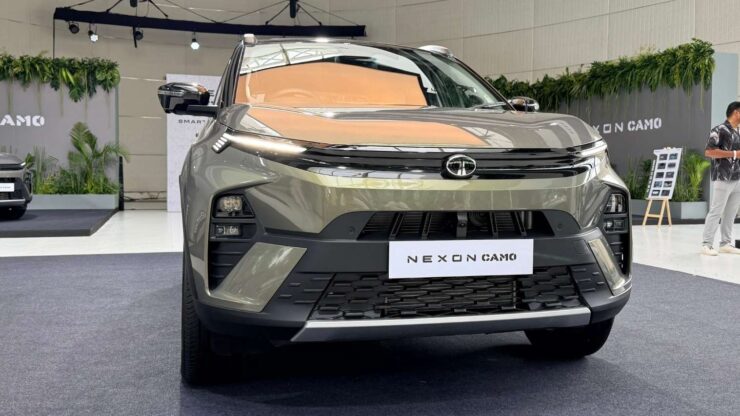

CNG made up 28% and EVs 23% of Tata's record Q2 FY27 PV sales of 2,01,723 units, with the two categories together crossing 51% of quarterly volume for the first time.
How Much of Tata's Q2 FY27 Sales Came From CNG and EV Models in India 2026?
In Q2 FY27 (July–September 2026), CNG models accounted for 28% of Tata Motors' passenger vehicle sales and electric vehicles contributed another 23%, meaning the two categories jointly crossed 51% of the company's total quarterly PV volume — a first in Tata's history. This milestone arrived in what the company itself called its highest-ever quarter, with total domestic and international PV sales reaching 2,01,723 units, up 40% year-on-year from 1,44,397 units in Q2 FY26.
In concrete terms, 28% of 2,01,723 units equals roughly 56,482 CNG vehicles sold in a single quarter — Tata's highest quarterly CNG volume on record. The EV tally of 47,150 units is equally striking, representing a 90% rise over the 24,855 EVs sold in Q2 FY26.
The quarter signals competitive pressure in the CNG segment. Maruti Suzuki has long dominated factory-fitted CNG through its S-CNG range, and the comparison below shows where Tata's iCNG models stand against Maruti's S-CNG equivalents in directly competing segments.
| Model | CNG Kit Type | ARAI Claimed Mileage (km/kg) | Ex-showroom CNG Variant Price (approx.) | Boot Space Trade-off |
|---|---|---|---|---|
| Tata Punch iCNG | Factory-fitted (twin-cylinder) | ~26.99 km/kg | ~₹9.69 lakh (onwards) | Twin cylinders under floor; usable boot retained |
| Tata Nexon iCNG | Factory-fitted (twin-cylinder) | ~24 km/kg | ~₹10.99 lakh (onwards) | Twin cylinders preserve most boot space |
| Maruti Suzuki Fronx S-CNG | Factory-fitted (single-cylinder) | ~28.51 km/kg | ~₹10.99 lakh (onwards) | Single cylinder in boot; reduced luggage room |
| Maruti Suzuki Baleno S-CNG | Factory-fitted (single-cylinder) | ~30.61 km/kg | ~₹9.49 lakh (onwards) | Single cylinder in boot; noticeably reduced boot |
| Maruti Suzuki XL6 S-CNG | Factory-fitted (single-cylinder) | ~26.3 km/kg | ~₹13.49 lakh (onwards) | Single cylinder eats into third-row access |
Prices are approximate ex-showroom figures and subject to change. Mileage figures are ARAI claims, not real-world results.
What exactly happened in Tata's Q2 FY27, and why does it matter for CNG buyers?
Q2 FY27 spans July 1 to September 30, 2026, the second quarter of India's financial year that runs April to March. Tata Motors Passenger Vehicles Ltd (TMPV) posted its best-ever quarter in this period, with domestic PV sales of 1,96,674 units against 1,40,189 units a year earlier — a clean 40% year-on-year rise. International sales added another 5,049 units (up 20%), taking the combined total to 2,01,723 units.
For CNG buyers, the significance is straightforward: record CNG volumes signal that the platform is commercially viable, that dealership service networks are being trained and stocked for CNG-specific maintenance, and that future model generations will likely carry the technology forward. Tata's CNG volumes hitting an all-time quarterly high is therefore not just a sales statistic — it is a confidence indicator for anyone considering a Tata iCNG purchase today.
Shailesh Chandra, Managing Director and CEO of TMPV, noted that passenger vehicle demand sustained momentum even though Q2 is seasonally softer than Q3 (the festive quarter). He attributed the growth partly to rising adoption of greener powertrains, with industry Vahan volumes growing around 24% year-on-year in the same period.
September 2026 alone was a landmark month: total PV sales crossed 70,000 units for the first time, reaching 70,210 units, up 15% from 60,907 units in September 2025. Domestic sales that month were 68,810 units, while EV sales hit 15,384 units — contributing close to one-third of Tata's entire Q2 EV volume in a single month.
How does Tata's 28% CNG share compare to Maruti Suzuki's S-CNG dominance?
Maruti Suzuki's S-CNG range spans hatchbacks (Baleno, Alto K10, Wagon R, Celerio), compact SUVs (Fronx), and MPVs (XL6, Ertiga). Maruti has historically commanded well over 50% of India's factory-fitted CNG car market, with S-CNG models often accounting for 25–30% of the brand's monthly volumes during CNG-heavy months.
Tata's 28% CNG share in Q2 FY27 shows that a second manufacturer has now built a CNG mix within its own portfolio that is comparable in proportion to what Maruti reports. The key structural difference lies in how each brand achieves that mix.
Maruti's S-CNG models use a single-cylinder CNG tank mounted in the boot. This keeps costs lower and packaging simpler, but it meaningfully reduces luggage space. The Fronx S-CNG, for instance, loses a significant portion of its already-compact boot to the cylinder. The Baleno S-CNG's boot shrinks from 318 litres to around 204 litres with the cylinder in place — a trade-off buyers must consciously accept.
Tata's iCNG system uses a twin-cylinder setup where two smaller cylinders are mounted beneath the floor or in a dedicated underbody space, preserving most of the boot. The Punch iCNG and Nexon iCNG both retain usable luggage room, which is a genuine differentiator for family buyers. However, Tata's twin-cylinder approach adds weight and complexity, and the ARAI-claimed mileage figures for Tata's iCNG models tend to trail Maruti's S-CNG equivalents — the Baleno S-CNG's 30.61 km/kg ARAI claim is notably higher than anything in Tata's current iCNG range.
The Maruti Fronx S-CNG's 28.51 km/kg ARAI claim also exceeds the Nexon iCNG's approximately 24 km/kg. On running costs, this gap is tangible. At Delhi's CNG price of approximately ₹75 per kg (a figure that varies by city and is subject to revision), the Fronx S-CNG's ARAI claim translates to a cost of roughly ₹2.63 per km, while the Nexon iCNG's 24 km/kg claim works out to approximately ₹3.13 per km. Real-world figures will be higher for both — ARAI tests are conducted under controlled conditions — but the proportional gap is likely to persist.
Tata holds an edge in the compact SUV body style itself: the Nexon iCNG offers a more SUV-like stance, a larger overall footprint, and the twin-cylinder boot advantage over the Fronx. Neither model is objectively superior; the choice depends on whether the buyer prioritises running economy (Fronx) or boot space and body style (Nexon).
What CNG models are driving Tata's volumes, and which segments do they cover?
Tata's iCNG portfolio as of Q2 FY27 spans several key segments. The Punch iCNG is the brand's entry point into factory-fitted CNG, positioned as a micro-SUV and competing directly with the Maruti Wagon R S-CNG and the Hyundai Exter CNG. The Nexon iCNG covers the compact SUV segment, where it faces the Fronx S-CNG and the Hyundai Venue CNG.
The Punch led Tata's SUV sales during Q2 FY27 along with the Nexon, suggesting both models contributed meaningfully to the CNG volume tally. Tata has also introduced newer nameplates — the Curvv SeriesX, Sierra Legend Series, and the Aeris sedan — though the CNG availability of these newer models is not confirmed in the Q2 FY27 data available.
For buyers researching the best CNG compact SUVs, the Nexon iCNG's twin-cylinder setup is a recurring reason cited for preference over single-cylinder rivals. The Punch iCNG similarly appeals to buyers who want a factory-fitted CNG warranty without sacrificing boot utility — a concern that is particularly acute in the sub-₹10 lakh segment where families often use the boot for groceries, school bags, and travel luggage simultaneously.
All Tata iCNG models carry factory-fitted kits, which means the CNG system is covered under the manufacturer's standard warranty. Dealer-fitted aftermarket CNG kits — common on older or non-CNG-variant models — typically void the manufacturer's powertrain warranty and are not part of this discussion.
How does the 51% combined EV + CNG share affect Tata's competitive positioning?
The 51% combined share represents the proportion of Tata's Q2 FY27 PV sales that came from either battery electric or factory-fitted CNG powertrains, with the remaining 49% coming from conventional petrol and diesel models. This is a structural shift, not a one-quarter anomaly: Tata has been systematically expanding both its EV and iCNG ranges over the past three financial years.
For competitive positioning, the number matters in two ways. First, it signals to fleet operators and retail buyers that Tata's service network, parts supply chain, and dealer training are increasingly oriented toward CNG and EV maintenance — reducing the after-sales risk that buyers of early-adopter CNG models sometimes faced. Second, it gives Tata a credible story in the "greener powertrain" segment that rivals Maruti's S-CNG dominance on volume, even if Maruti still leads on absolute CNG unit numbers across the industry.
EV sales grew 90% year-on-year to 47,150 units, and EVs now account for 23% of Tata's portfolio against approximately 8% for the broader industry. This EV share is the highest among mass-market Indian manufacturers and reflects Tata's early investment in the Nexon EV, Tiago EV, Punch EV, and Curvv EV platforms.
CNG's 28% share, while slightly lower than EV's 23% in absolute percentage terms, is significant because CNG vehicles are typically bought by a different buyer profile: price-sensitive families and small fleet operators who need low running costs but cannot afford or access EV charging infrastructure. CNG functions as a bridging technology in this context — it delivers meaningfully lower fuel costs than petrol without requiring home charging or dependence on a public charging network that remains unevenly distributed outside metro cities.
What does the H1 FY27 picture look like, and where is Tata headed?
The first half of FY27 (April–September 2026) saw Tata's total PV sales reach 3,76,840 units, up 42.7% from 2,64,028 units in H1 FY26 — a difference of 1,12,812 units in absolute terms. Q2 contributed 2,01,723 units to that H1 figure, placing it well above Q1 FY27 in volume terms.
Tata has publicly set out plans for higher production capacity, more nameplates, and substantially larger PV volumes over the next few years. The company has cited a target of 12 lakh annual PV sales as a medium-term ambition, which would require sustaining or accelerating the growth rates seen in H1 FY27. Achieving that target will depend heavily on whether CNG and EV models continue to grow as a proportion of the mix, since conventional petrol and diesel segments are more contested and margin-compressed.
For CNG buyers, the practical implication is that Tata's iCNG range is likely to expand to additional nameplates. The Harrier iCNG and Safari iCNG have been discussed in industry circles, though no confirmed launch timeline was available at the time of writing. Buyers who are on the fence about waiting for a larger iCNG SUV should weigh the certainty of today's Nexon iCNG against the uncertainty of a future model's timeline and pricing.
How do running costs compare between Tata iCNG, Maruti S-CNG, and petrol equivalents?
Running cost arithmetic is one of the most concrete ways to evaluate a CNG car purchase. The numbers below use Delhi CNG prices as a reference point — CNG prices vary significantly by city, and buyers in cities like Mumbai, Pune, or Ahmedabad should substitute their local CNG rate.
At an approximate Delhi CNG price of ₹75 per kg:
- Tata Punch iCNG (ARAI: ~26.99 km/kg): ₹75 ÷ 26.99 = approximately ₹2.78 per km on CNG
- Tata Nexon iCNG (ARAI: ~24 km/kg): ₹75 ÷ 24 = approximately ₹3.13 per km on CNG
- Maruti Fronx S-CNG (ARAI: ~28.51 km/kg): ₹75 ÷ 28.51 = approximately ₹2.63 per km on CNG
- Maruti Baleno S-CNG (ARAI: ~30.61 km/kg): ₹75 ÷ 30.61 = approximately ₹2.45 per km on CNG
For comparison, a petrol Nexon with an ARAI claim of approximately 17 km/l at Delhi petrol prices of around ₹95 per litre would cost approximately ₹5.59 per km — roughly 79% more per kilometre than the Nexon iCNG on CNG.
These are ARAI-claimed figures. Real-world CNG mileage typically runs 15–20% below ARAI claims depending on traffic conditions, driving style, and whether the car is running on CNG from the start or switching mid-journey. The cost-per-km advantage of CNG over petrol remains substantial even after applying a real-world discount, which is why CNG cars tend to have strong appeal for buyers covering more than 1,500 km per month.
The Maruti S-CNG models' higher km/kg claims do translate to a measurable running cost advantage over Tata's iCNG equivalents. A buyer covering 2,000 km per month on CNG would spend approximately ₹5,260 in the Baleno S-CNG versus approximately ₹6,250 in the Nexon iCNG — a monthly difference of roughly ₹990. Over a year, that is nearly ₹12,000 in additional fuel costs for the Nexon iCNG buyer. Whether the twin-cylinder boot space advantage and SUV body style justify that premium is a personal call, but buyers should go in with the arithmetic clear.
What are the real-world trade-offs a Tata iCNG buyer should know before purchasing?
Boot space: The twin-cylinder iCNG system is Tata's headline advantage over single-cylinder rivals. However, "twin-cylinder" does not mean "no boot compromise." The cylinders are mounted under the floor or in a sub-floor compartment, and while the usable boot volume is better preserved than in single-cylinder setups, the floor height may be slightly raised and the spare wheel arrangement changes. Buyers should physically inspect the boot before purchase.
Power on CNG: CNG has a lower energy density than petrol, and all CNG cars — Tata's iCNG models included — produce less power when running on CNG than on petrol. The Nexon iCNG's 1.2-litre turbocharged engine produces its full output on petrol; on CNG, output drops. Tata does not publish a separate CNG power figure in most communications, but the real-world performance difference is noticeable in highway overtaking and hill climbing. This is not unique to Tata; the Fronx S-CNG and Baleno S-CNG face the same physics.
CNG station availability: CNG infrastructure in India is concentrated in specific corridors — the Delhi-NCR region, Gujarat, Maharashtra's major cities, and parts of UP and Haryana have reasonably dense networks. Buyers in smaller towns or in states like the Northeast, Himachal Pradesh, or parts of South India may find CNG stations sparse. The best CNG cars guide on autoforumindia.com covers CNG availability by region in more detail.
Warranty: All Tata iCNG models carry factory-fitted CNG systems covered under the standard manufacturer warranty. This is a meaningful advantage over aftermarket dealer-fitted kits, which typically void the powertrain warranty and may not meet the same safety standards. Buyers should verify the specific warranty terms with their dealer, as warranty conditions can vary by variant and region.
Resale value: CNG cars have historically held resale value well in CNG-dense cities, since the running cost advantage is a selling point for second buyers too. In cities with poor CNG infrastructure, resale may be more challenging. This is a factor worth considering if the buyer plans to sell within three to five years.
What does Tata's Q2 FY27 performance mean for the broader CNG car market in India?
The broader CNG car market in India encompasses passenger vehicles sold with factory-fitted or dealer-fitted CNG systems, covering hatchbacks, compact SUVs, sedans, and MPVs. Maruti Suzuki has historically led this segment by a wide margin, but Tata's Q2 FY27 data shows a second major player achieving CNG volumes at scale.
Industry Vahan volumes grew around 24% year-on-year in Q2 FY27, led by rising adoption of greener powertrains. CNG's growth is being driven by persistently high petrol prices, expanding CNG station networks in Tier 2 cities, government push for city gas distribution, and the growing availability of factory-fitted CNG options across more body styles.
Tata's record CNG quarter in Q2 FY27 also coincides with broader gas sector growth. Adani Total Gas reported a 34% revenue jump in Q2 FY27, supported by higher CNG volumes and continued expansion of its city gas distribution network — a supply-side signal that CNG infrastructure is growing to meet demand.
For buyers currently evaluating CNG compact SUVs or CNG hatchbacks, the market context is favourable: more models are available, factory-fitted options have expanded, and the competitive pressure between Tata and Maruti is keeping pricing relatively disciplined. Hyundai's CNG offerings — the Exter CNG and Venue CNG — add further competition, particularly for buyers who want a Korean brand's feature set with CNG running costs.
The data from Q2 FY27 does not tell buyers which specific CNG model to buy. It does confirm that the CNG segment is growing fast, that Tata is now a credible volume player within it, and that Maruti's S-CNG range faces genuine competition for the first time at scale. For a buyer making a decision today, that competitive dynamic is likely to produce better value — in pricing, features, and after-sales support — than the market offered two or three years ago.
Explore the best CNG MPVs and best CNG hatchbacks under ₹25 lakh on autoforumindia.com for model-specific comparisons with verified km/kg figures and current prices.
Sources
- Tata Domestic PV Sales Near 2 Lakh Units In Q2 FY27, 47K+ EVs Sold – GaadiWaadi
- Tata Motors Passenger Vehicles Sales Rise 15% in September to 70,210 Units – Economic Times
- Tata Motors Delivers Strong Sales with 1,35,114 Units in Q2 FY27 – Tata Motors CV Official
- Tata Motors Passenger Vehicle Sales Rise 15% in September 2026 – India Today
- CNG Vehicles – Latest News – Economic Times
- 5 Best CNG Cars in India (2026) – AutoForumIndia
- Best CNG Hatchbacks Under 15 Lakh in India (2026) – AutoForumIndia
- Best SUVs With a CNG Option Under 30 Lakh in India (2026) – AutoForumIndia
- Best CNG MPVs Under 15 Lakh in India (2026) – AutoForumIndia
- Best CNG Hatchbacks Under 25 Lakh in India (2026) – AutoForumIndia