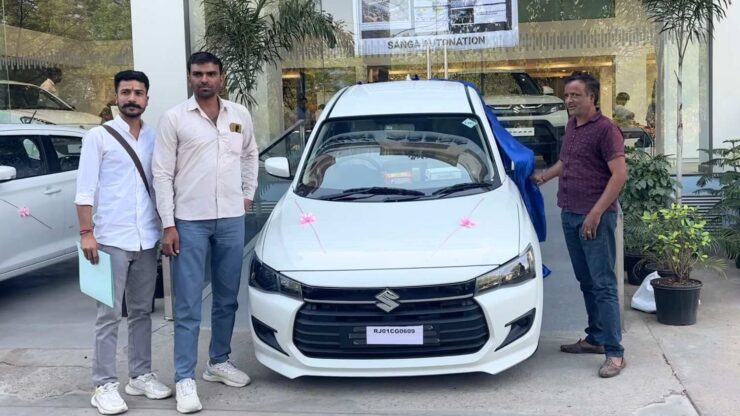

CNG car sales surged 46.1% YoY to 1,05,249 units in August 2026, with Maruti holding 70% share and Tata Punch CNG sales more than doubling to 7,767 units.
CNG car sales in India crossed the one-lakh mark in August 2026 for the first time, with manufacturers dispatching 1,05,249 units — a 46.1% jump from the 72,062 units recorded in August 2025. The milestone signals more than a volume record; it represents a structural shift in buyer preferences. CNG's share of total passenger vehicle retail sales hit a record-high 25% in August 2026, up from 21% in August 2025, while petrol's share fell to an all-time low of 41%. For the first time, CNG, hybrids and EVs together — at 42% combined — outsold petrol cars.
The market no longer treats CNG as a niche, economy-segment choice. SUVs such as the Tata Punch, Maruti Brezza, Maruti Fronx and Tata Nexon now sit prominently in the top-10 CNG sales chart, a shift that would have been hard to predict two years ago.
Who sold what in August 2026: the manufacturer breakdown
| Manufacturer | Aug 2026 Units | Aug 2025 Units | YoY Growth | Market Share |
|---|---|---|---|---|
| Maruti Suzuki | 73,621 | 52,214 | 41.0% | 69.9% |
| Tata Motors | 18,438 | 10,805 | 70.6% | 17.5% |
| Hyundai | 10,622 | 7,201 | 47.5% | 10.1% |
| Toyota | 2,568 | 1,842 | 39.4% | 2.4% |
| Total | 1,05,249 | 72,062 | 46.1% | — |
Source: GaadiWaadi, September 2026
Maruti Suzuki's 69.9% share has remained stubbornly high for years, and August 2026 did nothing to dislodge it. Tata Motors, however, is the story of the month: its 70.6% growth rate was the highest among the four manufacturers, and it is now firmly in second place with a 17.5% share. Hyundai grew 47.5% but remains a distant third at 10.1%. Toyota, which sells CNG versions of its Rumion and Innova HyCross (the latter a strong hybrid, not CNG), posted 39.4% growth but accounts for just 2.4% of the market.
What does the top-10 model chart tell a buyer?
The top-10 CNG models in August 2026 reveal two simultaneous truths: Maruti's dominance is structural, not accidental, and Tata is closing the gap faster than headline market-share numbers suggest.
| Rank | Model | Aug 2026 | Aug 2025 | YoY Growth |
|---|---|---|---|---|
| 1 | Maruti Ertiga CNG | 13,352 | 13,447 | -1% |
| 2 | Maruti Dzire CNG | 12,963 | 10,316 | +26% |
| 3 | Maruti Wagon R CNG | 9,405 | 7,096 | +34% |
| 4 | Tata Punch CNG | 7,767 | 3,838 | +102% |
| 5 | Maruti Brezza CNG | 7,608 | 5,801 | +31% |
| 6 | Maruti Victorsis CNG | 6,833 | — | New |
| 7 | Hyundai Aura CNG | 6,485 | 4,855 | +34% |
| 8 | Tata Nexon CNG | 6,178 | 4,419 | +40% |
| 9 | Maruti Eeco CNG | 6,107 | 5,090 | +20% |
| 10 | Maruti Fronx CNG | 6,024 | 3,095 | +95% |
Source: GaadiWaadi, September 2026
The Maruti Ertiga CNG, a factory-fitted S-CNG MPV with a 1.5-litre engine and claimed mileage of around 26.11 km/kg (ARAI), is the market's best-selling CNG model — but its sales were essentially flat at 13,352 units versus 13,447 a year ago. That stasis matters: the Ertiga's CNG crown is being chipped at from below by the Victorsis, Maruti's newer mid-size MPV, which registered 6,833 units in its first comparable month. Our Best MPVs with a CNG Option in India guide covers both in detail.
The Tata Punch CNG's 102% growth — from 3,838 to 7,767 units — stands out as the single most striking data point in the August report. It is now the fourth-best-selling CNG car in India, ahead of the Brezza, Victorsis, Aura and Nexon. The Maruti Fronx CNG's 95% growth to 6,024 units ranks second in the top 10, confirming that compact CNG SUVs are where the market is moving.
Why did CNG sales grow so sharply in August 2026?
Several forces converged. The most direct is the widening price gap between CNG and petrol. CNG is compressed natural gas dispensed at filling stations, priced by the kilogram rather than the litre. In Delhi, CNG retails at approximately ₹75/kg as of mid-2026, while petrol costs around ₹95/litre. A car returning 25 km/kg on CNG costs roughly ₹3.00 per km to run; the same car returning 15 km/l on petrol costs approximately ₹6.33 per km — more than double. That arithmetic is not new, but it becomes more compelling every time petrol prices nudge upward.
The E20 transition is a second factor. India's phased shift to 20% ethanol-blended petrol has created buyer hesitation. Equirus Securities noted in a report cited by ANI that "buyer hesitation around the E20 transition appears to have supported the shift towards CNG, hybrids and EVs." Whether that hesitation is well-founded, it is showing up in the sales data.
Third, the product range has expanded dramatically. Two years ago, a buyer who wanted a CNG car essentially had to choose a hatchback or an MPV. Today, factory-fitted CNG is available across compact SUVs (Punch, Fronx, Brezza, Nexon), sedans (Dzire, Aura) and MPVs (Ertiga, Victorsis, XL6). GST rate cuts that improved overall affordability in the passenger vehicle segment also played a role, with overall PV retail sales growing 16% year-on-year in August.
Why does Maruti hold nearly 70% of the CNG market?
Maruti Suzuki's S-CNG programme is a factory-fitted, OEM-integrated CNG system that comes with the manufacturer's full warranty intact — unlike dealer-fitted or aftermarket kits, which can void the petrol powertrain warranty. That distinction matters enormously to a first-time CNG buyer nervous about reliability. Maruti has been building S-CNG cars since 2010 and has refined the integration to the point where the system is tuned at the engine-management level, not bolted on as an afterthought.
The breadth of Maruti's CNG lineup is also a structural advantage. In August 2026, six of the top-10 CNG models were Maruti products: Ertiga, Dzire, Wagon R, Brezza, Victorsis and Fronx. No other manufacturer comes close to that spread. Maruti's service network — the largest in India — means a CNG buyer in a Tier-2 or Tier-3 city is far less likely to face a situation where the nearest authorised service centre is hours away.
Maruti's CNG proposition has a real weakness, though. Its S-CNG cars use a single-cylinder CNG tank mounted in the boot, which significantly reduces luggage space. The Dzire CNG, for instance, loses a substantial portion of its already modest boot to the cylinder. Tata's iCNG system, by contrast, uses twin smaller cylinders mounted under the boot floor in models like the Nexon and Punch, preserving usable boot space. For a family that regularly travels with luggage, this is not a trivial trade-off.
Power output on CNG is also lower than on petrol across all manufacturers — a physics reality, not a brand-specific flaw. The Maruti Fronx CNG, for example, produces less power on CNG than its petrol counterpart. Buyers who prioritise driving dynamics over running costs will find CNG variants uniformly less satisfying to drive hard.
Our Best CNG Compact SUVs Under ₹20 Lakh guide offers a full breakdown of Maruti's S-CNG compact SUV options.
What is driving the Tata Punch CNG's 102% growth?
The Tata Punch CNG's doubling in sales stems from product maturity and price positioning. Tata introduced the Punch iCNG with its twin-cylinder setup — two smaller CNG cylinders placed under the boot floor rather than a single large cylinder occupying boot space. This preserves the Punch's boot volume, a genuine differentiator against the Maruti Fronx CNG, which uses a single boot-mounted cylinder.
The Punch iCNG is factory-fitted, meaning it carries Tata's full warranty. It competes directly with the Maruti Fronx CNG in the compact CNG SUV space. In August 2026, the Punch sold 7,767 units versus the Fronx's 6,024 — a gap of about 1,743 units in Tata's favour. A year ago, the Fronx outsold the Punch CNG by a smaller margin (3,095 vs 3,838), and the gap has widened further in Punch's favour.
The Tata Nexon iCNG also had a strong month at 6,178 units, up 40% year-on-year. The Nexon iCNG sits in a slightly higher price bracket than the Punch and competes with the Maruti Brezza CNG (7,608 units in August). The Brezza still outsells the Nexon CNG, but the Nexon's 40% growth rate exceeds the Brezza's 31%.
Our Best CNG Compact SUVs Under ₹15 Lakh guide covers the trade-offs between these two models in detail.
How does Hyundai fit into this picture?
Hyundai's 47.5% growth to 10,622 units is solid, but the brand's CNG portfolio is narrower than Maruti's or Tata's. The Hyundai Aura CNG accounted for 6,485 of those 10,622 units — making it the only Hyundai model in the top-10 CNG chart. The Grand i10 Nios CNG and the Exter CNG contribute the remainder of Hyundai's CNG volume.
Hyundai's CNG cars are factory-fitted, meaning the warranty is intact. The Aura CNG is a sub-4-metre sedan competing with the Maruti Dzire CNG. In August, the Dzire outsold the Aura by a wide margin — 12,963 versus 6,485 — which reflects both Maruti's brand strength in this segment and the Dzire's more established CNG reputation.
Hyundai's challenge in the CNG space is the absence of a factory-fitted CNG compact SUV with the same volume traction as the Punch or Brezza. The Exter CNG is a micro-SUV that competes with the Wagon R CNG more than with the Punch or Fronx. Until Hyundai brings a Creta CNG or a Venue CNG to market, its CNG share is likely to remain capped around 10%.
What does Toyota's 2.4% share mean for buyers?
Toyota sold 2,568 CNG cars in August 2026, up 39.4% from 1,842 units a year earlier. Toyota's CNG presence in India is primarily through its Rumion CNG — a rebadged Maruti Ertiga sold through Toyota's network — and the Innova HyCross, which uses a strong hybrid system rather than CNG. The Rumion CNG benefits from the same S-CNG engineering as the Ertiga, which means it carries the same boot-space trade-off and the same mileage claims.
Toyota's 2.4% share is unlikely to grow dramatically without a dedicated CNG product development push. The brand's India strategy has leaned heavily on strong hybrids (Innova HyCross, Urban Cruiser Hyryder) rather than CNG, which means CNG buyers looking at Toyota are essentially buying a Maruti product with a Toyota badge.
Is CNG now a mainstream fuel choice in India?
The August 2026 data makes a strong case that it is. CNG and EVs together drove over a quarter of India's car sales in FY26, with combined CNG and EV volumes at approximately 12.3 lakh units — a 26% share of the passenger vehicle market, up from roughly 22% a year earlier. In August specifically, CNG alone hit 25% of PV retail sales.
CNG car adoption has accelerated across Maruti, Tata and Hyundai since FY25, driven by rising fuel prices and expanding CNG station infrastructure. India's city gas distribution network has grown significantly, with CNG stations now available in over 550 cities and districts, though coverage in smaller towns and on highways remains uneven. That last point is a real constraint: a buyer in a city with dense CNG coverage will find the running-cost arithmetic compelling, but a buyer who regularly drives long inter-city routes may find range anxiety on CNG — not on petrol — to be a genuine issue.
The SUV-ification of the CNG segment is the other structural shift. The top-10 chart now includes five SUVs or crossovers (Punch, Brezza, Victorsis, Nexon, Fronx) alongside three sedans/hatchbacks (Dzire, Wagon R, Aura) and one MPV (Ertiga) plus the Eeco van. A year ago, that balance tilted much more heavily toward hatchbacks and MPVs. This matters for buyers because CNG is no longer a compromise on body style — you can have a proper compact SUV with factory-fitted CNG.
What should a buyer take away from these numbers?
The August 2026 sales data is useful for a buyer in a specific way: it tells you which CNG cars have earned sustained consumer confidence at scale, and which are growing fast enough to suggest the manufacturer is investing in the segment.
Maruti's S-CNG lineup — from the Wagon R CNG at the entry end to the Fronx CNG and Brezza CNG in the compact SUV space and the Ertiga and Victorsis in the MPV segment — remains the safest bet for buyers who prioritise service network reach and resale value. The trade-off is boot space on single-cylinder models and, in some variants, a premium over equivalent Tata or Hyundai products. Our 5 Best CNG Cars in India guide covers the full range with current prices.
Tata's iCNG lineup — Punch and Nexon — is the right answer for buyers who want boot space preserved and are comfortable with Tata's service network in their city. The twin-cylinder setup is a genuine engineering advantage, and the Punch's 102% growth suggests the market has noticed. The caveat is that Tata's service network, while expanding, is not as deep as Maruti's in smaller towns.
Hyundai's CNG cars are well-built and factory-fitted, but the range is narrower. The Aura CNG is a strong choice in the sub-4-metre sedan segment, but Hyundai's absence from the fast-growing compact CNG SUV space (above the Exter) is a gap that limits its addressable market.
For buyers focused on running costs: at ₹75/kg CNG in Delhi and a conservative real-world 20 km/kg (manufacturer ARAI claims typically run 25–28 km/kg, but real-world figures are lower), you're looking at ₹3.75 per km. At ₹95/litre petrol and 14 km/l real-world, that's ₹6.79 per km. The saving of roughly ₹3 per km adds up to ₹9,000 per month for a buyer covering 3,000 km monthly — enough to recover the CNG variant's price premium over the petrol version in 12–18 months for most models.
CNG station availability is a caveat on running costs. In Delhi, Mumbai, Pune, Ahmedabad and Surat, this is a non-issue. In smaller cities and on national highways, it can mean planning your route around filling stations in a way that petrol drivers never have to. That constraint is real and should not be glossed over.
For buyers specifically looking at the compact SUV CNG segment — where the Punch, Fronx, Brezza and Nexon are all competing — our Best SUVs With a CNG Option Under 30 Lakh guide and the Best CNG Compact SUVs Under ₹20 Lakh roundup will give you the price and specification detail needed to make a final call.
The August 2026 data confirms that CNG has moved from being a fuel of necessity for high-mileage buyers to a mainstream choice for many Indian car buyers. The segment's 46.1% growth in a single month, against an overall PV market growing at 16%, tells you where the momentum is.
Sources
- CNG Cars Cross 1 Lakh Sales In August 2026: Punch Doubles, Maruti Still Dominates — GaadiWaadi
- India's car buyers shift from petrol as CNG, hybrid, EVs cross 42% sales share: Report — Times of India
- July auto sales rev up as Maruti crosses 2L, Tata EVs double — Times of India
- CNG car adoption accelerates as Maruti, Tata, and Hyundai see strong FY25 sales — The Hindu BusinessLine
- CNG, EVs drive over a quarter of India's car sales — The Hindu BusinessLine
- Maruti Suzuki S-CNG Cars — Official Page
- Tata iCNG Cars — Official Page